
Beyond the Degree: How Job Satisfaction Bridges Teacher Qualifications and Education Quality
Mediating Role of Job Satisfaction between Teacher Qualifications Structure and Education Quality
This empirical study investigates the relationship between teacher qualifications structure (educational level), job satisfaction, and education quality (organizational performance) in Beijing's compulsory education sector. It identifies that job satisfaction serves as a significant mediator, particularly in junior high schools, linking higher teacher credentials to improved academic outcomes.
TL;DR
Does hiring teachers with Master's or PhD degrees automatically improve a school's education quality? Not necessarily. This study reveals that while higher qualifications are a strong foundation, their impact is significantly amplified—or bottlenecked—by Job Satisfaction. In junior high schools, satisfaction acts as a critical mediator, responsible for over 25% of the success attributed to a teacher's educational background.
Background & Motivation: The Human Capital Dilemma
In the era of knowledge-driven competition, "Human Capital" is the most valuable asset of any organization. In the context of compulsory education, this capital is embodied in the Teacher Qualifications Structure. However, prior research has largely focused on the corporate sector. We know educators with higher degrees possess better pedagogical skills, but what drives them to apply those skills effectively?
The author argues that high-level qualifications don't exist in a vacuum. The psychological state of the teacher—their satisfaction with school development, management, and environment—is the "hidden gear" that turns academic credentials into actual student success.
Methodology: The Mediating Effect Model
The research employs a sophisticated mediating effect analysis to dissect the "Black Box" of education quality.
The Variables
- Independent Variable (X): Teacher Qualifications (graded from Junior College to Doctoral).
- Mediator (M): Job Satisfaction (school development, teacher development, daily management, and environment).
- Dependent Variable (Y): Education Quality (students' cognitive level, practical ability, and discipline thought).
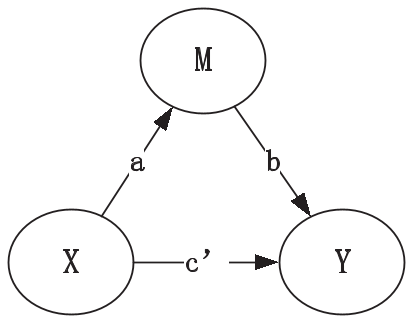 Fig 1: The structural relationship model used to test the mediating effect.
The study utilized the Bootstrap method, which is superior to traditional regression for testing mediation because it provides more accurate confidence intervals and handles non-normal distributions effectively.
Key Findings: Primary vs. Junior High Schools
The results highlight a fascinating divergence between different levels of compulsory education:
- Uniform Positive Impact: In both primary and junior high schools, having a higher percentage of teachers with advanced degrees leads to higher education quality (p < 0.01).
- The Junior High "Bridge": In junior high schools, job satisfaction is a powerful mediator. The higher the qualification, the higher the satisfaction, which in turn boosts quality.
- The Primary School "Direct Path": In primary schools, the direct impact of quals on quality is dominant, while the mediating effect of satisfaction is less pronounced (p > 0.1 for the indirect path).
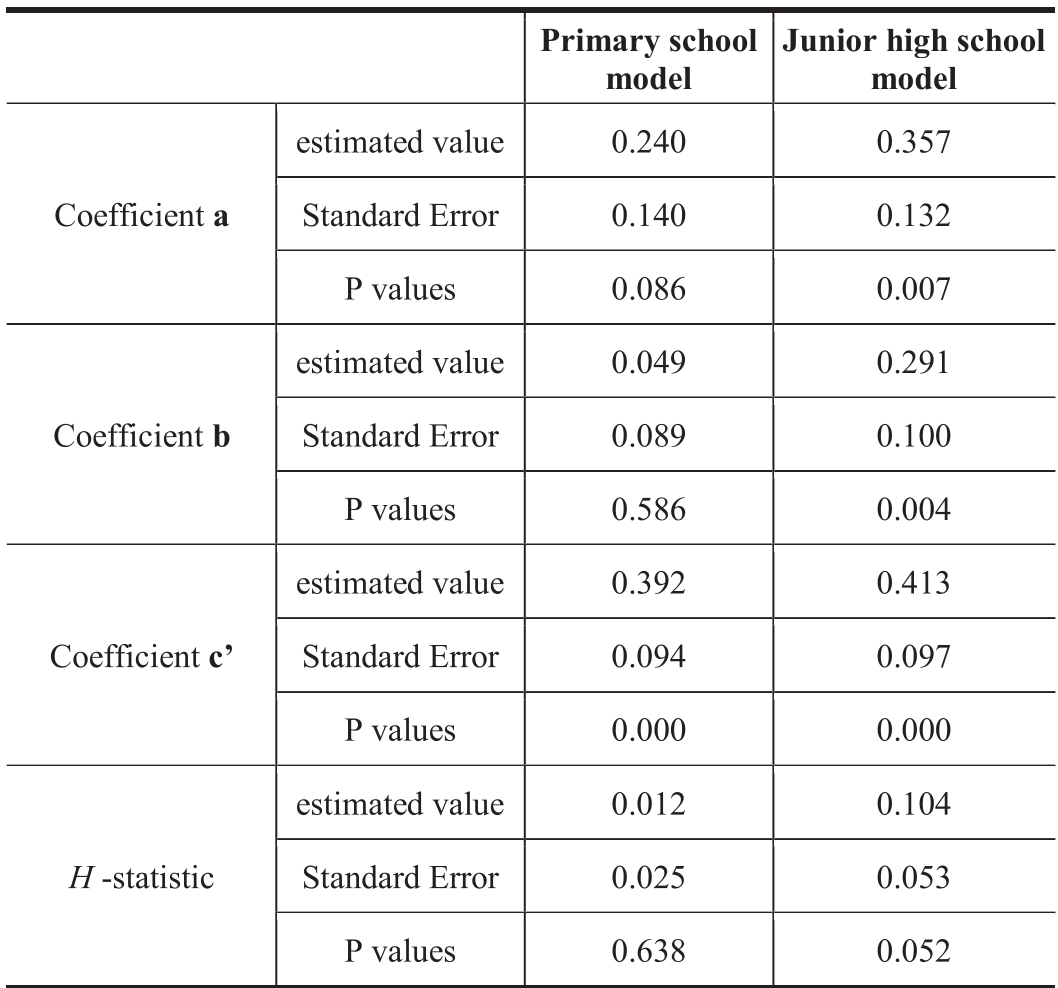 Table 1: Regression results showing the significant mediating effect in junior high schools (Coefficient b = 0.291) vs. primary schools (0.049).
Deep Insight: Why Does Satisfaction Matter More in Junior High?
The study notes that the junior high environment is more "dispersed" and complex than primary schools. Teachers in secondary education often face higher pressure regarding student entrance exams and specialized subject demands. In this high-stakes environment, a teacher's academic knowledge (Qualification) can only be fully unlocked if they feel supported and satisfied with their professional growth and school management.
Statistically, 25.71% of the total effect of a teacher's degree on school performance is channeled through their level of job satisfaction.
Critical Analysis & Conclusion
Takeaway
For school administrators, the message is clear: Recruiting talent is only half the battle. To improve education quality, schools must:
- Optimize the qualifications structure (hire and train for higher degrees).
- Simultaneously implement "Teacher-Centric" policies to ensure these highly qualified individuals remain motivated.
Limitations
The study is localized to District H in Beijing. While Beijing represents a high-standard educational hub, the dynamics might differ in less-developed regions where basic resource availability might outweigh the nuanced effects of job satisfaction.
Future Outlook
Future research should look into the dimensions of satisfaction (e.g., does "Daily Management" matter more than "Teacher Development" for PhD holders?). Understanding these nuances will allow for even more targeted administrative interventions to maximize the ROI of human capital in schools.