
Fair Play in Mobile Social Networks: Joint Resource Optimization via Nash Bargaining
Joint head selection and airtime allocation for data dissemination in mobile social networks
This paper proposes a joint head selection and airtime allocation scheme for data dissemination in Mobile Social Networks (MSNs). By utilizing Nash Bargaining Solution (NBS) theory, the framework optimizes resource management in star-topology groups to ensure Pareto optimality and proportional fairness among moving users.
TL;DR
Mobile Social Networks (MSNs) rely on users' devices to spread data, but why should any user sacrifice their battery to become a "group head"? This paper introduces a Nash Bargaining framework that jointly selects the best group head and allocates limited airtime, ensuring that every participant—whether they send data or help others—gains a fair "utility." It proves that proportional fairness is the key to sustainable, decentralized networking.
The Motivation: Why MSNs Struggle in the Real World
While MSNs are promising for off-grid communication and disaster recovery, they face a "Tragedy of the Commons." Existing literature often assumes that nodes are always willing to connect or that an Access Point (AP) is already present.
In reality:
- Energy is Scarce: Being a "Head" (the central node in a star topology) drains battery faster.
- Mobility is High: Available contact time (airtime) is fleeting.
- Users are Selfish: Without a fair reward or a guarantee of their own data being sent, users simply won't participate.
Methodology: The Nash Bargaining Intuition
The authors move beyond simple throughput maximization. They define a Utility Function for each user that accounts for:
- Valuation: The benefit of sending/receiving data.
- Cost: The physical energy cost (battery depletion).
- Reward: A system incentive () for acting as a group head.
Instead of a "winner-takes-all" approach, they use the Nash Bargaining Solution (NBS). The goal is to maximize the product of all users' utilities: This mathematical structure naturally leads to proportional fairness, where no user is neglected, and the burden of being a "Head" is compensated by rewards or priority airtime.
 Figure 1: Comparison between traditional star networks and the opportunistic MSN group formation.
Key Insights from Experiments
1. Breaking Naive Strategies
The paper compares its approach against two common-sense baselines:
- Naive-1: Picking the user with the most battery as Head.
- Naive-2: Picking the user with the best signal (link capacity) as Head.
The NBS approach wins because it doesn't just look at one metric. It finds the "Sweet Spot" where the chosen head's reward matches its energy cost while still providing enough airtime for others.
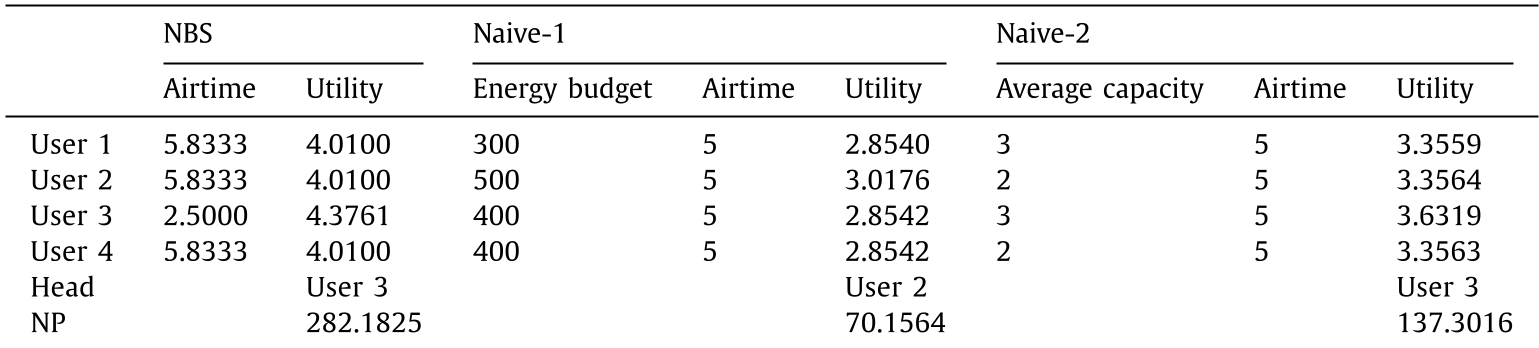 Table 2: Performance comparison showing that NBS achieves a significantly higher Nash Product (Fairness Index) than naive methods.
2. The "Others-First" Reward Point
An interesting discovery is the impact of the unit reward (). As the reward increases, the head becomes more willing to forward others' data. However, there is an "others-first" saturation point. Beyond a certain reward, the head prioritizes everyone else's data to maximize its reward utility, potentially neglecting its own dissemination needs.
3. Adapting to the Real World (Mobility)
Real MSNs are dynamic. The authors propose an Adaptive Scheme that breaks contact time into slots. By recalculating the NBS in each slot, the network naturally "rotates" the head responsibility. When one user's battery gets too low or their signal fades, another user with better current conditions steps up.
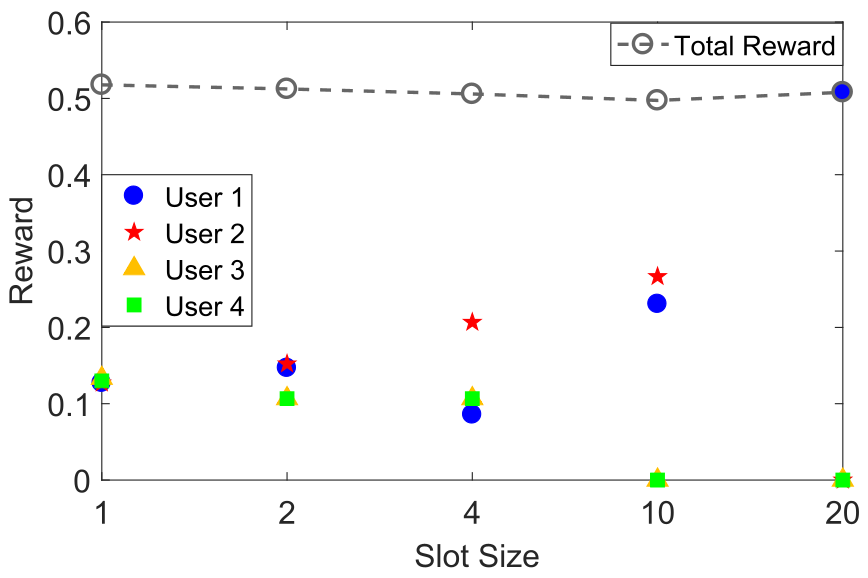 Figure: The adaptive scheme allows for significantly higher total data dissemination compared to static allocation by leveraging channel peaks.
Conclusion & Future Logic
This work provides a rigorous mathematical foundation for decentralization. By treating head selection and airtime as a joint bargaining problem, it ensures that MSNs are not just technically possible, but economically and socially viable for autonomous users.
Limitations: Currently, the model relies on users being honest about their battery and link states. Future work involving "Verified Trust" or blockchain-based rewards could settle the security concerns of dishonest utility reporting.
Final Takeaway: In the future of edge computing and MSNs, fairness isn't just a moral choice—it's a technical requirement for network survival.