
Harmonizing the Edge: Joint Offloading and Resource Allocation for Distributed Deep Learning
Joint Job Offloading and Resource Allocation for Distributed Deep Learning in Edge Computing
This paper addresses the Joint Job Offloading and Resource Allocation (JRP) problem for distributed deep learning in Edge Computing. It proposes an integer non-linear programming framework and a randomized rounding-based approximation algorithm to maximize system throughput while meeting Quality of Service (QoS) requirements.
TL;DR
As Deep Learning (DL) moves from centralized clouds to the network edge, the challenge shifts from "how to train" to "where to place data and how to slice resources." This paper introduces a robust mathematical framework to solve the Joint Job Offloading and Resource Allocation (JRP) problem. By transforming a complex non-linear program into a solvable linear model and applying randomized rounding, the authors achieve a 56% boost in throughput and a 53% increase in resource efficiency.
Background: The Distributed Edge Reality
Traditional Edge Computing models often treat tasks as independent "black boxes." However, Distributed Deep Learning (DDL) using Asynchronous Stochastic Gradient Descent (SGD) under a Parameter Server framework introduces unique constraints:
- Multiple Data Sources: A single training job might require data from 15+ distributed sensors.
- Resource Interdependence: Computation speed (GFLOPS) and communication bandwidth (Gbps) must be balanced to prevent bottlenecks during gradient synchronization.
The Core Challenge: Why is JRP Hard?
The authors identify that JRP is a sophisticated variant of the Multiple Knapsack Problem (MKP), which is NP-hard. Unlike standard MKP, JRP includes:
- Binary Admission: Either a job is accepted with all its data nodes, or it isn't.
- QoS Sensitivity: Jobs must finish within a hard deadline (), making resource allocation a non-linear function of the training time.
Methodology: From Complexity to Linear Efficiency
The researchers tackle the non-linearity by introducing a configurable coefficient , which defines the ratio of communication time to total training time. This clever reformulation linearizes the QoS constraints.
The 3-Step Algorithmic Pipeline:
- Pruning: Eliminate edge servers that physically cannot host specific data nodes due to storage or initial resource limits.
- LP Relaxation: Solve the linear version of the problem to get "fractional" assignment probabilities.
- Iterative Randomized Rounding: Convert these probabilities into hard 0/1 decisions while ensuring the storage constraint () is never violated.
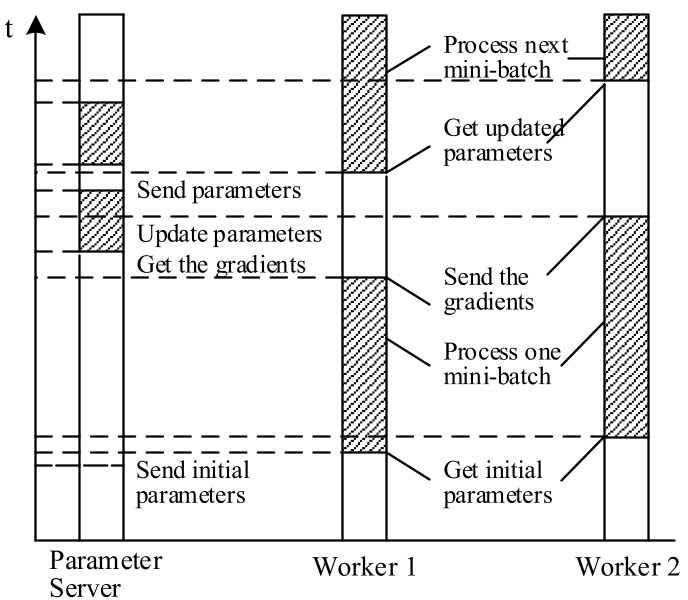 Figure 1: Illustration of the asynchronous SGD workflow within the Parameter Server framework used in this study.
Experimental Insights
The team simulated a 19-cell hexagonal edge network, testing three data distributions: Uniform, Normal, and Pareto.
Key Findings:
- Throughput Advantage: As job density increases, the proposed algorithm significantly outperforms "Greedy Load Balancing" and "Randomized" baselines. This is because the LP-based approach sees a global view of the resource "knapsack" rather than making local, myopic decisions.
- Utilization Efficiency: The algorithm reached nearly 93% of the theoretical optimal resource utilization, effectively packing more training "workers" into the same edge hardware.
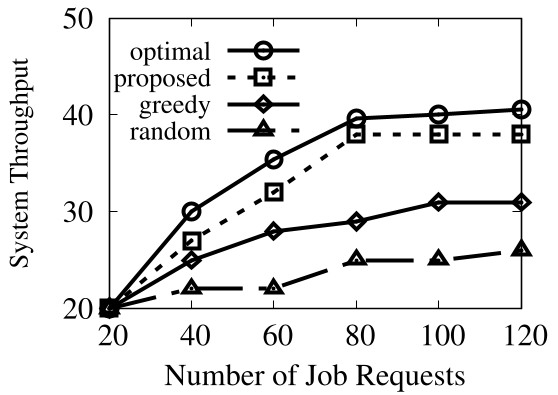 Figure 2: System throughput comparison under uniform data distribution, highlighting the scalability of the proposed method.
Critical Analysis & Conclusion
Takeaway
This work excels by bridging the gap between pure optimization theory and the physical realities of DDL. It doesn't just allocate storage; it acknowledges that communication and computation are two sides of the same coin in distributed training.
Limitations & Future Work
While the algorithm provides a strong performance guarantee (Theorem 1), it assumes a relatively static edge environment. In a real-world scenario, channel fading and dynamic computational loads from other edge services might require the iteration to be even more adaptive or move toward a Reinforcement Learning-based scheduling approach.
Impact
For engineers building "Edge Intelligence" platforms, this paper provides a concrete recipe for maximizing the "jobs-per-server" metric, which is the ultimate KPI for cost-effective distributed edge training.