JRLM++: Mastering the Pulse of Location-Based Social Networks via Multi-Grained Contexts
Joint Representation Learning for Location-Based Social Networks with Multi-Grained Sequential Contexts
This paper introduces JRLM++, a novel joint representation learning framework for Location-Based Social Networks (LBSNs). It embeds both users and Points of Interest (POIs) into a shared latent space by fusing social network topology with multi-grained (fine-grained location level and coarse-grained daily segment level) sequential check-in contexts, achieving SOTA results in location recommendation and link prediction.
TL;DR
JRLM++ is a sophisticated representation learning framework that bridges the gap between social graphs and physical mobility. By treating human movement not just as a sequence of coordinates, but as a hierarchical series of "episodes" (segments), it learns dense embeddings for users and locations that significantly enhance recommendation accuracy and social link discovery.
The Missing Dimension in LBSNs
In the realm of Location-Based Social Networks (LBSNs) like Foursquare or Gowalla, we deal with two distinct worlds: the Social World (who you know) and the Physical World (where you go).
Previous research typically specialized in one. Network embedding methods like DeepWalk or LINE are masters of topology but blind to trajectories. Conversely, trajectory mining tools often ignore the social "homophily"—the fact that friends tend to visit similar places. The real challenge, however, lies in the multi-grained nature of movement. Your visit to a coffee shop isn't just influenced by the pub you visited 10 minutes ago (fine-grained); it is influenced by the fact that today is a "workday" or a "travel-day" (coarse-grained).
Methodology: The Hierarchical Blueprint
JRLM++ (Joint Representation Learning Model++) tackles this by optimizing a tri-part objective function:
- Social Connectedness: Captures the "birds of a feather flock together" intuition.
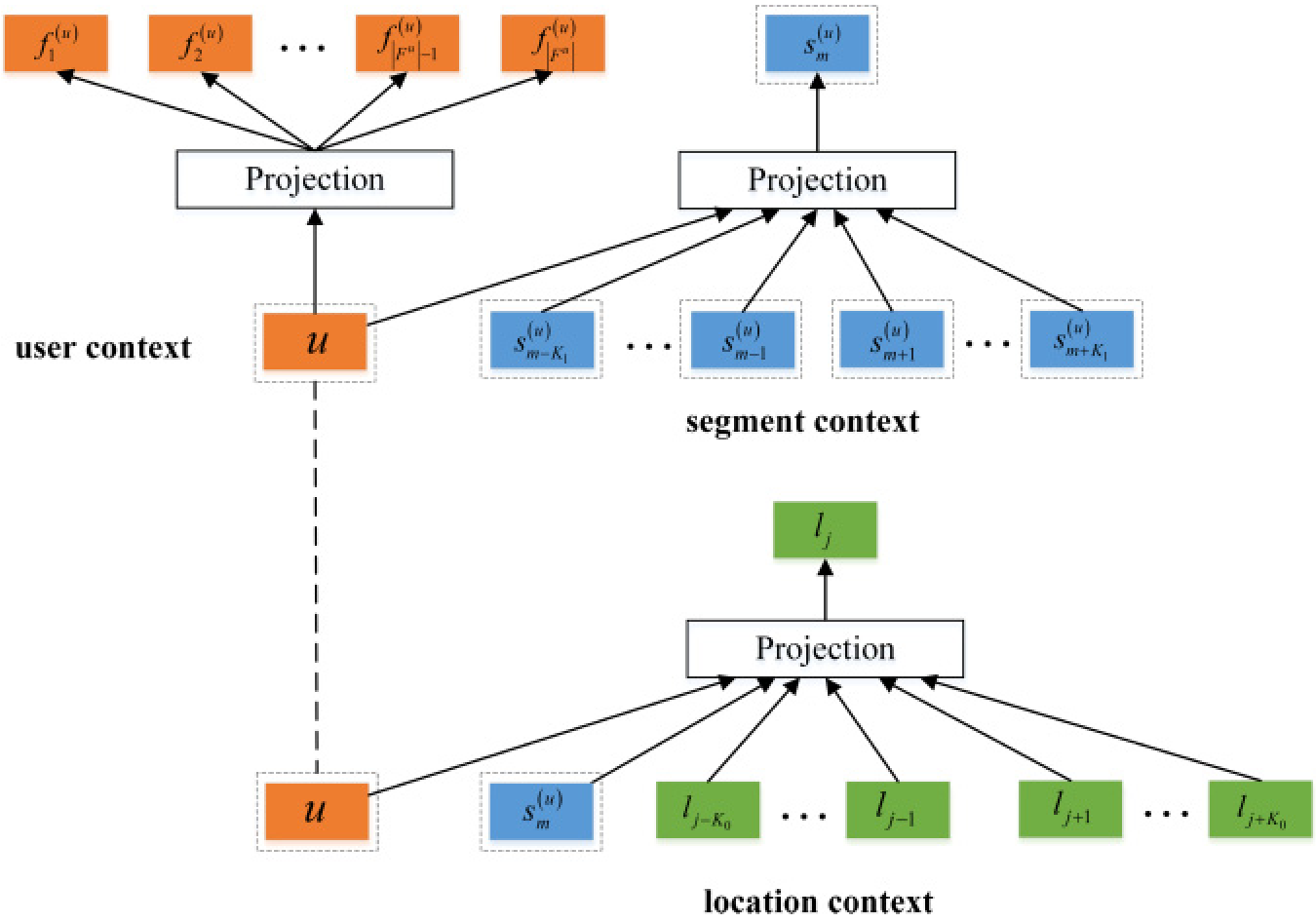
- Fine-Grained Context: Uses a sliding window (similar to Word2Vec's Skip-gram) to anchor a POI's meaning to its immediate predecessors and successors.
- Coarse-Grained Context: This is the "secret sauce." The model splits check-ins into daily segments, learning a "segment embedding" that acts as a latent theme for all check-ins within that day.
The Mathematics of "Why it Works"
Instead of a simple , JRLM++ optimizes . By including the segment vector and the user vector in the softmax aggregator, the model ensures that the resulting location embedding is aware of both the specific user's taste and the temporal "vibe" of the day.
Experimental Battleground: Foursquare & Gowalla
The authors validated JRLM++ against a heavy-hitting roster of baselines including GPFM (Geographical Probabilistic Factor Model) and HRM (Hierarchical Representation Model).
1. Location Recommendation
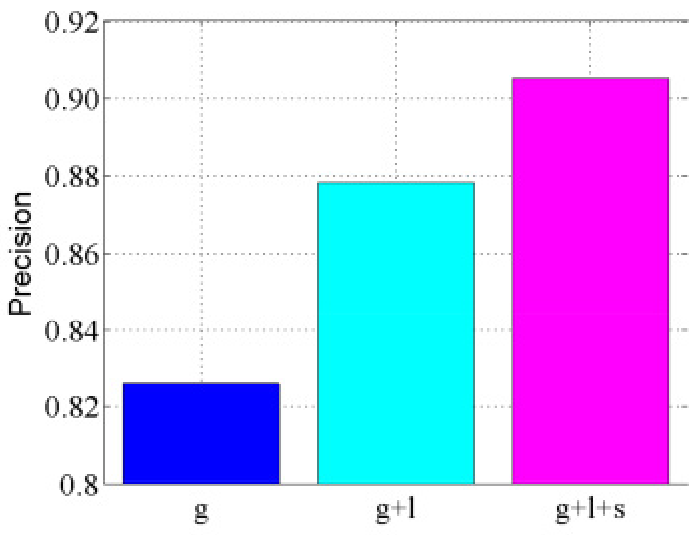
JRLM++ consistently delivered a higher Precision and Recall. Specifically, the jump from JRLM (the base joint model) to JRLM++ (with segments) demonstrates that modeling the "day" as a unit is vital for capturing user intent.

2. Social Link Prediction
Can we predict if two people are friends just by looking at their embeddings? Yes. By using the Hadamard product of user embeddings as input to an SVM, JRLM++ outperformed even DeepWalk—a model dedicated solely to graph structures. This proves that our physical trajectories are powerful mirrors of our social identities.
Critical Insights & Takeaways
- The Power of Segments: The "Ablation Study" (Figure 5) reveals that segment-level sequential relatedness is the biggest contributor to recommendation gains. This suggests that mobility is inherently "chunked" rather than a continuous stream.
- Unified Space: By projecting users and POIs into the same dimensional space, we can solve disparate tasks (recommendation vs. link prediction) using simple dot products or cosine similarities.
- Scalability: Utilizing Hierarchical Softmax allows the model to scale to millions of check-ins without the exponential cost typically associated with large-vocabulary softmax layers.
Conclusion
JRLM++ stays relevant by reminding us that "context is king." In a world where LBSN data is increasingly sparse and noisy, moving toward hierarchical, multi-grained representation learning is not just an academic exercise—it is the baseline for the next generation of intelligent, location-aware services.