
Bridging the Gap: Joint Social-Content Dynamics for User-Generated Video Recommendation
Joint Social and Content Recommendation for User-Generated Videos in Online Social Network
This paper introduces a joint social-content recommendation framework for User-Generated Videos (UGV) in Online Social Networks. It proposes a matrix update approach and a joint user-content space construction method to provide highly accurate recommendations for video importing and re-sharing.
TL;DR
In the era of Online Social Networks (OSNs), video consumption is no longer just about what you watch, but how you "Import" and "Re-share." This paper proposes a joint framework that integrates social propagation patterns with content similarity to solve the cold-start problem in User-Generated Video (UGV) recommendations, outperforming traditional collaborative filtering by treating social activity as a high-dimensional vector space.
Problem & Motivation: The Sparsity Trap
Current video platforms face a "Triple Threat" of challenges:
- Lack of Explicit Ratings: Users in social networks rarely "star" or "rate" videos; they simply share them.
- Cold-Start Paradox: New users have no history, and new videos (UGVs) have no views.
- Activity Divergence: Importing a video from an external site (like YouTube/Youku) is a creative act of discovery, whereas re-sharing is a social act of propagation. Traditional models treat these as identical.
The authors' insight is simple yet powerful: Social propagation is content-aware, and content similarity is socially driven. By modeling these together, we can "fill in the blanks" for users who haven't interacted with much content yet.
Methodology: The Matrix Update & Joint Space
The framework operates through two core technical innovations.
1. User-Content Matrix Update
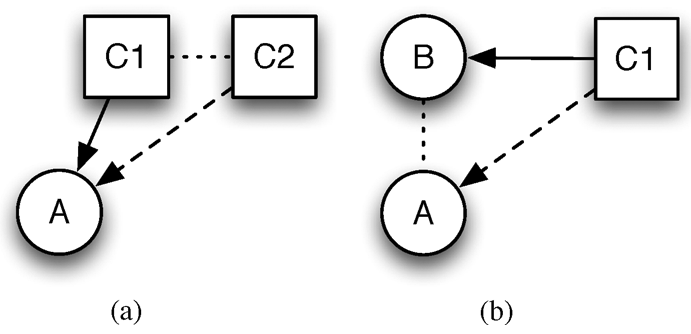
To tackle data sparsity, the system predicts missing entries in the user-video matrix before recommending. It uses two parallel insights:
- Social Propagation: If your "idols" (those you follow) share a video, you are likely to be influenced by it.
- Content Similarity: If you previously shared "Action" videos, you are likely to share similar "Action" content based on tag analysis.
2. Activity-Aware Joint Space
The authors construct a -dimensional space using "Representative Items."
- User Space: Uses "Landmark Users" (top-followed accounts) to define interest groups.
- Content Space: Uses popular videos as anchors to define content categories.
The final relevance score is a weighted sum:
The key finding? Importing videos requires a lower (content matters more), while Re-sharing needs a higher (who you follow matters more).
Experiments & Results
Using traces from Tencent Weibo and Youku, the researchers demonstrated that their method remains robust even as the number of "un-active" (cold-start) users increases.
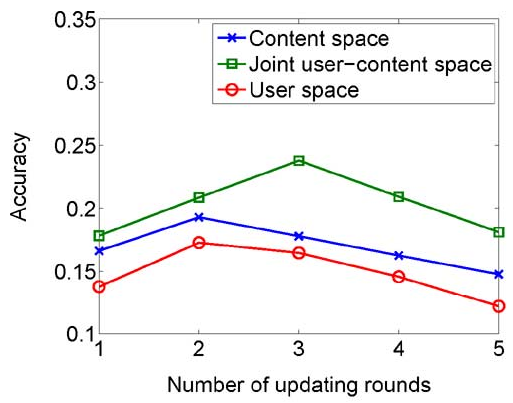
- Optimal Propagation Depth: The best results occur at 2-3 rounds of social propagation. Beyond this, the "interest signal" becomes too diluted (noise).
- SOTA Comparison: The joint approach significantly higher accuracy than pure Collaborative Filtering (CF) and Content-Based Filtering (CBF), especially for users with less than 10 historical records.
Critical Analysis & Conclusion
Takeaway
The paper successfully proves that social networks are not just graphs, but rich feature spaces. By distinguishing between "Importing" and "Re-sharing," the model respects the psychological differences in how users act as content filters versus content broadcasters.
Limitations & Future Work
The current approach relies on tag-based text analysis for "Content Similarity." In the modern context, this could be vastly improved by using Multi-modal Embeddings (extracting features directly from video frames and audio). Furthermore, the 2D matrix model could be evolved into a 3D Tensor to include temporal and geographic context, capturing the "viral" nature of videos as they trend through specific locations in real-time.