
Harmonizing Social Behavior and Network Topology: A New Frontier for Ad Hoc Mobile Clouds
The Journal of Systems and Software
This paper proposes a user behavior-based topology formation and optimization framework for ad hoc mobile clouds. It introduces an improved feature extraction and classification method (UBFE/UBFC) and a Flower Pollination Algorithm (FPA)-based offloading strategy to minimize latency and energy consumption.
TL;DR
To address the instability and resource constraints of ad hoc mobile clouds, this research introduces a behavior-driven framework. By grouping nodes with similar social habits into a tiered logical topology and optimizing task offloading via a bionic "Flower Pollination" algorithm, the system achieves a staggering 25%–50% reduction in latency and energy usage.
Background: The Infrastructure-less Challenge
Unlike traditional cloud computing or stationary cloudlets, an ad hoc mobile cloud is a spontaneous network of mobile devices. While it offers decentralized computing power, it suffers from a "double-edged sword" of mobility: nodes are constantly moving, causing frequent link failures. Traditional research focused purely on physical distance, but this paper argues that User Behavior is the missing link for creating stable, high-efficiency coalitions.
Methodology: From Social Habits to Tiered Architectures
1. Behavior-Based Feature Extraction (UBFE)
The authors utilize data from platforms like Sina Weibo and WeChat. They refine the TextRank algorithm by integrating TF-IDF to weight behavioral features.
- Insight: If two users have similar interests and habits, they are likely to request similar resources (e.g., similar apps or data), making them ideal candidates for the same ad hoc cluster to maximize cache reuse.
2. Tiered Topology Formation
Nodes are assigned a Measurement Score (), which balances service efficiency () and average relative distance ().
- LT0 (Agency Node): The core monitors that manage the cloud.
- LT1-LT3: Logical layers where nodes with high computing capacity and stability reside closer to the top.
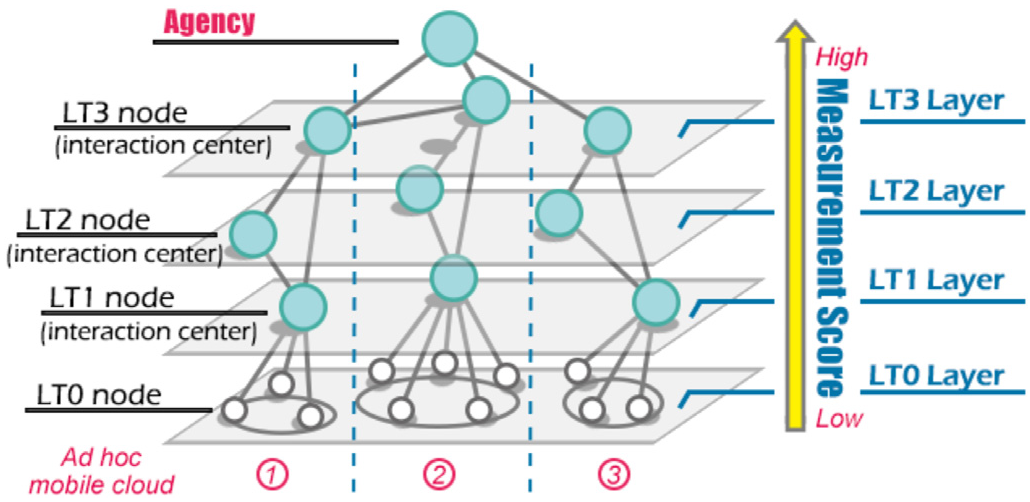 Fig 1: The proposed 4-tier logical architecture facilitates efficient node interaction and information exchange.
3. FPA-Based Offloading Strategy
Task offloading is modeled as an optimization problem. The authors use a modified Flower Pollination Algorithm (FPA).
- Global Pollination: Uses Levy flights to jump across the solution space, preventing the algorithm from getting stuck in local optima.
- Local Pollination: Refines solutions within a "neighborhood" to ensure precision.
Competitive Performance: The Numbers
The framework was tested against several benchmarks, including MCDO (Delay-optimized) and PEO (Energy-optimized).
Latency and Energy Gains
In varying bandwidth conditions (120kbps to 480kbps), the FPA-based strategy consistently outperformed others.
- Response Time: Reduced by up to 50% in low-bandwidth scenarios where efficient offloading is most critical.
- Energy Efficiency: The proposed method conserved nearly 22% more energy than the Energy-Traffic tradeoff (ETCO) baseline.
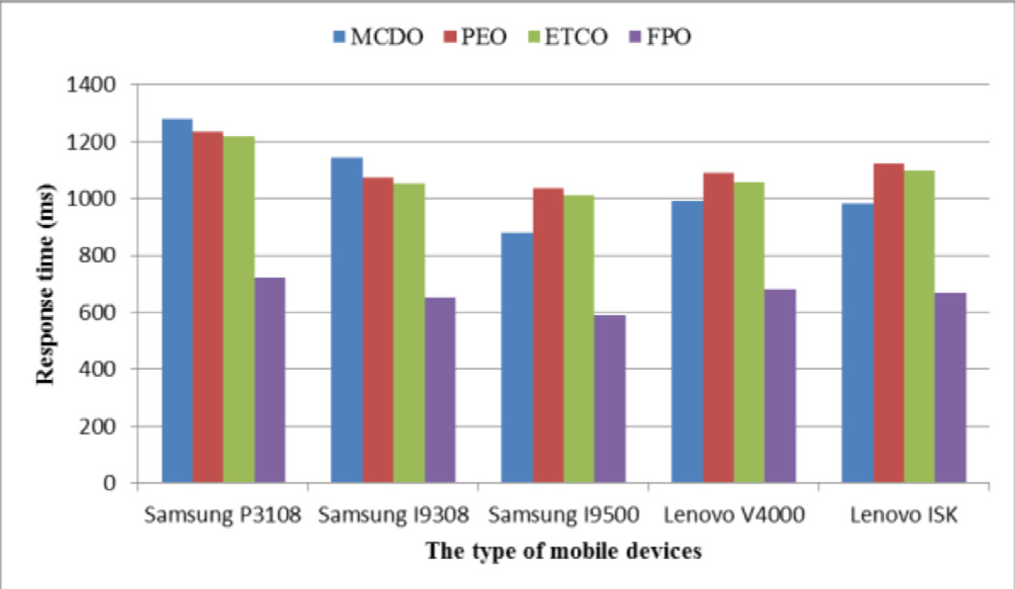 Fig 2: Response time comparison across different network bandwidths.
Scalability and Stability
As the network grows from 20 to 50 nodes, the Shortest Path Ratio remains stable, proving the topology doesn't collapse under increased complexity. Furthermore, the Aggregate Bottleneck Throughput declines much slower than non-behavioral models (like MOPS) during node failure events.
Deep Insight: Why Behavior Matters
The fundamental contribution here is the shift from Spatial-Awareness to Behavior-Awareness. By grouping users who "act" similarly, the network achieves a form of Inductive Bias: it anticipates resource needs based on the social profile of the cluster. This significantly reduces the "cost of discovery" within the ad hoc network.
Conclusion & Future Look
The paper successfully demonstrates that bionic algorithms and social analytics can bridge the gap between physical network instability and the high-performance requirements of modern mobile applications. Future research could explore how these behavior-based topologies adapt to 5G Slicing or Federated Learning environments, where data privacy and behavioral patterns are even more intertwined.
Takeaway: To build a better mobile network, don't just look at where the phone is—look at what the user does.