
The Crowdsourcing Paradox: Why Higher Bids Often Portend Project Failure
The Journal of Systems and Software
This study investigates the dynamics of Crowdsourcing Software Development (CSM) using Agency Theory. By analyzing archival data from a leading CSM platform, the authors examine how project description length and expected duration influence bidding behavior and project success (final payment).
TL;DR
In the fast-paced world of Crowdsourcing Software Development (CSM), bigger isn't always riskier. A deep dive into archival data reveals that while longer, well-detailed projects command higher prices, it is the relatively overpriced short projects that are most likely to fail. This happens because experienced providers price in the "uncertainty tax" when they sense a buyer doesn't understand the true complexity of a "simple" task.
Motivation: The Information Gap in the Human Cloud
Traditional software outsourcing research focuses on multi-year, million-dollar contracts. But CSM is a different beast: median projects last just one week and are described in fewer words than a standard email.
In this marketplace, the power balance is skewed. Buyers (Principals) can refuse to pay if they aren't satisfied, and all contracts are Fixed-Price (FP). This creates a Reverse Agency Problem: the provider (Agent) is the one facing the most risk from the buyer’s potential ignorance or misrepresentation of project needs.
Methodology: Decoding the Bidding Signals
The researchers analyzed over 30,000 requests for proposals (RFPs) using a two-pronged approach:
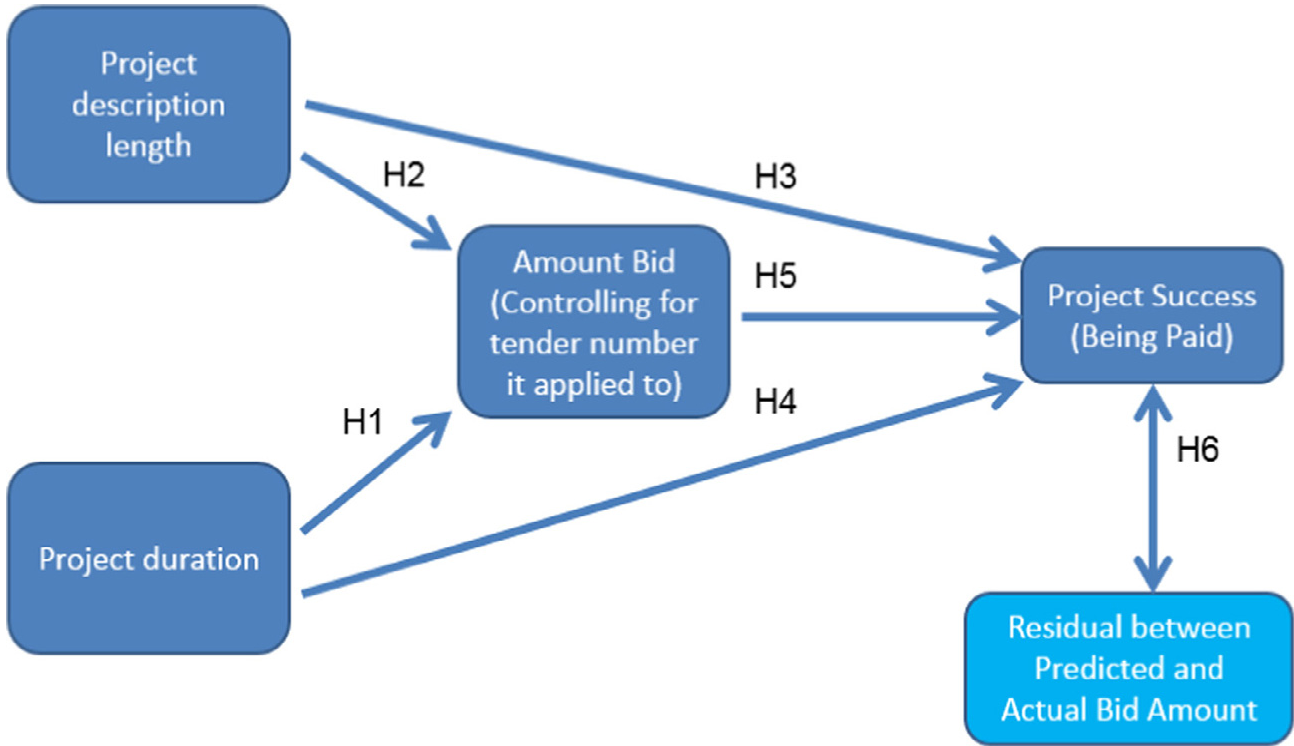
- GLM Analysis: To see how description length and duration affect the "Actual Amount Bid."
- Residual Analysis: This is the clever part. By calculating the difference between the actual bid and the "expected" market price (the residual), researchers could identify when providers were adding a "safety margin."
Key Findings: The "Safety Margin" Insight
1. Duration and Description Matter
As expected, if an RFP is longer (more words) and the expected duration is higher, providers bid more. This is rational—more work equals more money. These projects also have higher success rates because they decrease Information Asymmetry; the provider actually knows what needs to be done.
2. The Residual Flag
The study found that unsuccessful projects (those the buyer refused to pay for) had significantly larger positive residuals.
- The Logic: Agents are smart. When they see a project that is described briefly but seems complex, or a duration that seems impossibly short, they don't necessarily walk away—they bid higher than the project's "face value" to cover the anticipated extra work and risk.

3. The "Short Project" Trap
Post-hoc analysis revealed that buyers are surprisingly bad at estimating time for short projects. The variance between "Estimated Duration" and "Actual Time to Deliver" was much higher for short-term tasks.
"Agents were correct in their relatively higher bidding on eventually unsuccessful projects because buyers were less accurate in their assessment of shorter projects."
Critical Analysis & Takeaways
This paper turns the traditional view of "lowballing" on its head. In CSM, we don't just see providers bidding low to win; we see them bidding high to survive.
- For Buyers: If you want your project to succeed, write more. A brief description isn't concise; it's a red flag that signals you might not know what you want, leading providers to either avoid you or charge you an "uncertainty premium."
- For Platforms: CSM sites should implement automated tools to help buyers estimate durations more accurately, as duration inaccuracy is a primary driver of project friction.
Limitations: The study uses archival data from 2006. While the psychological and economic foundations of Agency Theory remain constant, modern platforms have introduced reputation systems and escrow milestones that might mitigate some of these risks today.
Conclusion
Project success in the crowdsourcing market isn't just about the price—it's about the quality of signaling. When a buyer fails to signal clearly through description and duration, the market responds with higher prices and higher failure rates.