
Beyond the Skill Matrix: Using Social Network Analysis to Build High-Performing Software Teams
The Journal of Systems and Software
The paper introduces a socio-technical framework for Information System (IS) project team formation, utilizing Social Network Analysis (SNA) to model candidate compatibility. By combining historical collaboration data with individual social skill profiles (e.g., leadership, empathy), the method predicts joint productivity and achieves a 16% reduction in effort deviation and a 23% decrease in defect density within large-scale industrial settings.
TL;DR
Building a software team is often treated like picking parts for a machine—matching technical roles to specific requirements. This paper argues that this "technical-only" approach is why many projects fail. The authors propose a Socio-Technical Framework that uses Social Network Analysis (SNA) to measure interpersonal compatibility. By analyzing previous collaborations and individual social skills, they achieved a 23% reduction in software defects and a 16% improvement in development efficiency in real-world industrial environments.
The Problem: The "Expert" Paradox
In the industrial Information Systems (IS) world, team formation is usually driven by "know-what" and "know-how." We look at a candidate's Java experience or SQL proficiency. However, a group of five senior developers isn't necessarily a "senior team."
Traditional methods ignore the forming-storming-norming-performing cycle. If a team spends too long in the "storming" phase due to personality clashes or poor communication, the project's budget and quality suffer. The challenge has always been: How do we predict synergy between people who have never worked together before?
Methodology: Mapping Social Capital
The core of the paper lies in the construction of two distinct types of social networks that go beyond simple LinkedIn-style connections.
1. Teammate Networks (The Objective History)
These networks connect individuals based on their shared history. Unlike prior research that only looks at "did they work together?", this framework weights the connections by success metrics (e.g., did their last joint project finish on time?) and subjective feedback (360-degree reviews).
2. Social-Skill Networks (The Predictive Engine)
This is the paper’s most significant innovation. For employees who haven't worked together, the authors map 11 social competencies—including empathy, negotiation, and active listening. They use these profiles to build a "compatibility estimator."
 Above: The framework's workflow, starting from candidate identification to SNA-based team analysis.
The Formula for Compatibility
The authors don't just guess; they use a sigmoid-based weight combination to merge subjective feedback () and objective project outcomes ():
This ensures that personal "friendships" (subjective) are balanced against actual "productive output" (objective).
Experimental Results: Real-World impact
The framework wasn't just tested in a lab; it was deployed in 41 organizations, including a multinational corporation with over 1,000 employees.
Key Findings:
- Managerial Coherence: 90% of the teams suggested by the social-skill networks were accepted by project managers as "logical" and "highly suited."
- Efficiency Gains: Teams formed using this framework showed a 16% improvement in effort deviation (staying closer to original estimates).
- Quality Boost: The most striking result was a 23% reduction in defect density. Better communication leads to fewer bugs.
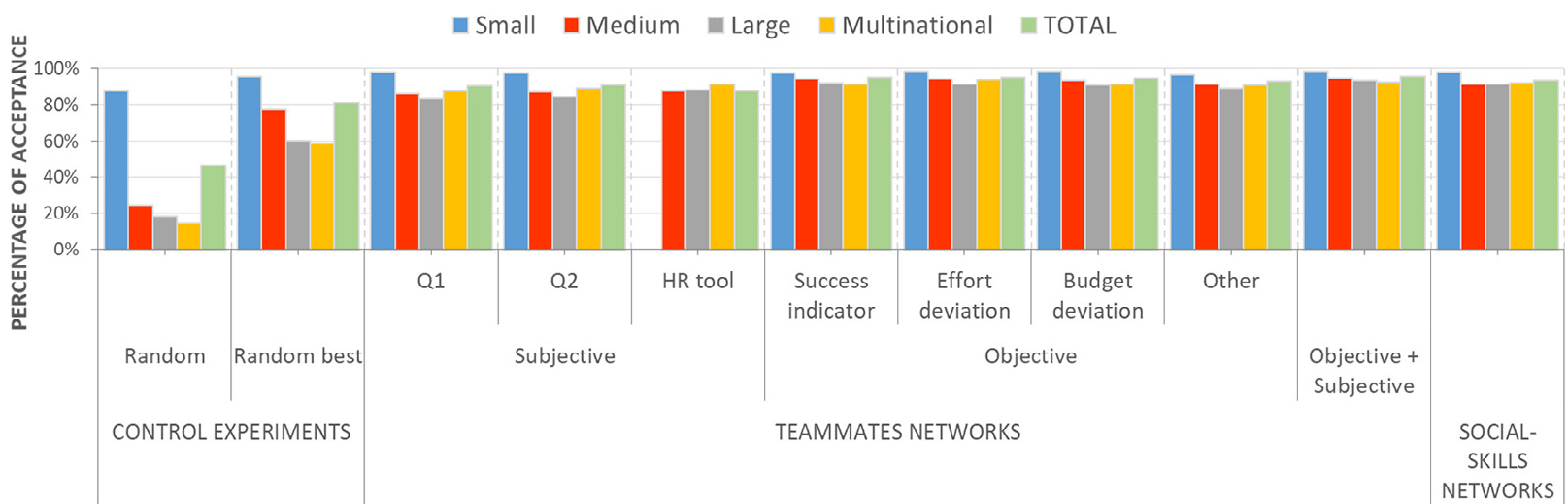 Fig 4: Acceptance percentage of suggested teams vs. random selection, showing the clear superiority of SNA-driven models.
Deep Insights: The "Social-Star" Strategy
One fascinating takeaway from the study is the Social-Star Strategy. The authors found that certain individuals act as "hubs" for knowledge sharing. Placing just one "Social-Star" (someone with high leadership and communication scores) in a team can facilitate technical knowledge flow even if the other members are relatively junior or socially reserved.
The study also notes that in distributed teams (cross-country), compatibility in "empathy" and "adaptability" becomes the primary predictor of success, outweighing even technical seniority.
Conclusion & Future Outlook
This work proves that social skills are not "soft" skills—they are hard project variables. By treating the software development team as a graph to be optimized, companies can bypass the friction of the "storming" phase and jump straight into productivity.
Limitations: The framework requires robust historical data. In small startups where no one has worked together and no HR tools exist, the "Teammate Network" is difficult to initialize. However, as the industry moves toward more globalized, distributed work, these SNA-based tools will likely become standard components of AI-driven project management suites.