
$k$-Symmetry: Future-Proofing Social Network Privacy via Graph Automorphisms
k-symmetry model for identity anonymization in social networks
This paper introduces the -symmetry model for social network identity anonymization. It leverages graph automorphisms to ensure that every vertex has at least structurally equivalent counterparts, effectively resisting any structural re-identification attack regardless of the adversary's background knowledge.
TL;DR
With the rise of social data sharing, simple anonymization (ID removal) is no longer enough. Adversaries can re-identify you just by knowing your "structural fingerprint"—e.g., "Bob has 3 friends, and 2 of them have only 1 friend." This paper presents the -symmetry model, a rigorous approach that uses graph symmetry to make every node indistinguishable from at least others under any structural attack. It also solves the "data utility" problem by allowing researchers to sample the original network's statistics from the blurred, symmetric version.
The "Structural Fingerprint" Problem
Most privacy models are reactive: they protect against specific known attacks like -degree or -neighborhood anonymity. But what if an attacker combines multiple metrics? The authors show that a combination of simple features (like degrees + triangle counts) has nearly the same re-identification power as the full theoretical upper bound of graph topology.
The insight is simple: to be truly safe, a node must belong to a set of nodes that are automorphically equivalent. If a graph looks exactly the same after swapping Node A and Node B, no structural query can ever tell them apart.
Methodology: Building Symmetry via Orbit Copying
The core of the paper is the Orbit Copying operation. An "orbit" is a set of nodes that are structurally identical. To achieve -symmetry, the authors:
- Partition the graph into its existing orbits.
- For any orbit smaller than , they "copy" it—adding new nodes and edges that mirror the original connections.
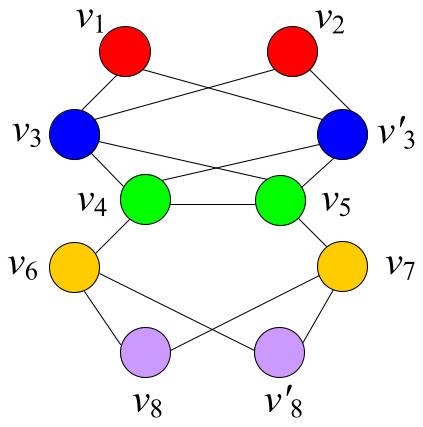 Figure: The effect of the anonymization procedure for k=2 and k=3. Notice how new nodes mirror the connectivity of the original orbits to maintain total symmetry.
This process is order-independent and guaranteed to produce a -symmetric graph in time, making it practical for medium-scale networks.
Preserving Utility: The Graph Backbone
A major critique of anonymization is that it "breaks" the data's scientific value. The authors solve this with the Graph Backbone concept. The backbone is the "minimal seed graph" from which a symmetric graph can be grown.
By publishing the -symmetric graph along with the number of original nodes, users can perform Backbone-based Sampling. Using either an exact isomorphism-based approach or a faster DFS-heuristic, analysts can extract subgraphs that behave statistically like the original network.
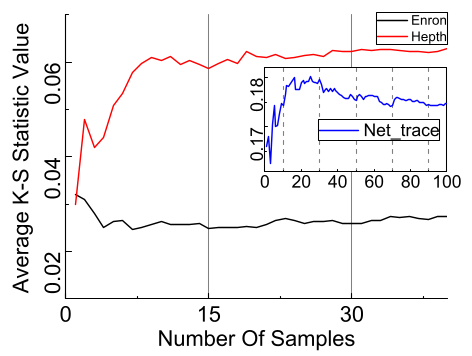 Figure: Convergence and utility preservation. The sampled graphs (black) almost perfectly mirror the original distributions (red) for degree, path length, and network resilience.
Deep Insight: The "Hub" Bottleneck
Real-world networks are "Scale-Free," meaning they have a few massive "hubs" (like a CEO in an email network). These hubs are structural outliers—it is incredibly "expensive" (requiring thousands of edge additions) to make a celebrity look like an average user.
The authors propose -symmetry, which allows publishers to exclude hub nodes from protection. Since hubs are effectively public figures anyway (high visibility), skipping them allows for a massive reduction in data distortion.
- Impact: Excluding just 1% of the highest-degree nodes can reduce the number of "fake" edges added by over 60%.
Critical Analysis & Conclusion
This work provides a definitive "upper bound" for structural privacy. While calculating exact graph automorphisms is technically challenging (related to the Graph Isomorphism problem), the authors suggest that approximate "Total Degree Partitioning" works as a near-perfect substitute in practice.
Takeaway: -symmetry moves us from "patching" specific leaks to a "secure-by-design" topological framework. For practitioners, the -symmetry variant is perhaps the most useful, balancing the high cost of protecting outliers with the need for broad-base privacy.