
KATARA: Transforming Data Cleaning with Knowledge Bases and Human Intelligence
KATARA: A Data Cleaning System Powered by Knowledge Bases and Crowdsourcing
KATARA is an end-to-end data cleaning system that leverages Knowledge Bases (KBs) and crowdsourcing to interpret table semantics and repair errors. It introduces a rank-join based pattern discovery module and an entropy-based crowd scheduling mechanism to achieve high-precision data annotation and SOTA repair suggestions.
TL;DR
KATARA is a hybrid data cleaning framework that moves beyond internal statistics. By aligning dirty tables with external Knowledge Bases (like Yago or DBpedia) and using a "smart" crowdsourcing loop, it identifies errors with high precision and suggests repairs even in tables with zero redundancy where traditional tools fail.
Context: Why Statistics Aren't Enough
Most data cleaning tools (like NADEEF or SCARE) rely on what is inside the table—functional dependencies (FDs) or statistical outliers. If a table says "Rome is the capital of France," a statistical tool might flag it, but without a source of truth, it cannot confidently say whether "Rome" should be "Paris" or "France" should be "Italy."
KATARA addresses this by assuming the "Truth is Out There." It treats Knowledge Bases (KBs) as the master data and the Crowd as the ultimate arbiter for ambiguity and KB incompleteness.
Methodology: The Three Pillars of KATARA
1. Pattern Discovery: Beyond Matching
KATARA doesn't just look for string matches; it seeks a Table Pattern—a directed graph where nodes are types (e.g., Person, Country) and edges are relationships (e.g., nationality).
- The Innovation: It uses a scoring model based on Pointwise Mutual Information (PMI) to ensure types and relationships are "coherent." For example, the type Country is more coherent with the relationship hasCapital than the type Economy.
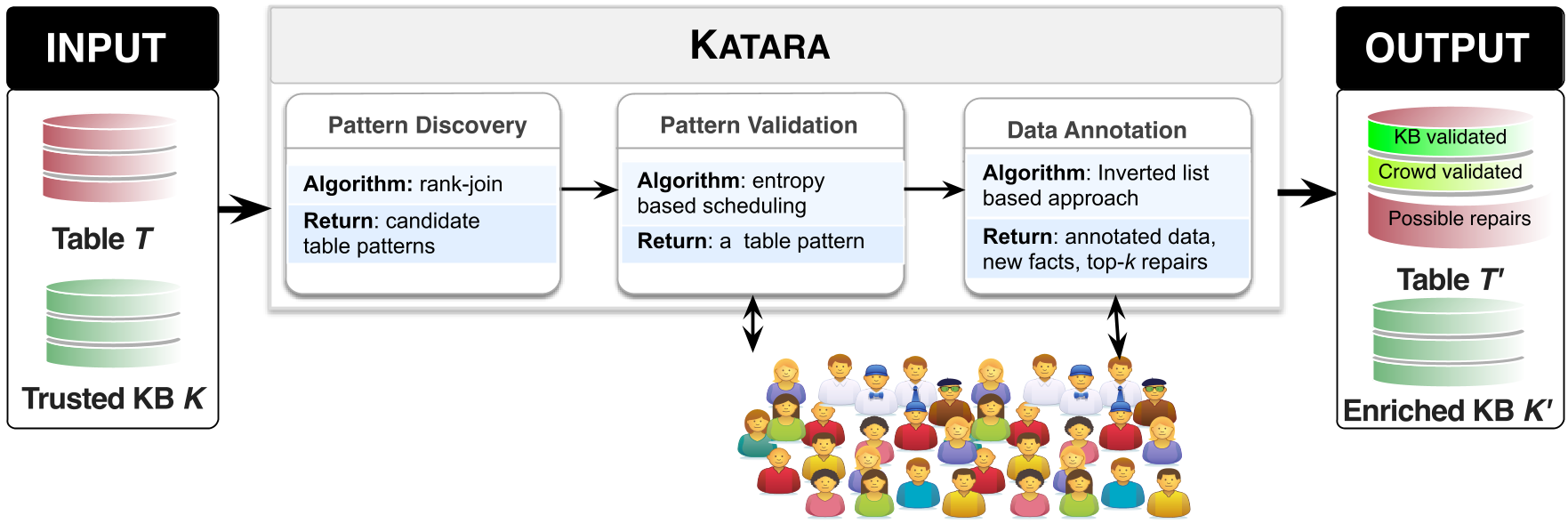 Figure 1: The KATARA Workflow: Pattern Discovery → Validation → Annotation.
2. Pattern Validation: Entropy-Driven Crowdsourcing
Asking humans to verify every possible pattern is expensive. KATARA treats pattern selection as an uncertainty reduction problem. Using Maximum Uncertainty Variable First (MUVF) scheduling, the system picks the most ambiguous column or relationship to ask the crowd about first. This minimizes the "monetary cost" of human intervention.
3. Data Annotation & Top-k Repairs
Once the pattern is set, KATARA classifies data into three buckets:
- KB-Validated: Matches the KB perfectly.
- Jointly Validated: Validated by the crowd (this also enriches the KB).
- Erroneous: Flagged by both.
For errors, KATARA uses inverted lists to find "Instance Graphs" in the KB that are closest to the dirty tuple, offering the user a ranked list of potential repairs.
Experimental Performance
The researchers tested KATARA against WikiTables, WebTables, and large RelationalTables.
- Precision: KATARA achieved near-perfect precision (1.0) on many datasets. Unlike constraint-based methods (EQ) that make "heuristic" changes to satisfy a rule, KATARA's repairs are grounded in real-world facts.
- Low Redundancy Champion: In WebTables, where data is unique and redundancy is low, tools like SCARE and EQ literally cannot function. KATARA maintained high effectiveness by relying on external KB coverage.
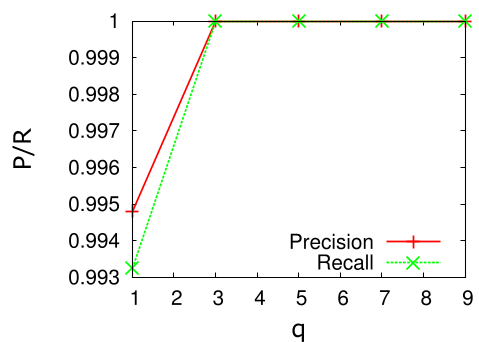 Figure 2: F-Measure comparison showing KATARA's RankJoin algorithm converging faster to the ground truth than prior SOTA (PGM, MaxLike).
Deep Insight: Knowledge Base Enrichment
A brilliant by-product of KATARA is that it acts as a "KB Extractor." When the crowd confirms a table value that isn't in the KB (e.g., a missing state capital in Yago), KATARA adds that fact back to the KB. This creates a virtuous cycle where the cleaning tool actually makes the source of truth better over time.
Conclusion & Limitations
KATARA proves that the future of data quality lies in Hybrid Intelligence. However, its "Achilles' Heel" remains KB coverage. If the KB doesn't know about a specific domain (like niche sports or specialized medical data), the system reverts to relying heavily on the crowd, which can be expensive.
Future research direction: Applying Large Language Models (LLMs) to act as a "Virtual Crowd" to further reduce costs while maintaining the external-knowledge-first philosophy of KATARA.
Takeaway: If your data cleaning pipeline only looks inward at your own table, you are missing half the picture. External knowledge is the key to moving from "consistent data" to "true data."