
Defeating the "Kevin Bacon" Attack: A New Blueprint for Social App Privacy
Keeping information safe from social networking apps
The paper introduces an enhanced sandboxing framework to prevent personal data leakage from third-party social networking applications in platforms like Facebook. It specifically addresses stealthy data exfiltration through "Kevin Bacon" attacks and provides a secure mechanism for developers to access aggregate analytics through Differential Privacy.
TL;DR
Third-party social apps are notorious for leaking personal data. This paper presents a sophisticated sandboxing framework that prevents apps from silently spreading your data through your social graph (the "Kevin Bacon" attack) while still allowing developers to collect necessary "noisy" analytics using Differential Privacy.
The Core Dilemma: Connectivity vs. Privacy
In the ecosystem of Online Social Networks (OSNs), we face a paradox: apps need access to our social graph to be "social," but once they have that access, the platform lose control. Standard sandboxing (like the prior xBook system) creates a wall around an app, but social apps require holes in that wall to let data flow between friends.
The authors identify that these necessary holes create a massive security loophole. If an app can share data with a friend's instance of the same app, a malicious developer can program the app to "hop" from friend to friend until the data reaches the developer’s own account. This is the Kevin Bacon Attack—leveraging the "six degrees of separation" to siphon data globally.
Breaking the Chain: The Split-Sandbox Architecture
To stop the "hop," the researchers re-engineered the server-side architecture. Instead of one sandbox, they use two distinct execution environments for every user:
- User Read-Write Sandbox: Can access the user's private data and share it with friends, but cannot see data incoming from friends.
- User Read-Only Sandbox: Can see data shared by friends to display it, but is strictly prohibited from writing or re-sharing that data.
This ensures that data can only travel one hop—from User A to User B—and never from User B to User C.
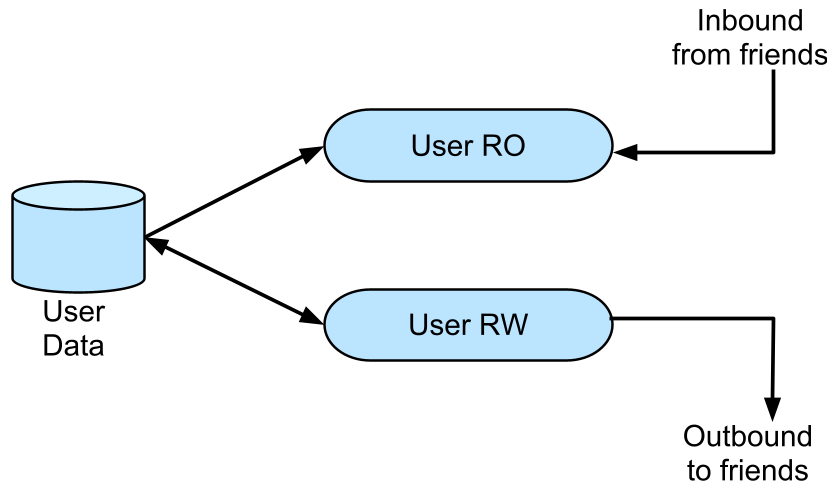 Figure 1: The dual-sandbox approach at the server level to enforce 1-hop social sharing.
On the client side, the researchers recognized that JavaScript is too dynamic for easy security enforcement. Instead, they utilized Fine, a functional language that allows for static verification of information flow. This code is verified before being compiled into JavaScript, ensuring the browser can't "leak" data between the read-only and read-write channels.
Analytics Without Intrusion: Epoch-based Differential Privacy
Developers still need to know how many people use their apps or how well they perform. To allow this without exposing individual records, the system uses a Secure Data Aggregator.
The innovation here is the use of Epochs. Since social data is a continuous stream, the system divides data into time-based chunks. Each epoch has its own "privacy budget" (). By using Differential Privacy techniques—adding calculated "noise" to the results—developers get accurate aggregate stats while the system mathematically guarantees that an individual user's data cannot be identified.
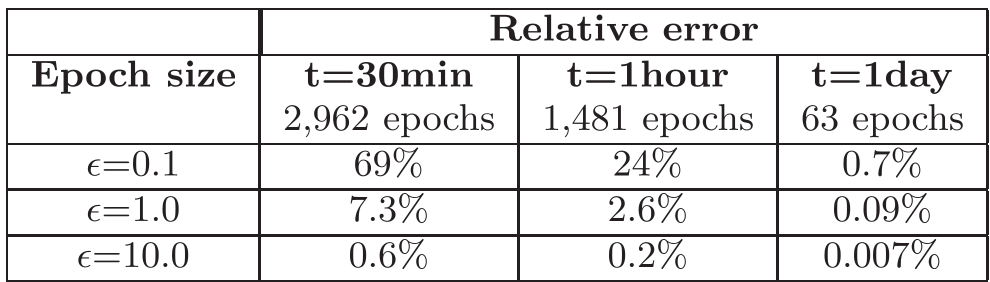 Table 1: The trade-off between privacy (epsilon), epoch size, and accuracy.
Real-World Feasibility
Does this break the apps we love? The authors analyzed 50 top Facebook apps and found:
- 76% of apps could run perfectly within this framework.
- Most apps only share data with friends (52%), which the 1-hop rule supports.
- Only "dating apps" or apps using 3rd-party widgets like Google Maps would fail, as they inherently require sharing data with strangers.
Conclusion & Critical Insight
The "split-sandbox" is a clever, high-level enforcement of Information Flow Control (IFC). By moving the complexity away from granular data labeling and into structural architectural isolation, the authors made a secure system that remains programmable.
While the programming overhead is higher (C# lines increased by ~70% in their quiz app), the cost is a necessary trade-off for a world where our social connections aren't used as a highway for data theft. The use of Fine to bridge the gap between static theory and dynamic browser reality is a particularly strong contribution to the field of Web Security.