
Defeating the "Kevin Bacon" Attack: Advanced Sandboxing for Social Apps
Keeping information safe from social networking apps
The paper introduces an enhanced sandboxing framework for Online Social Network (OSN) applications, combining coarse-grained server-side isolation with language-based client-side Information Flow Control (IFC) and differential privacy. It specifically addresses the "Kevin Bacon" lateral data propagation attack and provides a mechanism for secure aggregate data analytics for developers.
TL;DR
Third-party social apps are notorious for leaking personal data. This research presents a framework that prevents apps from harvesting user data via their social connections. By splitting the execution environment into isolated read/write sandboxes and using Differential Privacy for developer statistics, the system stops the "Kevin Bacon" attack—a method where data travels hop-by-hop across a social graph to a developer's hands—while keeping 76% of existing apps functional.
The Social Privacy Dilemma
In the ecosystem of Facebook or LinkedIn, 3rd-party apps (quizzes, games, etc.) are a double-edged sword. To provide a "social" experience, an app must see your friends' data. However, once an app gains access, the platform usually loses control. Prior work suggested simple sandboxes, but these break down because social apps require communication between friends.
The authors identify a stealthy new threat: The Kevin Bacon Attack.
- The Intuition: An app shares your data with your friend's instance. That instance shares it with another friend. Within "six degrees of separation," your private data has been siphoned off to the application developer's own social account, all while following "legitimate" sharing rules.
Methodology: Split Sandboxes & Static Verification
To solve this, the researchers moved beyond simple "boxes" to a dual-sandbox architecture.
1. The Server-Side Split
Instead of one sandbox per user, the system creates two:
- User Read-Only: Can read data from friends but has no permission to write to any shared database.
- User Read-Write: Can write the user's own data but is strictly blocked from reading any data originating from friends.
This "no-read-up/no-write-down" philosophy ensures that data from a friend cannot be "re-packaged" and forwarded to another friend, effectively killing the Kevin Bacon attack at the 1-hop boundary.
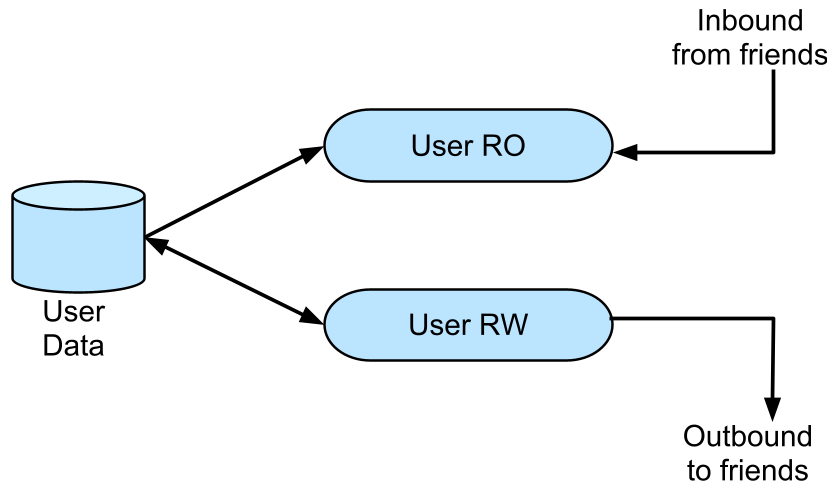 Figure 1: The architecture isolating Read-Only and Read-Write operations to enforce the 1-hop sharing policy.
2. Client-Side Integrity with 'Fine'
Standard JavaScript is too dynamic for secure information flow control. The authors employ Fine, a functional language (F# variant) that supports static verification. Developers write in Fine, the compiler proves that the code doesn't leak data between prohibited channels, and then it emits safe JavaScript for the browser.
3. Secure Data Aggregation
Developers still need "Analytics" (e.g., "How many people played my game today?"). To prevent these queries from being used as covert channels, the system uses Differential Privacy (DP).
- Epochs: Data is split into time-based chunks (epochs). Each has a "privacy budget."
- Noise: The system adds mathematical noise to results so a developer can see trends but never individual behavior.
Experimental Results
The researchers tested their framework against 50 real-world Facebook apps. The results were encouraging:
- Compatibility: 76% of apps (like quizzes and games) worked perfectly. Only "inherently invasive" apps like dating services or those using 3rd-party trackers failed.
- Accuracy vs. Privacy: Using a 1-day epoch, the error introduced by differential privacy was less than 1%—more than accurate enough for debugging and business vitals.
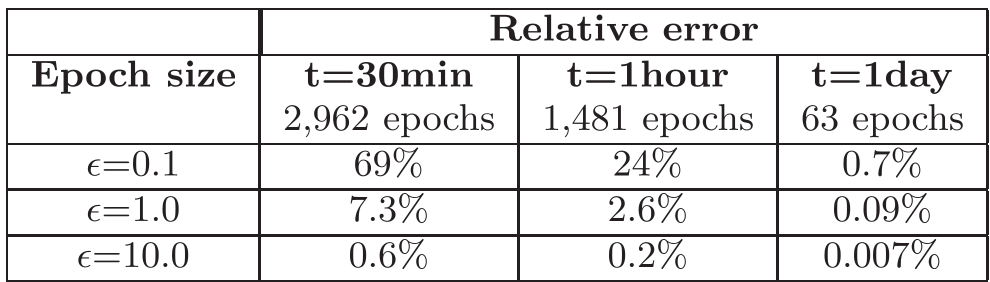 Table 1: Trade-off between Epoch size and relative error. Larger windows (1 day) provide near-perfect accuracy even with strict privacy parameters.
Critical Insight & Conclusion
The genius of this paper lies in acknowledging that context matters. We don't want to stop sharing; we want to stop uncontrolled propagation. By leveraging formal methods (Fine) and statistical privacy (DP), the authors provide a blueprint for a "Social OS" that treats privacy as a flow-control problem rather than a binary access problem.
Limitations: The programming overhead is significant. Code in Fine can be nearly double the length of standard JavaScript, suggesting that developer adoption remains the biggest hurdle for this level of security.