
KCFA: Bridging the Nonlinear Gap in Audiovisual Emotion Recognition
Kernel Cross-Modal Factor Analysis for Information Fusion With Application to Bimodal Emotion Recognition
The paper introduces Kernel Cross-Modal Factor Analysis (KCFA), a novel nonlinear method for information fusion in bimodal (audiovisual) emotion recognition. KCFA identifies optimal transformations by minimizing the Frobenius norm in a high-dimensional kernel space to represent coupled patterns between modalities, combined with HMMs for temporal modeling.
TL;DR
Human emotions are inherently multimodal, yet fusing audio and visual data effectively remains a challenge due to their nonlinear relationships. This paper presents Kernel Cross-Modal Factor Analysis (KCFA), a method that projects disparate data streams into a joint high-dimensional space to identify coupled patterns. By minimizing the Frobenius distance between modalities rather than just maximizing correlation, KCFA achieves State-of-the-Art (SOTA) results with higher computational efficiency and fewer hyperparameter headaches than traditional KCCA.
The "Independence" Trap in Multimodal Fusion
Most multimodal systems treat audio (speech) and visual (facial expressions) as two ships passing in the night—processing them separately and only merging them at the very last second (score/decision level fusion). However, psychological reality suggests these channels are deeply coupled.
The authors argue that:
- Linearity is a myth: The relationship between a smile and the pitch of a voice isn't a simple straight line.
- CCA is fragile: Canonical Correlation Analysis (CCA) requires matrix inversions, which break down if your data is high-dimensional or redundant.
- KCCA is a "Hyperparameter Nightmare": While Kernel CCA handles nonlinearity, it requires a regularization parameter () that is notoriously difficult to tune across different datasets.
Methodology: The Logic of KCFA
The core intuition of Cross-Modal Factor Analysis (CFA) is to find two transformation matrices, and , that make the transformed versions of modality and modality as close as possible in terms of the Frobenius norm.
Moving to Kernel Space
By applying the Kernel Trick, the authors transform this linear search into a high-dimensional feature space. Unlike KCCA, which maximizes correlation, KCFA seeks to couple the patterns.
- The SVD Solution: The transformation is solved via Singular Value Decomposition (SVD) of the kernel matrices.
- Orthogonality: KCFA naturally produces orthogonal projections, preserving the structure of the data better than the non-orthogonal projections often found in CCA.
- Temporal Stability: Once the features are fused/transformed, they are fed into a Hidden Markov Model (HMM) to capture how emotions evolve over 1-2 second windows.
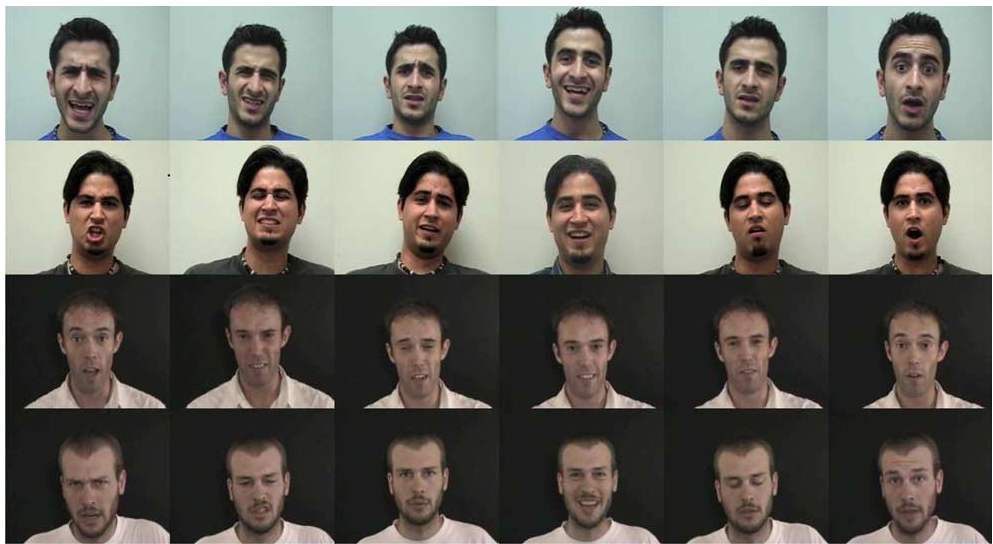
Experimental Battleground: RML & eNTERFACE
The authors tested KCFA against single modalities, simple concatenation, and the powerful (but slow) KCCA.
Performance Gains
In every test case, KCFA outperformed the competition. On the RML database, simple feature concatenation actually hurt performance, proving that "more data" isn't better if the fusion strategy is weak. KCFA, however, significantly boosted accuracy by identifying the true association.
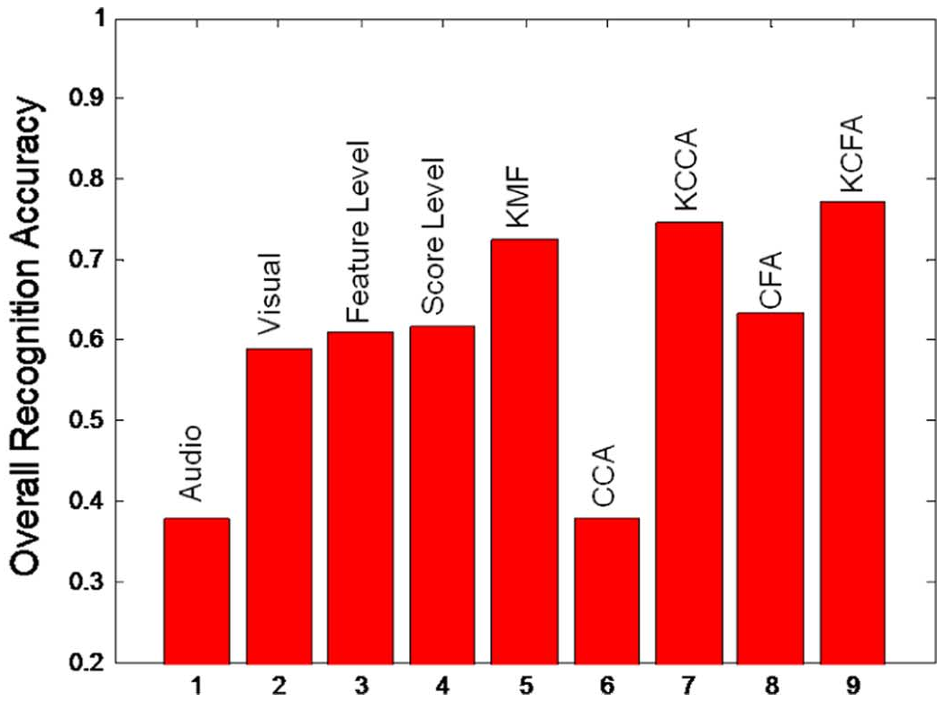
Efficiency Wins
One of the most striking results is the training speed. Because KCFA avoids the costly matrix inversions required for the KCCA generalized eigenvalue problem:
- KCFA: ~30 seconds.
- KCCA: ~200 seconds.
- Result: A 6.6x speedup with better accuracy.
Critical Insight: Why Frobenius over Correlation?
Why does minimizing distance (KCFA) beat maximizing correlation (KCCA)? In noisy audiovisual data, two signals might be highly correlated but still represent "coupled noise." By minimizing the Frobenius norm, KCFA forces the representations to be physically closer in the latent space, which, when paired with the kernel trick's nonlinear flexibility, provides a more robust anchor for the HMM classifier.
Conclusion & Future Impact
This work demonstrates that identifying cross-modal association is far more valuable than simple feature stacking. While modern Deep Learning often uses "Attention" mechanisms to solve this today, the mathematical foundations of KCFA—minimizing Frobenius distances in a transformed manifold—remain highly relevant for designing efficient, low-latency fusion layers in edge-AI devices where heavy Transformers might be overkill.
Limitations
- Kernel Selection: While KCFA removes the need for the parameter, it still requires choosing a kernel (e.g., Gaussian) and its variance ().
- Scalability: Like all kernel methods, scaling to millions of samples requires Nyström approximations or similar techniques to handle the kernel matrix size.