
Identifying Social Media "Brand Ambassadors": A MapReduce-Powered Skyline Approach
Selecting Key Person of Social Network Using Skyline Query in MapReduce Framework
Identifying Key Persons in Social Networks using Skyline Queries in MapReduce. This paper introduces a multi-metric approach to selection based on social relationships (friends, followers, and group importance) and achieves high scalability using the MapReduce framework to process massive Facebook-like datasets.
TL;DR
In the era of Big Data, finding the "Key Person" in a social network isn't just about who has the most friends. It's a multi-dimensional challenge involving friends, followers, and the importance of the groups they join. This paper presents a scalable MapReduce framework to perform Skyline Queries on massive social datasets, effectively identifying users who are "not dominated" by anyone else across multiple influence metrics.
Background: Beyond the Single Metric
In traditional social network analysis, we often rank users by a single value (e.g., follower count). However, a true "Key Person" or brand ambassador might have a balanced profile: high reach (friends), high authority (followee strength), and high niche relevance (group membership).
The Skyline Query is the perfect mathematical tool for this. Instead of a weighted sum (which is subjective), a skyline query finds all individuals who are not "dominated" by others.
- User A dominates User B if A is better than or equal to B in all dimensions and strictly better in at least one.
- The Skyline is the set of all users who are not dominated by any other user.
The "Key Person" Metrics
The authors identify three pillars of social influence:
- Friend Power: The raw count of mutual connections.
- Followee Strength: The total number of followers (indicating authority).
- Group Score: A weighted metric where a user's value increases based on the popularity of the groups they participate in.
Methodology: The MapReduce Pipeline
Processing millions of Facebook records requires more than a single server's RAM. The authors architected a 5-phase MapReduce workflow to handle the computation:
1. Metric Calculation Phases
The first four phases focus on calculating the dimensions of the social graph. For example, in Friend Power Calculation, the system maps user pairs, shuffles them by UID, and reduces them to a final count. Similar logic is applied to calculate Followee Strength and Group Weights.
2. The Sorting and Skyline Strategy
The final phase is where the "magic" happens. To avoid a brute-force comparison of every user against every other user (an operation), the authors utilize a sorting-based strategy:
- Data is vertically partitioned and sorted by each metric.
- The Eliminator (Coordinator) tracks user occurrences. When a user appears in the top results of all sorted lists, the system can determine a stopping point for candidate selection.
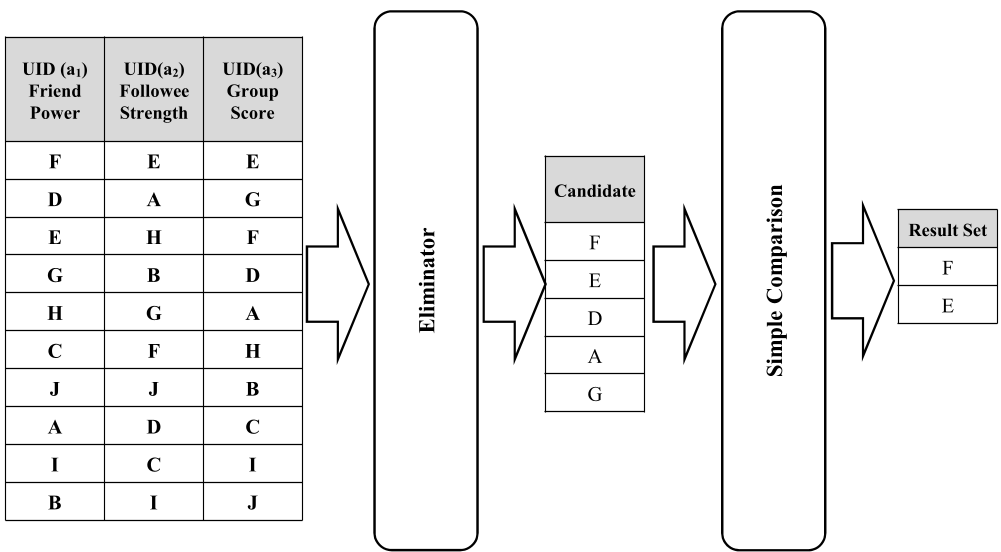 Fig 1: The Skyline computation logic using a counter-based threshold.
Experimental Performance
The researchers tested their system on a cluster of 4 PCs against a high-performance single-machine baseline.
Scalability Breakthrough
The most telling result is found in the Skyline Computation phase. While a single PC can handle basic counting well, it hits a "memory wall" when calculating the non-dominated set for large populations.
- Single PC: Crashed or failed to return results once the dataset exceeded 100k records.
- Proposed MapReduce Method: Displayed near-linear scaling up to 800k records and beyond, proving that the bottleneck in social analysis is memory-bound, not just CPU-bound.
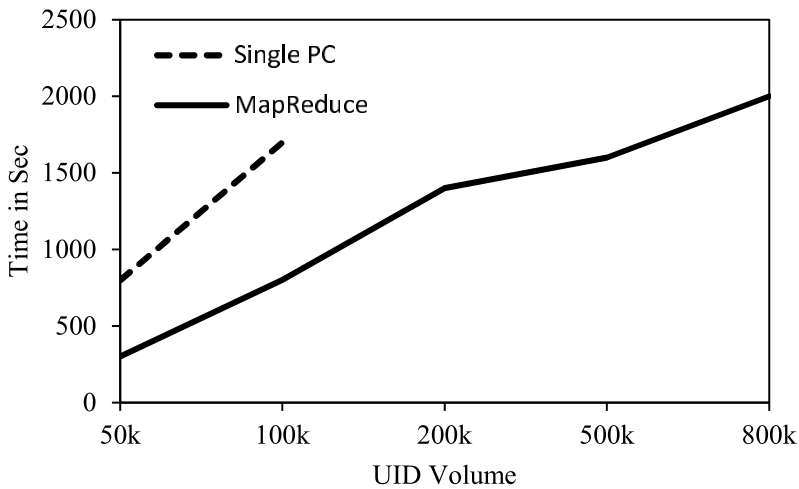 Fig 2: Comparison of Follower Strength calculation time as data cardinality grows.
Critical Insight & Conclusion
By moving away from arbitrary "Top-K" scoring and toward the "Skyline" approach, the authors provide a more objective way to identify influencers. If you are better than everyone else in at least one category and not worse in others, you belong in the Key Person set.
Takeaway for Practitioners: When ranking entities with conflicting attributes (e.g., price vs. quality vs. speed), Skyline queries afford a balanced perspective. By leveraging MapReduce, this logic can finally be applied to the scale of modern social media.
Future Work: The authors suggest that adding "activity metrics" (likes, comments, shares) would further refine the model, moving from static profile analysis to dynamic influence tracking.