
Finding the North Star: Identifying Opinion Leaders in Facebook Fan Pages through Multi-Feature Clustering
Finding the Key Users in Facebook Fan Pages via a Clustering Approach
The paper introduces a clustering-based framework to identify "opinion leaders" or key users within Facebook Fan Pages. By applying the K-means algorithm to a large-scale dataset of over 410,000 comments, the system successfully segregates influential users from general fans across diverse corporate sectors.
TL;DR
This research presents an automated pipeline to extract "Key Users" (Opinion Leaders) from the vast noise of Facebook Fan Pages. By combining NLP (TF-IDF and Sentiment Analysis) with social metrics and K-means clustering, the authors demonstrate that a tiny, distinct group of users drives the electronic Word-of-Mouth (eWoM) for major brands like Samsung and HTC.
Context & Positioning
In the era of social commerce, a brand's Fan Page is more than a billboard; it is a living ecosystem. However, not all fans are created equal. Some are "lurkers," while others are "Opinion Leaders"—individuals whose feedback shapes the brand's perception. This paper positions itself as a bridge between traditional social science (Lazarsfeld’s Opinion Leader theory) and modern data mining, providing a scalable unsupervised learning approach to find these high-value targets.
The "Key User" Challenge
Why not just look at the users with the most comments? As the authors point out, simple activity metrics can be fooled by "Water Armies" (paid spammers). A true key user must satisfy several dimensions:
- Relevance: Do they talk about the brand's core topics? (Topic Similarity)
- Engagement: Does the community value their input? (Likes & Replies)
- Tone: What is the sentiment of their contribution? (Sentiment Analysis)
Methodology: The Synthesis of NLP and Clustering
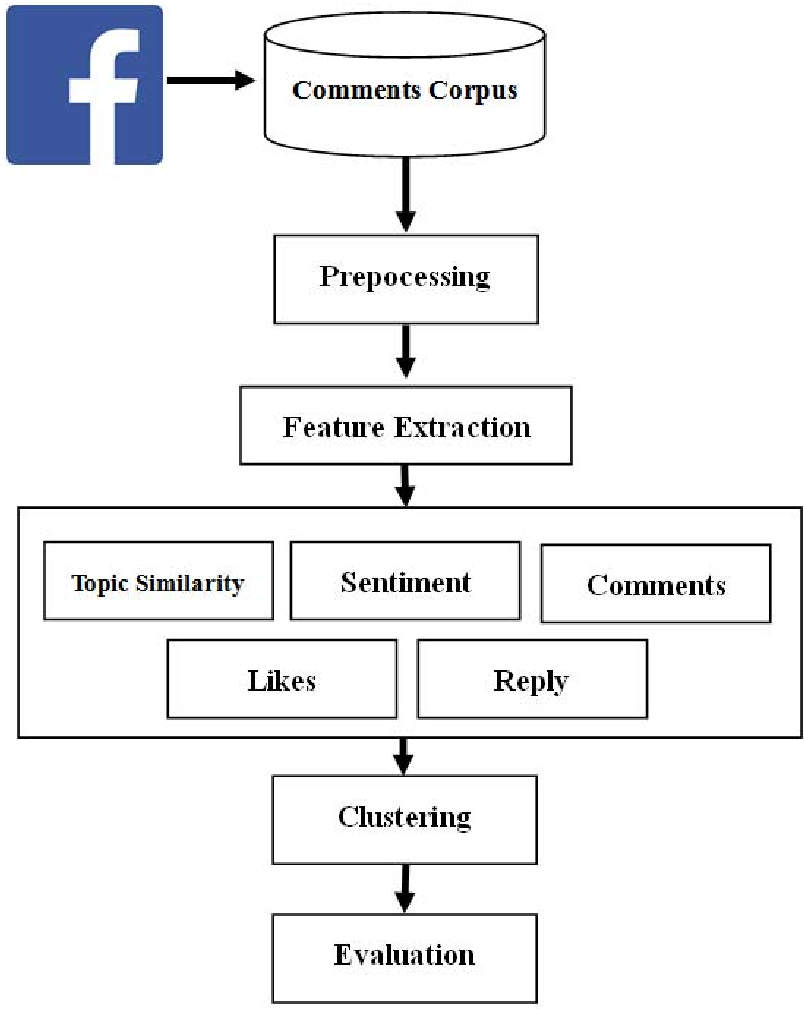
The authors propose a system that moves from raw data collection via the Facebook Graph API to a refined multi-dimensional feature space.
1. Feature Engineering
- TF-IDF Topic Similarity: Uses Chinese word segmentation (CKIP) to ensure the user's comments align with the Fan Page's official content.
- Sentiment Analysis: Leverages the National Taiwan University Semantic Dictionary (NTUSD) to quantify the emotional weight of comments.
- Social Validation: Tracks "Likes" and "Replies" as an indicator of a user's prestige and influence within the group.
2. K-means Clustering & Evaluation
The core engine uses K-means with Euclidean distance to segment users. To solve the perpetual problem of unsupervised learning—the lack of a "Gold Standard"—the authors use a clever validation trick: they treat the cluster IDs as labels and train an SVM classifier. If the classifier can perfectly identify a cluster, it proves that the group is mathematically distinct from the masses.
Experimental Results: The 1% Rule
The experiments across ten diverse Fan Pages (from Pizza Hut to Fox Sports) revealed a consistent pattern. In almost every case, a "Key Cluster" emerged.
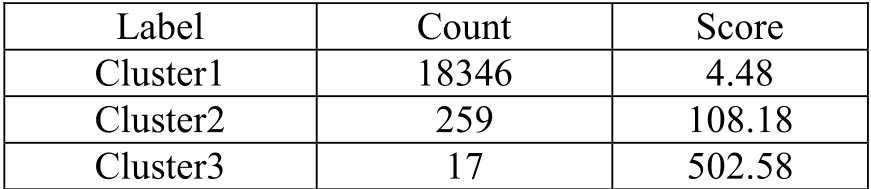
- Concentrated Influence: In the Samsung Fan Page, out of 37,902 active fans, only 27 users were identified as the core key cluster.
- High Scores: These key users often had feature scores (a composite of activity and engagement) hundreds of times higher than the average user.
- Separability: As seen in the table below, when or higher, the Key Cluster (Cluster 3 for HTC) achieves a classification accuracy that is near perfect, signifying they are a "species" of user entirely different from the occasional commenter.
Depth Insight: Why it Works
The success of this method lies in the multi-modal feature set. By combining content (what they say) with context (how others react), the system naturally filters out spammers. A "Water Army" member might have a high comment count, but they rarely receive high "Likes" or "Replies" from genuine users, and their sentiment may appear robotic or repetitive, allowing the clustering algorithm to place them in a secondary "active but non-influential" group.
Critical Analysis & Conclusion
Takeaway
This work provides a practical blueprint for digital marketers. Instead of shouting into the void of 5 million fans, a company can focus its engagement strategies—such as direct beta-testing offers or VIP events—on the 20-50 users who actually move the needle.
Limitations
- Temporal Dynamics: The study uses a static snapshot of data. Influence is often ephemeral; an opinion leader today might be inactive tomorrow.
- Content Depth: While sentiment and topic similarity are used, the quality of the argument (logic, expertise) isn't fully captured by TF-IDF alone.
Future Outlook
The logical next step involves LLM-based (Large Language Model) feature extraction, where the nuances of a user's expertise could be mapped in high-dimensional embedding spaces, moving beyond simple keyword matching to true semantic understanding of influence.