
Synergizing Linguistics and Linked Data: A New Frontier for Automatic Query Expansion
Keyword Query Expansion on Linked Data Using Linguistic and Semantic Features
The paper introduces a novel Automatic Query Expansion (AQE) framework that combines traditional linguistic features (from WordNet) with lightweight semantic features derived from Linked Open Data (LOD). By employing machine learning classifiers like SVM and Decision Trees, the authors demonstrate that semantic features are competitive with linguistic ones, achieving significant improvements in keyword-to-resource matching for Question Answering tasks.
TL;DR
Bridging the gap between how humans speak and how databases are structured remains a hurdle for semantic search. This paper presents a machine-learning approach to Automatic Query Expansion (AQE) that fuses WordNet's linguistic hierarchies with the web of Linked Open Data (LOD). By treating semantic relationships (like subClassOf and sameAs) as weighted features, the authors achieve a significant boost in retrieval accuracy, proving that the Semantic Web itself is the best tool for navigating its own complexity.
The Problem: The Vocabulary Gap
Even as the Linked Open Data cloud grows at an exponential rate, querying it remains a "layperson's nightmare." Standard SPARQL queries require users to know exact URI labels. As identified by the authors, the core issue is the Vocabulary Problem: a user asks "Who is married to Barack Obama?" but the database only understands the property dbpedia-owl:spouse.
Traditional expansion methods use synonyms, but they often lack the domain-specific rigor or the instance-level data found in structured knowledge bases.
Methodology: Beyond Simple Synonyms
The authors' approach is not just about adding more words; it is about feature engineering for relevance.
1. The Expansion Pipeline
The system performs an initial retrieval of resources and then expands the keyword set through two parallel paths:
- Linguistic Path (LE): Extracts synonyms, hyponyms, and hypernyms from WordNet.
- Semantic Path (SE): Navigates RDF properties including
owl:sameAs,rdfs:seeAlso,skos:broader, and class hierarchies.
2. Feature Weighting and Pruning
Not all features are created equal. The authors use a linear combination: Where is a binary vector indicating the feature's presence, and is a weight learned via Information Gain (IG) or SVM coefficients.
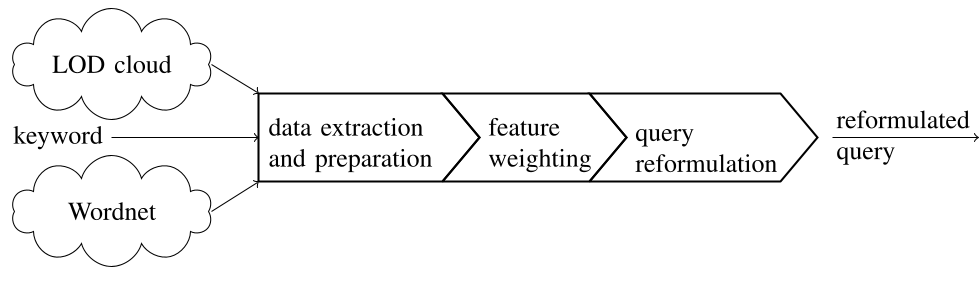 Figure 1: The proposed AQE Pipeline showing the flow from keyword input to pruned expansion set.
Experimental Insights
The study utilized the QALD (Question Answering over Linked Data) benchmark to test their hypothesis.
The Power of Semantic Relations
One of the most striking findings was the behavior of individual features. For instance, sameAs and seeAlso proved to be comparable—and sometimes superior—alternatives to traditional synonyms.
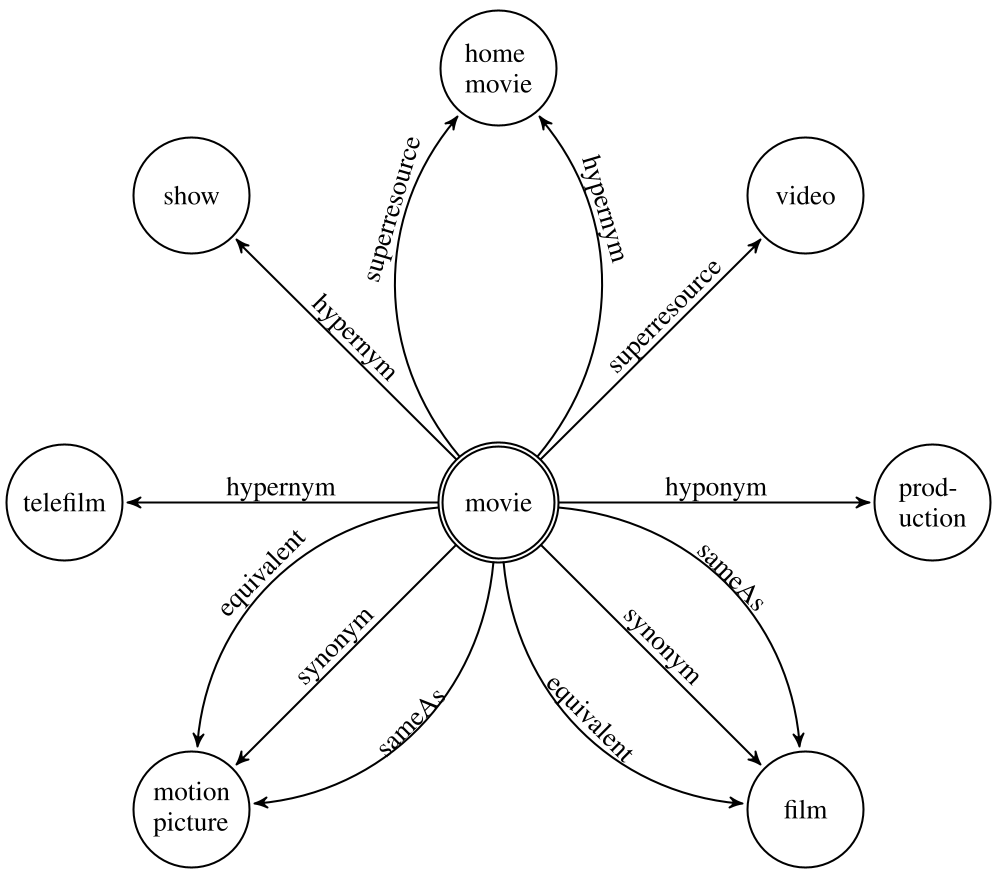 Figure 2: A visualization of how the term "movie" expands into "film" and "motion picture" using semantic bridges.
Competitive Performance
As shown in the table below, the "Semantic Only" configuration consistently matched or outperformed the "Linguistic Only" setup when optimized with the correct weighting schema.
| Features | Weighting | Precision | Recall | F-Score |
|---|---|---|---|---|
| Linguistic | SVM | 0.730 | 0.650 | 0.620 |
| Semantic | SVM | 0.680 | 0.630 | 0.600 |
| Semantic | Decision Tree/IG | 0.755 | 0.684 | 0.661 |
Critical Analysis & Takeaways
The brilliance of this work lies in its simplicity and portability. By using a linear classifier, the authors provide a lightweight solution that can be integrated into existing search pipelines without the overhead of deep neural networks (which, in 2013-2014, were less accessible).
Key Takeaways:
- LOD is a valid linguistic resource: Semantic Web relations can double as lexical expansion tools.
- Weighting is Mandatory: Simply adding all hypernyms/hyponyms leads to "query drift" and a drop in precision; learned thresholds are vital.
- Future Directions: While the paper focuses on English, the LOD-based approach is naturally suited for cross-lingual expansion because many URIs contain labels in multiple languages.
The authors conclude that while query expansion is often treated as a peripheral step, its intelligent design using semantic features is a foundational requirement for bridging the gap between human intent and structured data.