
Beyond Demographics: Fitting Network Distributions for Smarter Knowledge Acquisition
Knowledge acquisition from social platforms based on network distributions fitting
This paper introduces the Multistage Survey Control System (MSCS), an adaptive sampling approach for online social networks that targets the distribution of network measures rather than just demographic attributes. By utilizing the K-bins algorithm, the method achieves a representative sample that mirrors the full network's structural properties (e.g., degree centrality) using significantly fewer participants.
TL;DR
Researchers often assume that if an online survey has enough participants, it is representative. This paper proves that's a fallacy when it comes to social networks. By introducing the Multistage Survey Control System (MSCS) and the K-bins algorithm, the authors demonstrate how to build samples that accurately reflect the underlying "physics" of the network—its degree distributions and connection patterns—using up to 80% fewer respondents than traditional methods.
The "Loudest Voice" Problem in Social Research
In the digital age, social scientists and knowledge managers rely on surveys. However, online participation is rarely random. We face a chronic problem of Self-Selection Bias: the most active, highly connected, or motivated users are the most likely to respond.
In network terms, this means our samples are skewed toward the "hubs" while ignoring the "long tail" of the distribution. If you are trying to study how knowledge spreads or how to build effective collaborative learning teams, a sample that only represents the "super-users" will give you a distorted view of how information actually moves through the silent majority.
Methodology: The Geometry of Distribution Fitting
The authors shift the goal: instead of just balancing the sample for age or gender, they balance it for Network Measures (Indegree, Outdegree, Clustering Coefficient).
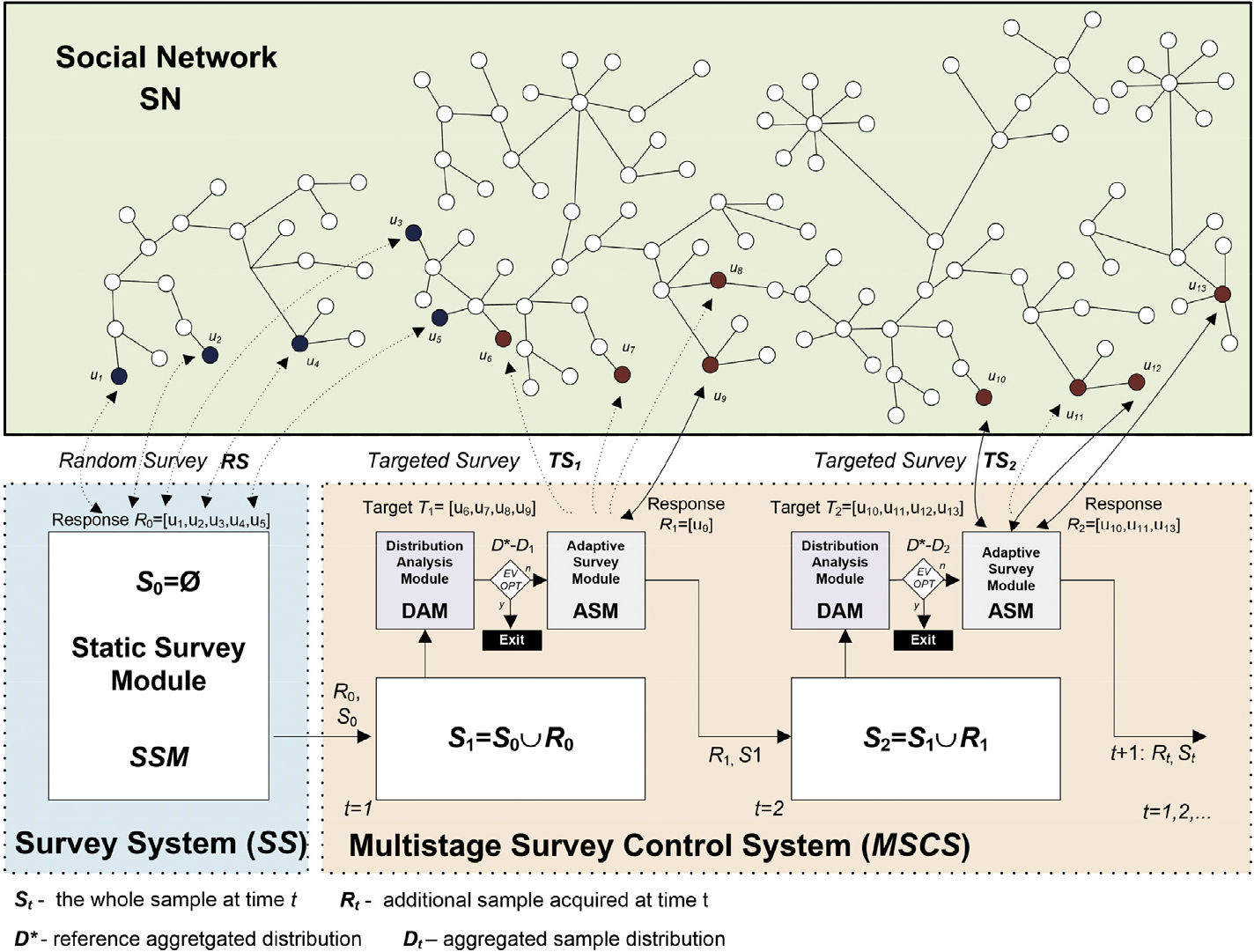
The MSCS Framework
The process is iterative and adaptive. At each stage (t), the system:
- Calculates the current distribution of network measures in the sample ().
- Compares it to the known full network distribution () using Kullback–Leibler (KL) Divergence.
- If the gap (Error ) is too high, it targets specific "bins" of users to close the gap.
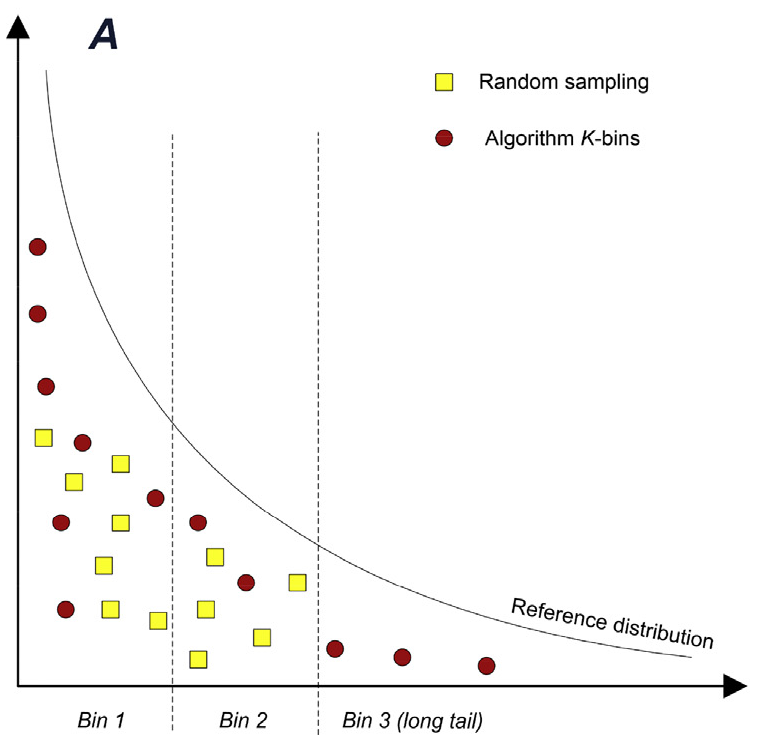
The K-bins Algorithm
To handle the Power-Law nature of social networks (where many users have few links and few users have many), the authors developed K-bins. It normalizes multiple network metrics into a single value, divides the range into segments (bins), and ensures that users from every segment—especially the rare ones—are requested to participate.
Experimental Proof: K-bins vs. Random Sampling
The authors tested their method on a virtual world network of nearly 10,000 users.
- The 5% Threshold: For small sample sizes (which are common in expensive or time-consuming surveys), K-bins significantly outperformed random sampling. While random sampling might take thousands of iterations to "stumble upon" a rare long-tail node, K-bins seeks them out immediately.
- Diminishing Returns: The research identified a clear "Power Law" decrease in error. After sampling about 20% of the network, the benefits of adding more users dropped significantly.
| Network Measure | Full Network | Surveyed (Standard) | Bias Observed |
|---|---|---|---|
| Avg. In-degree | 30.62 | 99.26 | +224% (HUB BIAS) |
| Avg. Out-degree | 30.62 | 89.02 | +190% (HUB BIAS) |
The table above reveals the danger: standard survey participants had over triple the average number of connections compared to the actual population. The proposed method corrects this distortion.
Critical Insight: Why This Matters for the Future
This work is a bridge between Social Science and Network Topology. It suggests that "representativeness" is not a qualitative feeling, but a measurable mathematical distance.
Applications in Collaborative Learning
In organizations, we often pick the same "high performers" for every training session. This paper suggests that might be a mistake. By sampling based on network metrics like betweenness or closeness, organizations can identify "knowledge brokers"—users who might not have the most connections but are crucial for bridging different departments.
Limitations & Future Work
The primary hurdle for this method is that it requires the researcher to have a bird's-eye view of the network (e.g., as a platform operator) to know the "target" distribution. Future research should look at how to estimate these distributions when the network structure is only partially known.
Conclusion
The MSCS approach represents a shift toward precision sampling. In a world of Big Data, we don't necessarily need more data; we need better-fitted data. By targeting the long tail, we can gain deep insights into human behavior and knowledge sharing with a fraction of the traditional effort.