
KCSA: Bridging Reinforcement Learning and Cuckoo Search for Complex Industrial Scheduling
6254_A Knowledge-Based Cuckoo Search Algorithm to Schedule a Flexible Job Shop With Sequencing Flexibility.
This paper introduces a Knowledge-based Cuckoo Search Algorithm (KCSA) to solve extended Flexible Job Shop Problems (FJSP) characterized by Directed Acyclic Graph (DAG) precedence and mating operations. By integrating SARSA-based Reinforcement Learning and hybrid heuristics, the authors achieve State-of-the-Art (SOTA) performance in minimizing makespan across complex manufacturing scenarios.
TL;DR
Scheduling modern manufacturing systems isn't just about ordering tasks; it's about managing complex dependencies like "mating operations" (tasks that must start simultaneously on the same machine) and sequence-dependent setup times. This paper introduces KCSA (Knowledge-based Cuckoo Search Algorithm), a framework that uses SARSA Reinforcement Learning to tune its own parameters on-the-fly, achieving a 70% boost in robustness and setting new benchmarks for Flexible Job Shop Problems (FJSP).
The "Blind Search" Problem in Industrial Meta-heuristics
While algorithms like Cuckoo Search (CS) are theoretically powerful due to their heavy-tailed Lévy flights, they suffer from two fatal flaws in practice:
- Parameter Sensitivity: Static parameters like step length () often fail as the population evolves.
- Stochastic Instability: Purely random mechanisms struggle with "mating constraints," where the feasible solution space is extremely sparse.
The authors' research intuition was simple: If a search algorithm can "remember" what worked and "sense" its current state, it can adjust its strategy like a closed-loop control system.
Methodology: The Three Pillars of the Knowledge Base
The core of KCSA is its Knowledge Base, which replaces the "blindness" of traditional CS with three specialized matrices:
1. The Parameter Controller (Matrix Q)
Using the SARSA reinforcement learning algorithm, KCSA monitors the population's Evolution Rate, Diversity, and Intensification. It maps these states to the optimal step size () and discovery rate ().
- Physical Intuition: When the population is too clustered (low diversity), RL increases to push individuals further out. When near a global optimum, it shrinks for fine-tuning.
2. The Heuristic Guides (Matrices P & G)
Instead of random mutations, KCSA uses probability matrices derived from the HEFT (Heterogeneous Earliest Finish Time) heuristic.
- Matrix P: Stores probabilities for operation sequences.
- Matrix G: Guides machine allocation based on current workload balances.
3. Closing the Loop
The knowledge base is updated online. As the search progresses, successful solutions feed back into the matrices, refining the "knowledge" for subsequent iterations.
 Figure 1: The KCSA Architecture, showing the integration of the online Knowledge Base with the standard CS loop.
Experimental Results: Robustness is King
The authors tested KCSA against Genetic Algorithms (GA), Particle Swarm Optimization (PSO), and standard CS.
- Performance: KCSA outperformed peers in 25 out of 30 major benchmark scenarios.
- Robustness: The Standard Deviation (SD) of KCSA's results was significantly lower than its competitors. This is crucial for practitioners—industry needs a reliable schedule, not just a one-time lucky guess.
- Complexity: Despite the overhead of RL, the time complexity remains , making it feasible for real-time applications.
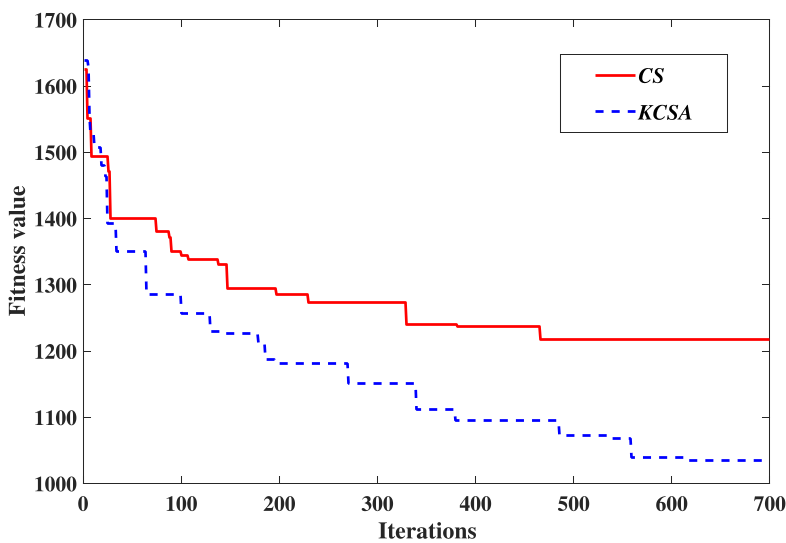 Figure 2: Convergence curves showing KCSA (red) maintaining exploration capabilities long after standard CS (blue) has plateaued.
Critical Insight & Future Outlook
The true value of this work lies in the self-adaptive parameter control scheme. By treating the "state of the search" as an RL environment, the authors have mitigated the "No Free Lunch" theorem's impact—the algorithm learns the specific landscape of the problem it is currently solving.
Limitations: The offline training phase for Matrix Q can be computationally intensive, and while the algorithm manages mating operations well, its performance in extremely high-dimensional machine environments (500+ machines) remains to be explored.
Conclusion: KCSA moves us closer to "Autonomous Scheduling" systems that can handle the nuanced, DAG-based constraints of semiconductor and high-precision manufacturing without needing a PhD to tune the optimizer.