
Knowledge-Based Policy Analysis: The Shield for Dynamic Mobile Social Networks
Knowledge-Based Policy Conflict Analysis in Mobile Social Networks
This paper proposes a knowledge-based policy analysis framework for Mobile Social Networks (MSNs) that combines temporal logic with a "knowledge extension" to detect and resolve dynamic policy conflicts. By modeling explicit and implicit attributes, the system achieves a 94.5% detection accuracy, significantly outperforming traditional logic-based methods.
TL;DR
Mobile Social Networks (MSNs) are inherently dynamic—users move, relationships shift, and contexts change. This paper introduces a framework that fuses Temporal Logic with a Knowledge Extension to predict and prevent privacy conflicts. By tracing how physical changes (like moving out of a city) affect logical permissions (like viewing a photo), the proposed system achieves near-perfect conflict detection accuracy (94.5%).
Background: The Hidden Danger of "Moving"
In the world of Facebook or LinkedIn, permissions are often tied to groups. But in Mobile Social Networks, group membership is often "context-aware." Imagine Sam creates a "NYC Group" based on location. If his friend Bill moves from New York to New Haven, he might be removed from the "NYC Group" but remain in a "Private Group" that has different permissions.
The problem? Most systems can't see the link between Bill's GPS coordinate and the conflicting permissions across these two groups. This is where Knowledge-Based Policy Conflict Analysis steps in.
Pain Points & Motivation
Traditional Policy-Based Management (PBM) uses First-Order Logic or basic Temporal Logic. While effective for static systems, they suffer from two major flaws in mobile environments:
- Context Blindness: They see the "What" (the rule) but ignore the "Why" (the underlying attributes like location).
- Ambiguity: Without a knowledge base, logic engines often report "False Alerts"—tagging two policies as conflicting just because they share a subject, even if their contexts are unrelated.
Methodology: Bridging Logic and Knowledge
The authors' core "Insight" is the distinction between Explicit and Implicit attributes within a Knowledge Extension.
1. The General Policy Model
Every policy is decomposed into a segment: {Subject, Object, Action, Context}.
- Explicit Attributes: Direct data points (e.g., GPS Location: NYC).
- Implicit Attributes: States derived from a relationship (e.g., Membership: NYC_Group).
2. Knowledge Extension Architecture
Instead of hardcoding rules, the authors use a Knowledge Extension to act as a "Map." When an explicit attribute changes, the map shows which implicit attributes must follow.
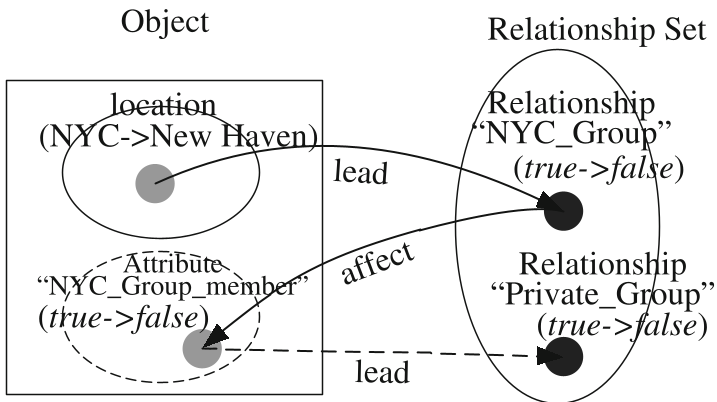 Caption: The flow from Explicit Attributes (Location) through Relationships to Implicit Attributes (Membership).
3. Conflict Categories
The framework identifies three primary conflict types using Temporal Logic:
- Conflict of Duty: The same subject cannot perform two specific actions simultaneously.
- Conflict of Interest: One action affects a subject's eligibility for another.
- Incongruent Outcomes: Different subjects acting on one object with clashing results.
Experiments & Results
The researchers tested their framework against a "Temporal Logic Only" baseline using policy sets from real-world MSN applications.
Accuracy Boost
The inclusion of the Knowledge Base improved detection accuracy by 30-40%.
- Standard Temporal Logic: 54.5% detection rate with a high false-positive rate.
- Knowledge-Based Framework: 94.5% detection rate with zero false alerts.
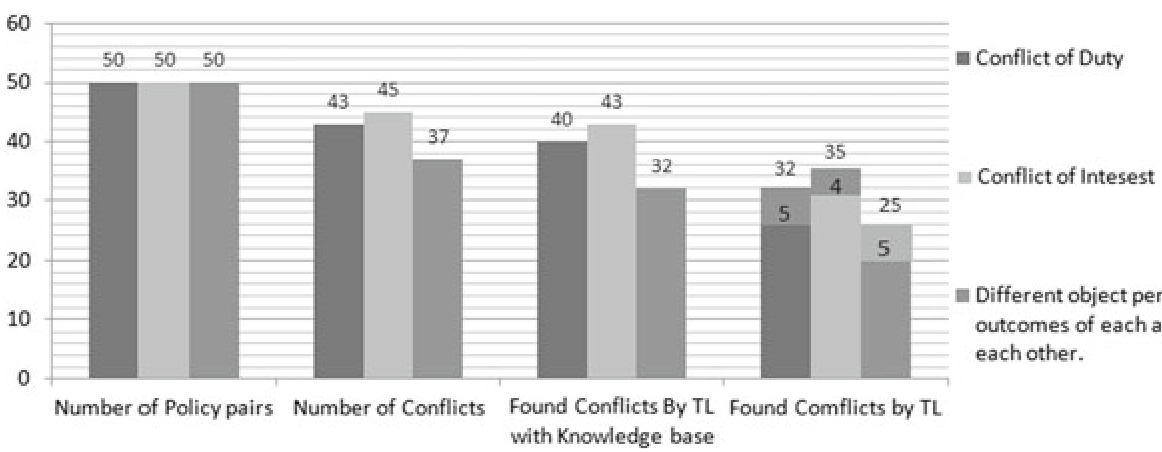 Caption: Accuracy of conflict detection across different types (Duty, Interest, and Difference).
Critical Insight & Future Work
The beauty of this framework lies in its Separation of Concerns. By keeping the Knowledge Extension separate from the Logic Engine, the system becomes highly adaptable. If a new social platform is integrated, users only need to update the "knowledge" (ontology), not rewrite the underlying logic rules.
Limitations: The system still struggles slightly with "Type 3" conflicts (Different subjects/one object), as the direct clash of outcomes is often hidden behind complex application logic.
The Takeaway for Developers: As we move toward the "Internet of Things" and "Edge Computing," security cannot be a static list of "Allow/Deny." It must be a dynamic, knowledge-aware graph that understands how the physical world dictates digital rights.