
Decoding Lifestyles: An OWA-Based Approach to Clustering Social Media Users
KNOWLEDGE‐BASED SYSTEMS
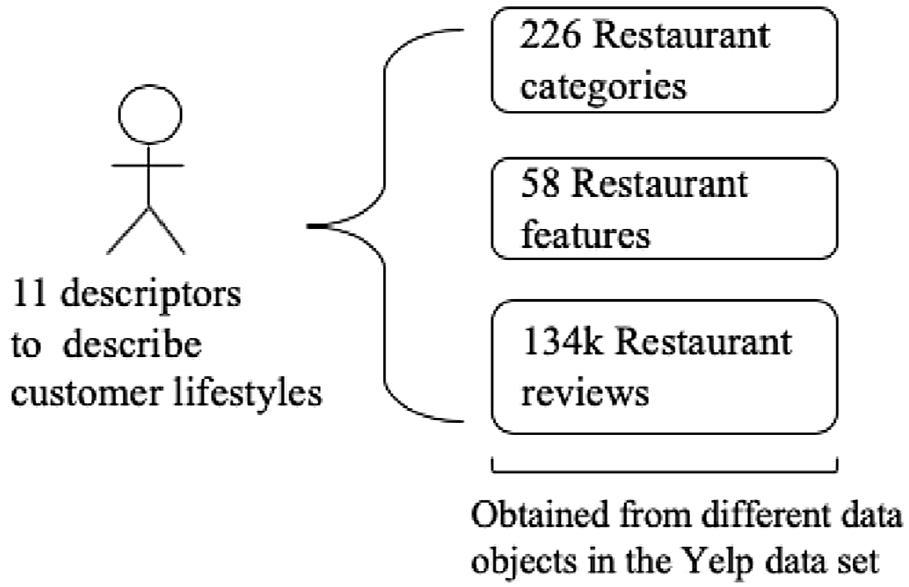
The paper introduces a novel unsupervised hierarchical clustering framework that integrates Ordered Weighted Averaging (OWA) operators to profile user lifestyles. Applied to massive datasets from Yelp (134,102 reviews) and Airbnb (1,826 reviews), the method successfully identifies distinct lifestyle segments by aggregating categorical restaurant/listing attributes with decision drivers extracted via Natural Language Processing (NLP).
TL;DR
Understanding why a person chooses a specific restaurant or Airbnb isn't just about ratings—it's about their "lifestyle." This paper presents a sophisticated hierarchical clustering method that uses Ordered Weighted Averaging (OWA) and NLP to group users based on both the features of the places they visit and the priorities they express in their written reviews. The result is a highly interpretable map of consumer segments that avoids the information loss typical of traditional data conversion.
Context: Why Traditional Discovery Fails
Most recommender systems (RS) treat users as vectors of ratings or demographic tags. However, "lifestyle" is nuanced. A user might prefer a restaurant because it's "kid-friendly" and "close to home," while another chooses it for "ambience" and "craft cocktails."
The technical challenge is twofold:
- Data Nature: Most social data is categorical (e.g., cuisine type: "Korean" vs. "Italian"). Converting these to numbers often distorts their meaning.
- Implicit Drivers: Purely looking at where people go ignores the why. The "why" is buried in text reviews.
Methodology: The Fusion of OWA and Overlapping Indices
The authors' core innovation lies in how they measure similarity between two users (or two groups of users).
1. Vectorizing the Lifestyle
Each user is defined by a profile consisting of:
- Item Descriptors: Physical attributes of locations visited (Parking, Price, Dietary options).
- Decision Drivers: Extracted via NLP (UDPipe) from reviews, focusing on nouns related to Food, Price, Location, Ambience, and Service.
2. The Overlapping Index
Instead of calculating distance, the authors use an Overlapping Index to see how much the frequency distribution of one cluster's attributes overlaps with another. This treats the frequency of a user's choices as a probability distribution, preserving the intensity of their preferences.

3. OWA Aggregation
This is the "secret sauce." Since some descriptors are more important than others, the Ordered Weighted Averaging (OWA) operator allows the system to aggregate multiple similarity scores into one Global Similarity Degree (GSD). This uses "linguistic quantifiers" (like "most of") to decide how many criteria must match for two users to be considered "similar."
Experimental Results: Real-World Lifestyles
The model was tested on two massive datasets:
- Yelp: 499 prolific reviewers, 134,102 reviews.
- Airbnb: 373 reviewers, 1,826 reviews.
Interpretable Segments
The clustering didn't just produce random groups; it produced actionable marketing personas:
- The Nightlife Enthusiast: Highly focuses on "Ambience," "Full Bar," and "Validated Parking."
- The Value Seeker: Prioritizes "Price" and "Location" in reviews.
- The Professional Traveler (Airbnb): Looked for "Minimum stays of 1 month," "Flexible cancellation," and "Work-friendly amenities."
Technical Deep Dive: Speed and Efficiency
Despite the complexity of Hierarchical Agglomerative Clustering (HAC), the implementation in R ran within minutes on a standard laptop. This efficiency is achieved because the Overlapping Index simplifies the comparison of high-dimensional categorical data without requiring the creation of massive sparse binary (one-hot) matrices.
Critical Insight & Future Outlook
This work represents a shift from "Collaborative Filtering" (people who liked X also liked Y) to "Behavioral Alignment" (people who live life like X will enjoy Y).
Limitations: The current model is a "hard" clustering approach—a user belongs to one lifestyle only. The authors suggest moving toward Fuzzy Clustering in the future, acknowledging that humans are multi-faceted (e.g., a "Foodie" on Friday might be a "Budget Traveler" on Monday).
Closing Takeaway: For platforms like Yelp or Airbnb, this method provides a bridge between raw data and human-centric understanding, enabling "Question Routing" where a query about a quiet dinner is answered by someone whose lifestyle actually prioritizes "quiet" and "ambience."