
CIMMIC: Breaking Community Barriers and Harnessing the "Silent Influence" in Social Networks
KNOWLEDGE‐BASED SYSTEMS
This paper introduces CIMMIC, a novel framework for Competitive Influence Maximization (CIM). It leverages a community-aware seed selection algorithm (SNSAwithCB) and a unique propagation model (CIPMCIN) that accounts for the subtle influence of inactive nodes to achieve state-of-the-art results in defeating competitors with minimal seed sets.
TL;DR
In the high-stakes world of E-commerce and social media marketing, competition is the norm. Traditional Influence Maximization (IM) models often fail because they ignore the barriers between tightly-knit communities and the hidden power of "inactive" users. This paper presents CIMMIC, a method that identifies community-bridging nodes and accounts for the subtle influence of inactive users, allowing a competitor to overtake an opponent with fewer resources (seed nodes).
The Problem: Siloed Communities and the "Invisible" User
Most existing research in Competitive Influence Maximization (CIM) treats social networks as a monolith or fails to address the "sticky" nature of communities (Homophily).
- Community Homophily: Information flows fast within a clique but rarely jumps to another. Selecting the most influential person within a group often results in a "local" peak that never goes global.
- The Inactive Node Oversight: Standard models like Linear Threshold (LT) or Independent Cascade (IC) assume that if a user hasn't "bought in" (active state), they have zero influence. In reality, thousands of "hesitant" users sharing subtle positive sentiments can eventually tip the scales for their peers.
Methodology: The CIMMIC Framework
The authors tackle these issues through two main innovations: a new propagation model and a boundary-aware selection algorithm.
1. CIPMCIN: The Propagation Model of Inactive Nodes
Unlike the previous DCM model, CIPMCIN (Competitive Information Propagation Model considering Inactive Nodes) calculates influence by summing both active neighbor probabilities and a "subtle" influence from inactive ones.
Mathematically, the influence of inactive nodes is modeled as:
ini(v) = Σ (p_u,v * Σ p_w,u)
Where the influence accumulates from neighbors-of-neighbors, even if the intermediate node u isn't fully activated yet.
2. CBI and SNSAwithCB: Crossing the Border
To solve the homophily problem, the authors define Community Boundary Influence (CBI). This metric prioritizes nodes that have high "connectivity" to external communities, acting as bridges.
The Selecton Algorithm (SNSAwithCB) operates in two phases:
- Heuristic Phase: Rapidly selects a percentage of seeds based on raw CBI values to establish a footprint.
- Greedy Phase: Refines the selection by calculating marginal gains, ensuring the final set (SN2) effectively covers more ground than the competitor (SN1).
 (Note: Architecture illustrates the flow from community detection to final seed selection)
Experimental Evidence
The authors validated their model across several SNAP datasets (Facebook, Twitter, Wiki-vote).
- Model Accuracy: By accounting for inactive nodes, the CIPMCIN model predicted a significantly wider spread of influence compared to the DCM model. On the Twitter dataset, the influence range was nearly 2.7x larger.
- Efficiency: The two-phase algorithm proved that the heuristic stage saves massive computational time without sacrificing the quality of the final seed set. As shown in the comparison with the CI2 algorithm, CIMMIC achieved higher Average Influence (AI) in its greedy stage.
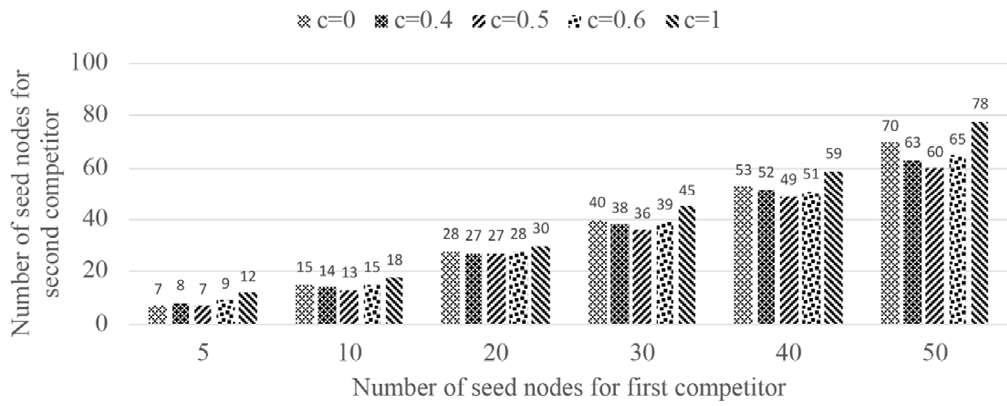 Graph: Impact of varying the heuristic parameter 'c'. A value of c=0.5 was found to be the sweet spot for balance between speed and coverage.
Critical Insights & Future Outlook
The core takeaway for academic and industry professionals is that Influence is not binary. The binary "Active/Inactive" classification used in older models is a simplification that loses critical data. By modeling the "thinking" state and the cumulative effect of inactive users, researchers can build more resilient marketing bots and recommendation engines.
Limitations: The current model does not yet handle overlapping communities (where one user belongs to multiple groups simultaneously). Future work will likely integrate "k-bridge" extraction methods to refine the CBI metric further.
Conclusion
CIMMIC proves that to win in a competitive environment, you don't just need the loudest voices; you need the bridges between worlds and the accumulated whispers of the silent majority.