
TaTaRec: Capturing the Evolving Interests of the Crowd via Time-Aware Recommendation
KNOWLEDGE‐BASED SYSTEMS
This paper introduces TaTaRec (Time-Aware TAsk RECommendation), a novel framework for crowdsourcing systems. It employs a unified Probabilistic Matrix Factorization (PMF) approach integrated with an exponential aging scheme to prioritize fresh worker preferences and an active learning strategy (ActivePMF) to optimize task assignments.
TL;DR
In the world of crowdsourcing, a worker's interest today isn't necessarily their interest tomorrow. Most systems, however, treat years-old data with the same weight as yesterday's click. TaTaRec changes this by introducing a time-decay mechanism into Probabilistic Matrix Factorization (PMF), coupled with an ultra-efficient online-updating engine that speeds up model refreshes by over 200x.
Background & Motivation: The Static Preference Trap
Crowdsourcing platforms like Amazon Mechanical Turk (MTurk) often struggle with "massive redundancy"—asking ten people the same question to ensure quality is expensive. Task recommendation is the surgical solution: send the right task to the right worker.
The authors identify a critical gap in existing SOTA (State-of-the-Art) methods: Temporal Neglect. Workers evolve; they gain new skills or get bored with repetitive translation tasks. Previous models were "time-free," leading to stale recommendations that reduced worker engagement and output quality.
Methodology: Fusing Context and Time
1. Unified Feature Representation
TaTaRec doesn't just look at who did what. It performs a triple-threat factorization, linking three distinct matrices:
- Worker-Task Preference: Direct interaction.
- Worker-Category Preference: General interests (e.g., "This worker likes Image Tagging").
- Task-Category Grouping: Task metadata.
By sharing latent feature spaces among these three, the model can infer preferences even when data is sparse (the "Cold Start" problem).
2. The Aging Scheme (The "Time" in TaTaRec)
The core innovation is the weighting function: . As the age of a preference increases, its influence on the optimization objective decreases exponentially. This ensures that the model pivots quickly when a worker starts exploring new task categories.
3. ActivePMF & Online Updating
To keep the model lean, the authors realized that retraining the entire matrix for every single submission is overkill. They implemented:
- Partial Updates: Only update the specific feature vectors of the active worker/task if their interaction history is large enough.
- Batch Updates: Accumulate updates and process them in blocks (e.g., every 500 tasks) to leverage computational efficiency.
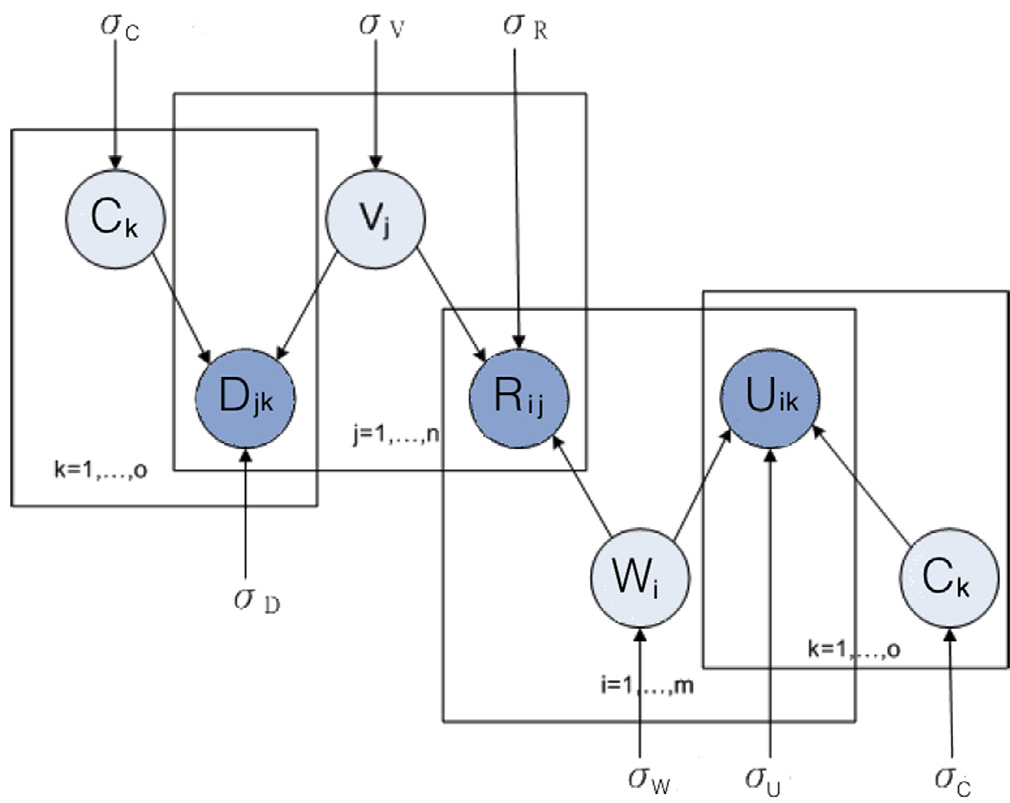 Figure 1: The graphical model showing the fusion of worker, task, and category latent spaces.
Experimental Insights
The authors validated TaTaRec on real-world MTurk data and synthetic sets. Two major findings stand out:
- Accuracy Gains: When the latent dimension is sufficiently high (k=20), TaTaRec crushes standard PMF. The integration of category information and temporal decay allows for much finer-grained predictions.
- The Efficiency Frontier: The "Full-Retrain" approach took 4.2 minutes per update—unusable for a live system. By setting a batch size of 500, they slashed this to 0.018 minutes while keeping the RMSE (Root Mean Squared Error) competitively low.
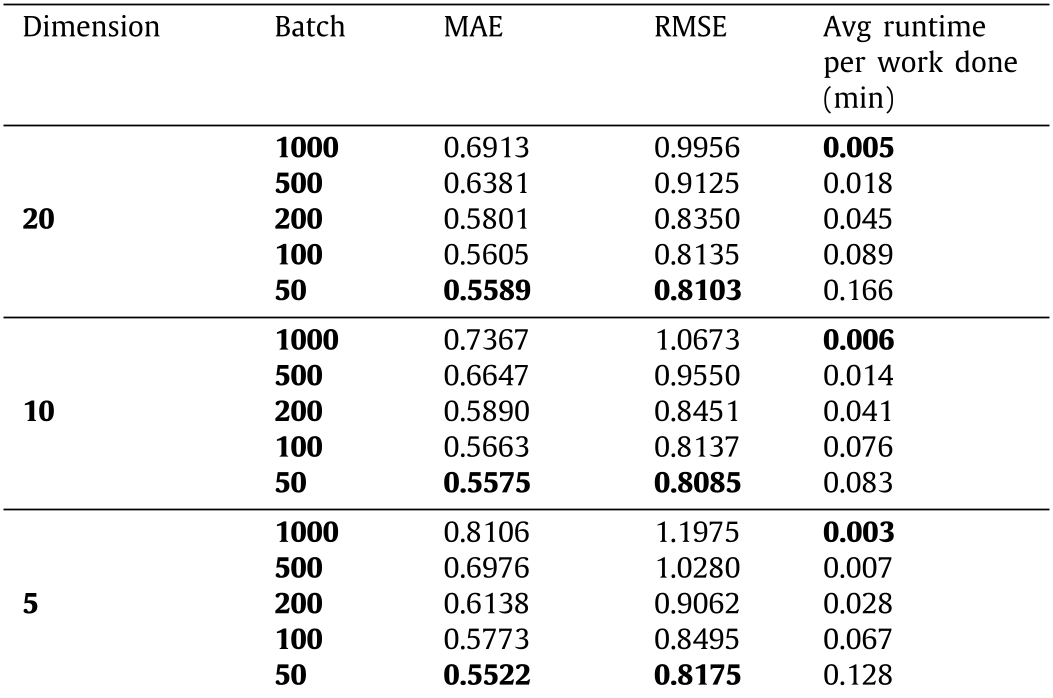 Table 1: Trade-off between Dimension, Batch size, and Runtime.
Critical Analysis & Takeaways
Why it works: TaTaRec succeeds because it acknowledges that human behavior is a moving target. The "Active" part of ActivePMF ensures the system doesn't just wait for data but actively seeks out the most informative worker-task pairs to reduce uncertainty.
Limitations:
- Hyperparameter Sensitivity: The decay rate () and the category weighting () require careful tuning.
- Short-term Data: As the authors noted, in datasets spanning only one month (like the NAACL workshop data), the aging scheme's impact is muted compared to multi-year datasets.
Future Outlook: The next logical step is incorporating Social Context. If my professional peers (in the same worker "community") are moving toward a specific task type, TaTaRec could potentially predict my own preference shift before I even perform my first task in that category.
Conclusion
TaTaRec proves that time is not just a timestamp—it's a dimension of intent. For system architects, the takeaway is clear: stop treating your interaction logs as a static pile of data, and start treating them as a decaying stream of intelligence.