
HDCM: Rescuing Sentiment Analysis from the Chaos of Noisy Social Media Labels
KNOWLEDGE‐BASED SYSTEMS
The paper introduces the Hidden De-noising Classification Model (HDCM), a unified probabilistic framework designed to perform sentiment and emotion classification using corpora containing noisy labels. Evaluated on STS and ISEAR datasets, HDCM achieves superior stability and accuracy compared to SOTA baselines like CharSCNN, especially as the noise ratio increases.
TL;DR
Researchers from Sun Yat-sen University have developed the Hidden De-noising Classification Model (HDCM), a probabilistic framework that learns to ignore "bad" labels in training data. By modeling the inherent difficulty of a text and the reliability of the person labeling it, HDCM provides a robust solution for sentiment and emotion detection that actually performs better and more stably as the data gets messier—all without needing manual cleaning or external lexicons.
The "Dirty Data" Dilemma
In the world of NLP, we are often told that "data is the new oil." However, social media data is more like crude oil mixed with sand. Most sentiment datasets are built using distant supervision—assuming a tweet with a : ) is positive. But users are sarcastic, use hashtags ironically, or are simply "spammers" spreading misinformation.
Existing SOTA models like CharSCNN (Convolutional Neural Networks) are powerful but "brittle." They tend to overfit to the noise, leading to erratic performance when the ground truth is compromised. Previous fixes required hiring humans to re-verify labels (expensive) or building complex sentiment dictionaries (inflexible).
Methodology: Modeling the "Hidden" Reality
The genius of HDCM lies in its refusal to take labels at face value. It treats the "true label" () as a hidden variable and attempts to recover it by analyzing two latent factors:
- Document Simplicity (): Is this text inherently easy to classify, or is it a "fraudulent" message designed to mislead?
- User Authority (): Is the annotator an expert, an amateur guessing randomly, or a malicious spammer intentionally flipping labels?
The Probabilistic Engine
The model uses a logistic function to bridge these factors:
Using an Expectation-Maximization (EM) algorithm, the model iteratively guesses the true label (E-step) and then updates its estimation of user authority and document difficulty (M-step). This creates a self-correcting loop that effectively "filters" the noise during the training process itself.

Experimental Showdown: Stability is King
The authors tested HDCM against strong baselines including CNNs and various SVMs. They didn't just test on clean data; they intentionally injected noise at small, moderate, and large scales.
Key Result: The "Robustness Gap"
As shown in the performance tables, while deep learning models like CharSCNN perform well on low-noise data, their performance fluctuates wildly as noise increases (High Standard Deviation). HDCM, conversely, maintains a tight, high-accuracy performance across all noise levels.
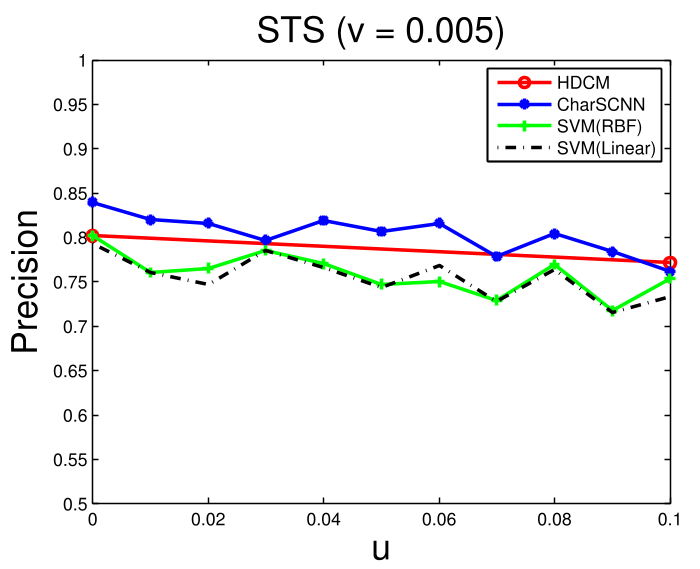 Fig: Note how HDCM (blue line) remains stable while baselines degrade as the noise parameter increases.
In the ISEAR (Emotion) dataset, which is a complex 7-class task (Joy, Fear, Anger, etc.), HDCM proved its scalability. Handling multi-class noise is significantly harder than binary sentiment, yet HDCM’s standard deviation was nearly 10x lower than its competitors.
Critical Insight: Why This Matters
The HDCM approach marks a shift from "Data Cleaning" to "Model Resilience." Instead of trying to fix the dataset before training, the authors acknowledge that in the age of Big Data, noise is a feature, not a bug.
Limitations & Future Work
While HDCM is computationally efficient (processing 113k instances in ~20 seconds), it currently treats labels as discrete categories. The authors suggest that moving toward continuous labels and incorporating word valence priors (the idea that positive words generally carry less "information" than negative ones) could further enhance the model's precision.
Conclusion
HDCM provides a mathematically elegant and practically fast way to handle the messy reality of social media. For practitioners working with crowdsourced or "weakly labeled" data, this framework offers a blueprint for building classifiers that can find the signal within the noise without the need for expensive manual intervention.