
DBP-Algorithm: Minimizing Multi-Rumor Influence During Breaking News Events
KNOWLEDGE‐BASED SYSTEMS
The paper introduces a novel framework for Multi-Rumor Influence Minimization (MRIM) specifically designed for breaking news events on Online Social Networks (OSNs). It proposes the HISBMmodel, a multi-rumor propagation model incorporating human behaviors and Markov chain-based opinion dynamics, paired with a Dynamic Blocking Period (DBP) algorithm that achieves up to 93.38% reduction in rumor impact.
TL;DR
Social media rumors during breaking news spread in clusters, not in isolation. This paper introduces a Dynamic Blocking Period (DBP) approach that treats multi-rumor mitigation as a network inference problem. By leveraging Survival Theory and Markov Chains to predict not just who will see a rumor, but who will believe it, the authors achieve a staggering 93.38% reduction in rumor influence while protecting the overall user experience of the network.
Problem & Motivation: The Breaking News Chaos
During events like the 2015 Paris attacks or modern election cycles, rumors don't arrive one by one; they arrive in waves. Existing "Rumor Influence Minimization" (RIM) strategies suffer from three fatal flaws:
- Single-Rumor Focus: They treat each rumor as an independent process, leading to inefficient resource allocation.
- User Dissatisfaction: Blocking "influential" nodes for an unlimited time (as in traditional node-blocking) destroys user retention.
- Ignoring Opinion: Traditional models (IC/LT) only track infection (seeing the rumor), not influence (supporting the rumor).
The authors' insight is simple: To stop a rumor, you must target the Believers, not just the Transmitters, and you must do so with surgical, time-limited interventions.
Methodology: Human Behavior meets Mathematical Rigor
1. The HISBMmodel and Markovian Opinion
The paper extends the HISBmodel to a multi-rumor context. It introduces a Markov Chain to represent user states: Supporting, Denying, Questioning, or Neutral.
- Decision Factor (): Calculated based on the ratio of positive/negative rumors received and the user's Subjective Judgment ().
- Physical Intuition: If a user has high background knowledge (), they acts as a "stifler" rather than a "spreader." High values of converge the Markov process toward "Denying," effectively killing the rumor's momentum.
2. The Dynamic Blocking Period (DBP)
Instead of blocking a node for a fixed steps, DBP calculates the "High Activity" window for each rumor.
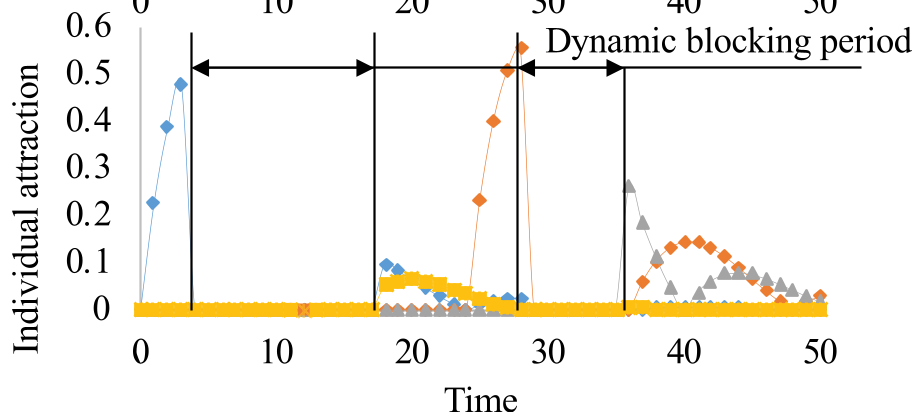 Figure 1: Comparison between static blocking and the proposed DBP. DBP allows for multiple short-lived blocks that cover the peak activity of several concurrent rumors.
3. Survival Theory Formulation
The problem is framed as minimizing the Likelihood Function ()—the probability that a node gets infected and supports the rumors. The objective function is proven to be submodular and monotone, allowing a greedy algorithm to guarantee a approximation of the optimal solution.
Experimental Evidence: SOTA Performance
The DBP-algorithm was tested on real-world OSN snapshots (Twitter, Facebook, Slashdot).
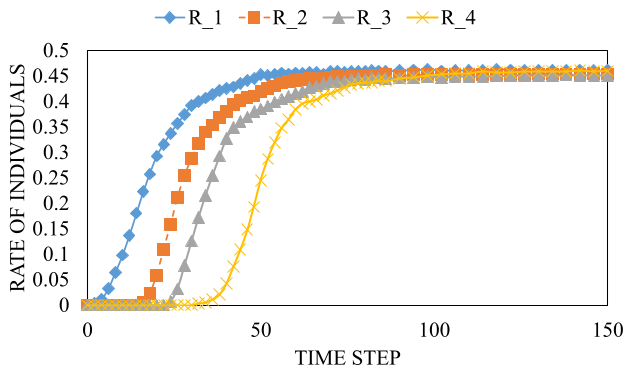 Figure 2: Performance metrics across different detection times and budgets (K).
Key Results:
- Versus Baselines: When compared to "Blocking Nodes" (BN) or "Truth Campaigns" (TCS), DBP consistently showed a higher reduction in "Believers."
- Resource Efficiency: Even when the "budget" of nodes to block () is small (e.g., 2.5%), DBP identifies the most critical nodes across all rumors simultaneously.
- Scalability: The complexity remains manageable for community-scale detection, though the authors suggest local community targeting for massive-scale networks.
Critical Analysis & Conclusion
This work represents a significant shift from "Network Science" (topology-only) to "Social Computing" (topology + human behavior).
Takeaways:
- Precision Matters: Blocking the most connected node is less effective than blocking the node most likely to validate the rumor.
- Temporal Intelligence: Dynamic blocking periods are the "vaccines" of social media—they are most effective when they coincide with the viral peak.
Limitations: The model assumes that "Subjective Judgment" () and "Background Knowledge" () can be accurately estimated, which remains a massive challenge in NLP-based rumor detection. Future research should integrate these behavioral parameters with real-time sentiment analysis for a truly automated defense system.
Conclusion: By aligning the blocking time with the rumor attraction time, the DBP approach proves that we don't need to censor the internet to stop rumors; we just need better timing.