
DABot: Redefining Social Bot Detection on Sina Weibo via Active Learning and RGA Networks
KNOWLEDGE‐BASED SYSTEMS
The paper introduces DABot, a novel end-to-end framework for social bot detection on Sina Weibo. It combines a multi-dimensional feature extraction process (30 features), an Active Learning module to expand labeled datasets, and a specialized deep neural network named RGA (ResNet-BiGRU-Attention), achieving a state-of-the-art accuracy of 0.9887.
TL;DR
Researchers from Sichuan University have developed DABot, a comprehensive framework specifically designed for the Sina Weibo ecosystem. By integrating Active Learning to create a massive 300,000-sample dataset and pioneering a hybrid ResNet-BiGRU-Attention (RGA) architecture, they have pushed the detection accuracy to a staggering 98.87%, outperforming standard CNN and LSTM baselines.
Contextual Positioning
Within the landscape of Online Social Networks (OSNs), bot detection has long been a cat-and-mouse game. While Twitter has been extensively studied, Chinese platforms like Sina Weibo present unique challenges in language processing and user behavior. DABot is not just a model; it is a full-stack pipeline that addresses the data scarcity and feature incompleteness that have plagued previous Chinese OSN research.
The "Data Hunger" Problem & The Active Learning Cure
Deep learning thrives on data, yet labeling social bots is notoriously expensive and requires expert intuition. The authors solved this by:
- Initial Seeding: Manually labeling a small 20K dataset (SWLD-20K).
- Uncertainty Sampling: Using an entropy-based query strategy to identify the most "confusing" unlabeled samples.
- Iterative Expansion: Human supervisors labeled only the most valuable samples, allowing a Decision Tree classifier to eventually label the remaining 300K samples with a 99.1% verification pass rate.
Methodology: The RGA Architecture
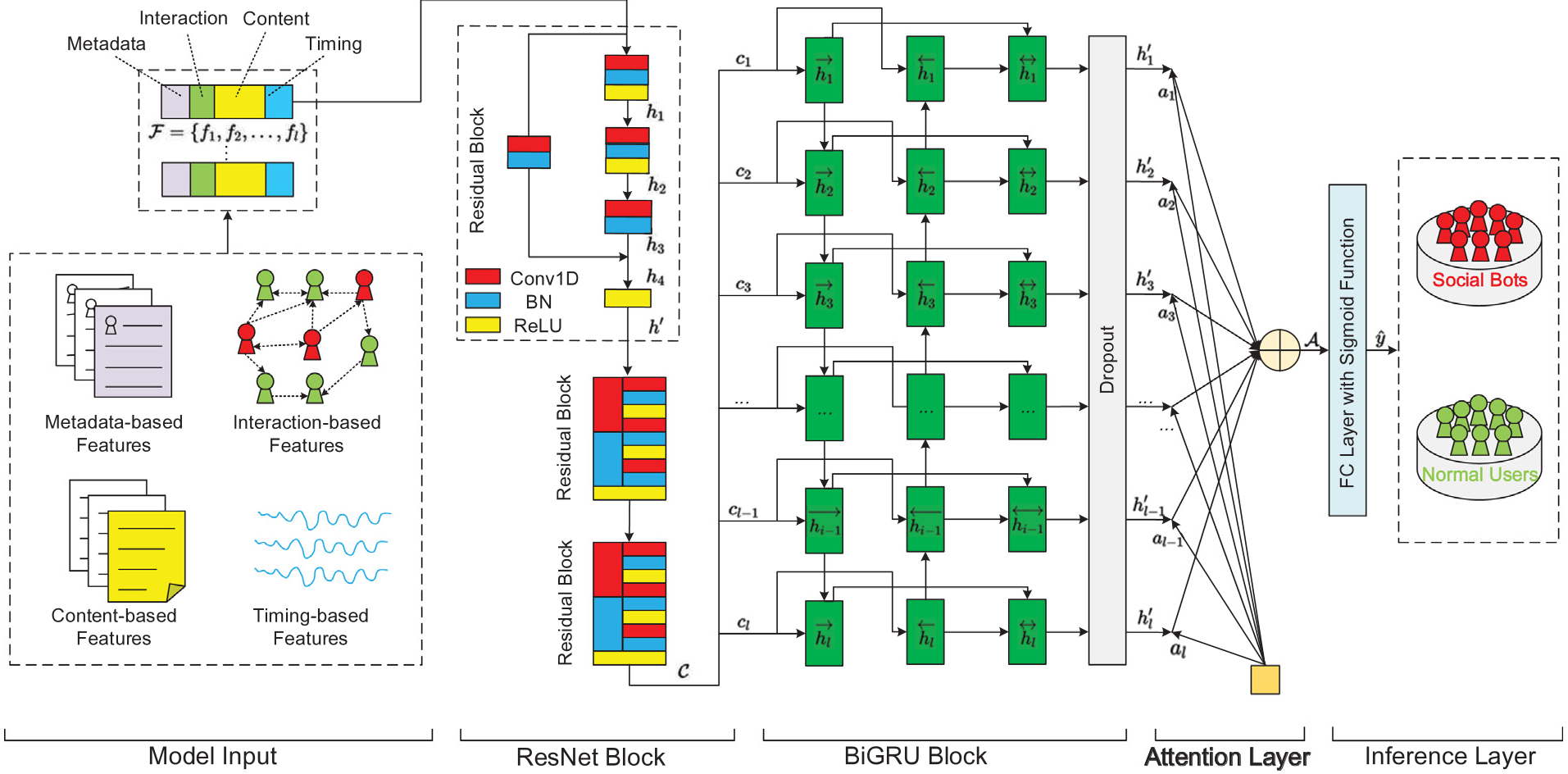
The core of the detection module is the RGA model, which treats user feature vectors as pseudo-time-series data.
1. Feature Engineering (30 Dimensions)
The model looks at four categories:
- Metadata (e.g., "Comprehensive Level" - a new feature based on verification and normalized levels).
- Interaction (e.g., "Diversity of Sources" - using the Margalef index).
- Content (e.g., Punctuation and interjection frequency).
- Timing (e.g., Burstiness and Shannon entropy of posting intervals).
2. The Hybrid Neural Network
Instead of relying on a single architecture, RGA stacks three powerful paradigms:
- ResNet Block: Uses residual connections to extract deep spatial patterns from the features without suffering from vanishing gradients.
- BiGRU Block: Captures temporal dependencies in both forward and backward directions, essential for identifying "bursty" or rhythmic bot behaviors.
- Attention Layer: Assigns weights to specific features, ensuring the model focuses on the most suspicious signals (like high URL ratios or low interaction rates).
Experimental Validation
The authors conducted rigorous ablation studies to see what really drives performance.
Feature Impact
Ablation tests revealed that Content-based features are the heavy hitters. When content features were removed, model performance dropped most significantly, proving that "what" a bot says is often more revealing than "when" they say it.
Model Superiority
The RGA model was tested against eight baselines. It consistently achieved the highest Precision (0.9933) and F1-score (0.9886).
| Approach | Accuracy | F1-score |
|---|---|---|
| Random Forest (RF) | 0.9820 | 0.9820 |
| LSTM | 0.9862 | 0.9861 |
| CNN | 0.9869 | 0.9869 |
| RGA (Ours) | 0.9887 | 0.9886 |

Depth Insights & Conclusion
The true value of this paper lies in its holistic approach. By combining 9 completely new features with a "human-in-the-loop" active learning strategy, the researchers demonstrated that we don't need millions of manually labeled points to build a high-fidelity detector.
Future Outlook: As bots evolve into "Cyborgs" (human-assisted bots), the authors suggest that social bot cluster detection—looking at how bots interact with each other in groups—will be the next frontier in maintaining the integrity of online social networks.
Limitations
- Evolutionary Lag: The model is trained on a specific "snapshot" of bot behavior (2019-2020). As bot developers adopt LLMs (like GPT-4), the content-based features may need significant updates.
- Compute Overhead: While RGA is accurate, the combination of ResNet and BiGRU is computationally more expensive than simple Random Forests, which might impact real-time deployment on massive data streams.