
DLATrust: Leveraging Learning Automata for Reliable Trust Inference in Social Networks
KNOWLEDGE‐BASED SYSTEMS
The paper introduces DLATrust, a heuristic trust propagation algorithm based on Distributed Learning Automata (DLA) and a modified collaborative filtering aggregation strategy. It aims to infer local trust between indirectly connected users in Online Social Networks (OSNs) by discovering reliable trust paths and effectively aggregating their values.
TL;DR
Inferring trust between two strangers in a massive social network is a "needle in a haystack" problem. DLATrust transforms this search into a reinforcement learning task using Distributed Learning Automata (DLA). By treating network nodes as intelligent agents that learn to pick the most reliable paths, the algorithm achieves SOTA accuracy and superior scalability compared to traditional shortest-path or exhaustive search methods.
The Core Challenge: The Complexity-Accuracy Trade-off
Trust is the bedrock of social interaction. In Online Social Networks (OSNs), we often need to estimate trust between users who have no direct connection. This is typically done via Trust Propagation:
- Path Discovery: Finding chains of trust from Source to Target .
- Propagation: Calculating trust strength along a single chain (e.g., using Min or Product).
- Aggregation: Combining values from multiple chains into a final score.
The Problem: Finding all paths is computationally expensive (exponential complexity). Existing methods like TidalTrust or MoleTrust blindly limit search depth, which often discards highly reliable long-range paths, leading to poor Coverage and Accuracy.
Methodology: DLATrust - The Learning Approach
1. Isomorphic DLA Construction
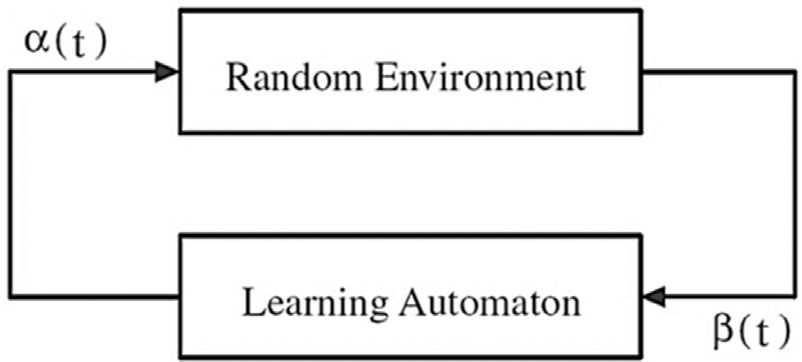
The authors equip every node in the social graph with a Learning Automaton (LA). This creates a "mirror" of the social network where nodes are no longer static points but active decision-makers.
2. Intelligent Path Discovery (The LA Scheme)
Instead of a blind Breadth-First Search (BFS), DLATrust uses a Linear Reward-Epsilon Penalty () scheme.
- Action: A node chooses which neighbor to trust as the next hop.
- Reward: If a chosen path successfully reaches the target with high strength, the probability of selecting that neighbor in the future increases.
- Penalty: If a path fails or yields low trust, the probability is decreased.
Through repeated iterations, the DLA converges toward the most reliable trust manifold, effectively "pruning" the search space without rigid depth constraints.
3. MCFAvg: Robust Aggregation
Standard Weighted Average (WAvg) fails when users have different "internal scales" for trust (e.g., one user's '7' is another user's '10'). DLATrust introduces MCFAvg (Modified Collaborative Filtering Average), which normalizes scores based on the mean trust level of the source and neighbors, making it more robust against biased ratings and malicious behaviors.
u_{k} \in Nei_{t}} W_{k} ( au_{kt} - \bar{ au}_{k})}{| Nei_{t} | Max_{ au}} $$ ## Experimental Insights The method was validated using the **Advogato** dataset (a community of developers). ### Key Findings: * **Higher Accuracy**: DLATrust outperformed TidalTrust and MoleTrust in **MAE (Mean Absolute Error)** and **FScore**. * **Scalability**: While exhaustive path searching (Min-MCFAvgAP) takes roughly 81,441 seconds, DLATrust achieves similar accuracy in just **9.7 seconds**. * **Depth Independence**: Unlike other models where accuracy drops as search depth increases (due to noise), DLATrust's accuracy *improves* or stabilizes because it learns to ignore the noisy "weak links" in longer paths. 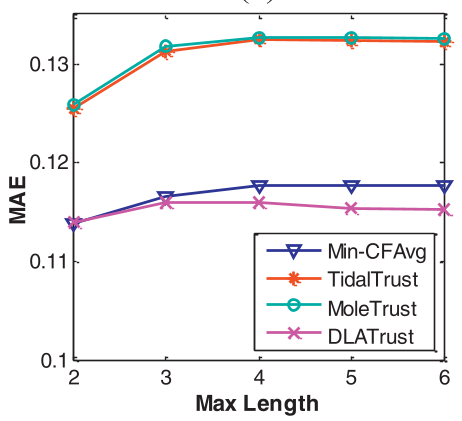 *Fig: As search depth (Maximum Length) increases, DLATrust maintains or improves accuracy whereas traditional models degrade.* ## Critical Analysis & Conclusion The beauty of DLATrust lies in its **Inductive Bias**. It assumes that the network contains a reliable "backbone" of trust that can be learned through trial and error. By moving away from deterministic graph traversal toward a probabilistic learning framework, it solves the reachability-complexity dilemma. **Limitations**: The algorithm requires multiple iterations to converge, which might be a bottleneck for real-time queries in hyper-scale networks (billions of nodes) without pre-computation or caching of the DLA states. **Future Work**: Integrating this reinforcement learning approach with **Graph Neural Networks (GNNs)** could potentially allow the model to generalize trust features across different sub-communities, further enhancing zero-shot trust prediction. ## Takeaway DLATrust proves that "smart searching" using Learning Automata is superior to "exhaustive searching" in trust networks. It is a vital contribution for anyone building decentralized social platforms or recommendation engines where reliability is paramount.