
GCR: Redefining Trust Inference through the Lens of Social Traits
KNOWLEDGE‐BASED SYSTEMS
This paper introduces GCR (Gullibility-Competence-Reciprocity), a high-speed and robust inference algorithm for predicting both trust and distrust in Weighted Signed Social Networks (WSSNs). Unlike traditional propagative methods, GCR uses localized social traits to estimate interpersonal trust as a weighted outcome of a "tug-of-war" between nodes.
TL;DR
Trust and distrust are the pillars of online interactions, yet predicting them accurately and quickly remains a challenge. The GCR (Gullibility-Competence-Reciprocity) algorithm moves away from complex, slow graph-path traversals. By focusing on the local social characteristics of the individuals involved, GCR delivers SOTA accuracy with nearly 100x speedup over traditional methods, proving resilient even in highly sparse networks.
The Flaw in the Path: Why Propagation Fails
For years, trust inference was synonymous with transitivity: "If u trusts v, and v trusts w, then u trusts w." While intuitive, this logic breaks down in modern Weighted Signed Social Networks (WSSNs) for several reasons:
- Distrust is not transitive: If I distrust my enemy, I don't necessarily distrust my enemy's enemy.
- Trust Decay: The reliability of an opinion diminishes as it travels through multiple "hops."
- Computational Complexity: Finding all paths between two nodes in a massive social graph (like Wikipedia) is a resource nightmare.
- Controversy: Different users have different biases, making "global" prestige scores often inaccurate for individual pairings.
Methodology: The "Tug-of-War" Intention
The authors hypothesize that a trust relation is not just a link, but a result of competing social forces. They define three core traits:
- Gullibility ( / ): How likely is a trustor to trust (or distrust) everyone by default? This is measured as the distance of their current outgoing trust vector from an "ideal" vector of absolute trust/paranoia.
- Competence ( / ): How much trust does the trustee generally command from others?
- Reciprocity (): Does the trustor tend to return the favor when trusted?
The Formula of Forces
The algorithm treats these traits as pulling a rope in three directions. The final predicted trust value is a weighted mean of the extremes ( for max trust, for max distrust, and for reciprocated trust):
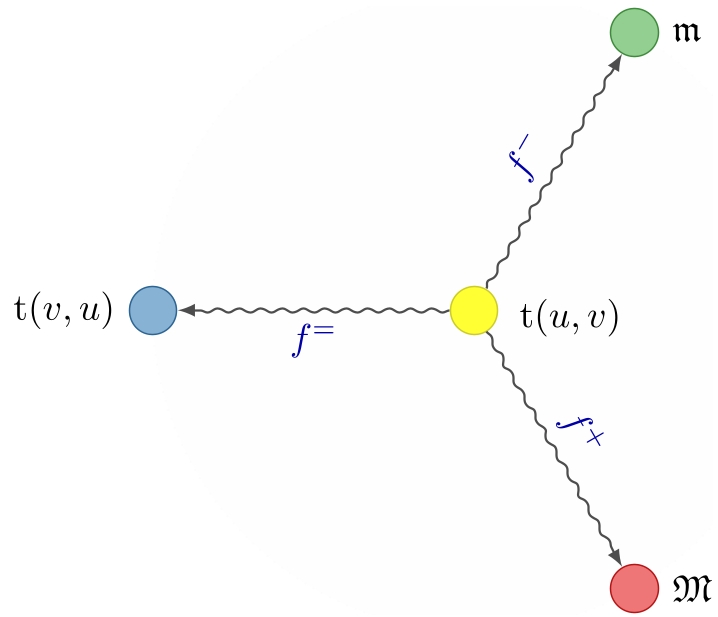
Mathematically, this boils down to: where , , and represent the combined "forces" of gullibility, competence, and reciprocity.
Experimental Results: Speed and Sparsity
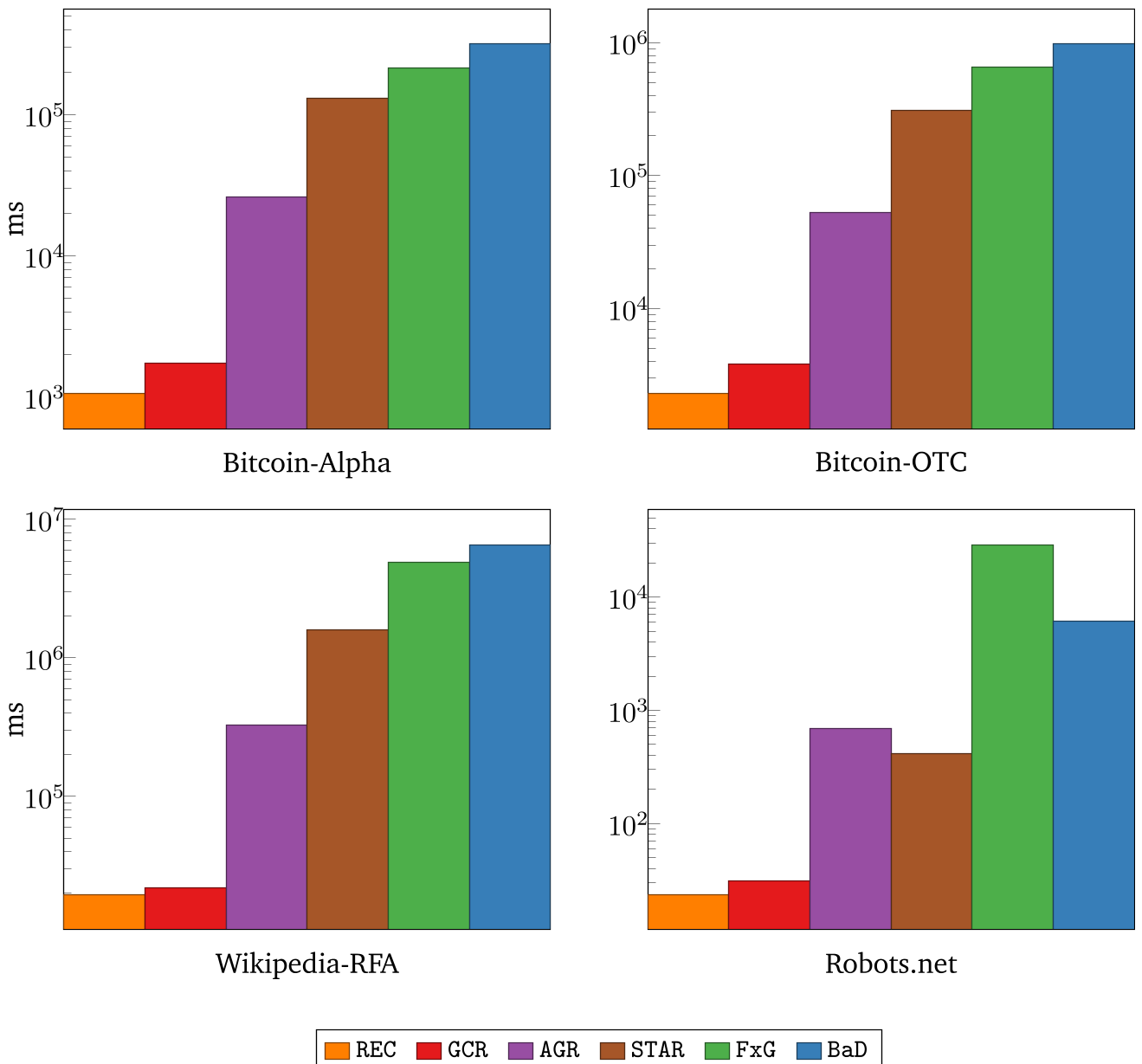
The GCR algorithm was tested against heavyweights like STAR (path-based), BaD (Bias and Deserve), and FxG (Fairness and Goodness) across four datasets: Bitcoin-Alpha, Bitcoin-OTC, Wikipedia-Rfa, and Robots.net.
1. The Speed Advantage
GCR operates in time—essentially linear to the number of direct neighbors. As shown below, it is significantly faster than any other method except the naive "Reciprocal" baseline.
2. Robustness to Sparsity
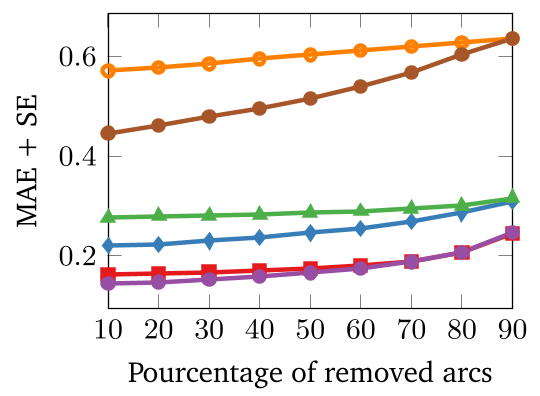
One of the most impressive findings is GCR's performance in Leave-N%-out tests. In social networks where data is often missing or private (sparse networks), global and propagative methods collapse. GCR remains nearly flat, providing high-quality predictions even when 90% of the network data is missing.
Critical Insight: Why Does It Work?
GCR succeeds because it captures Social Bias. By understanding that a trustor is "gullible" or that a trustee is "competent," the algorithm accounts for the subjectivity that global metrics ignore. It doesn't need to know the whole graph; it only needs to know who the two people are and how they behave with their immediate circle.
Conclusion & Future Outlook
The GCR approach provides a robust framework for real-time trust management systems. While the current model uses three traits, the "tug-of-war" architecture is modular. Future research could easily plug in traits like "Bandwagon effect" or "Confirmation Bias."
Limitations: The model currently assumes traits are independent (e.g., gullibility doesn't affect reciprocity), which might not hold true in complex human psychology. However, as an engineering solution for OSNs, GCR offers the best trade-off between speed, accuracy, and robustness available today.