
CMID: Fighting Rumors with Strategic Distraction — A Multi-Influence Approach
KNOWLEDGE‐BASED SYSTEMS
This paper introduces the Context-aware Multiple Influences Diffusion (CMID) model, an agent-based framework designed to minimize undesirable social influence (e.g., rumors) by introducing strategic "distraction" influences. Using two novel seeding algorithms, PCS and MCS, the approach achieves superior suppression results compared to traditional blocking or degree-based methods without requiring administrative control of the network.
TL;DR
Instead of "banning" misinformation—which is often impossible in decentralized social networks—this paper proposes using strategic distraction. By modeling human attention as a limited resource (LAC), the Context-aware Multiple Influences Diffusion (CMID) model proves that injecting "supportive" or high-interest topics can effectively drown out undesirable rumors more efficiently than direct opposition.
Background & Positioning
In the digital age, a "Public Relations crisis" or a "malicious rumor" can spread faster than official corrections. Most academic solutions suggest "blocking" users or "cutting" links—actions that only a platform admin can take. This paper shifts the paradigm: Influence Minimization as an Optimization of Attention. It treats the social network as a dynamic ecosystem where multiple topics compete for a slice of the user's limited cognitive pie.
The Problem: The "Streisand Effect" of Direct Opposition
A fascinating insight from the paper is that injecting an opposite opinion (e.g., a "fact-check" that shares the same topic as the rumor) can sometimes increase the spread of the rumor.
- Why? Because in a context-aware environment, the presence of any content related to a topic reinforces that topic's visibility in the "Local Influence Context."
- The Solution: Use Supportive Distraction. If you want a rumor about topic A to die, promote topics B and C which are popular but unrelated, or multi-topical messages that captivate the "contaminated" users.
Methodology: The Geometry of Attention
The authors use Agent-Based Modeling (ABM) to simulate individual behavior. Unlike the standard Independent Cascade (IC) models, CMID considers:
- Limited Attention Capacity (LAC): Users can only "remember" or post a finite number of messages.
- Influence Context (CI): Messages are represented as Fuzzy Sets over topics. The similarity between messages is calculated using the Normalized Hamming Distance.
Model Architecture
The framework operates on both a macroscopic level (the whole network) and a microscopic level (the individual's "reading list").
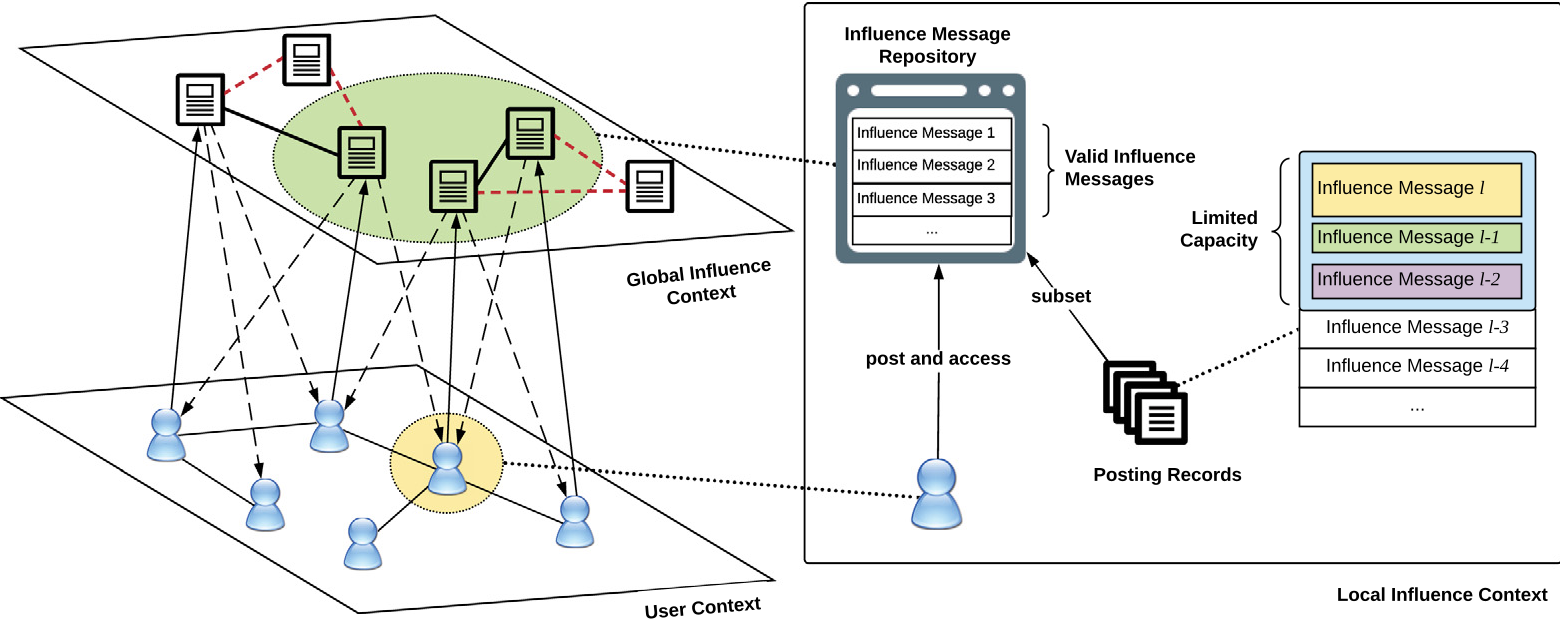 Figure 1: The dual-level architecture of Context-aware Multiple Influences Diffusion.
The authors proposed two specific algorithms:
- PCS (Preference-based Seeding): Finds the "most infected" users and gives them a single message that matches the average interest of the group.
- MCS (Multi-topical Seeding): This is the "heavy hitter"—it provides personalized messages to each seed user to maximize the distraction effect.
Evidence: Distraction vs. Interdiction
The experiments performed on the University of California student network (1,899 nodes) reveal a clear hierarchy of effectiveness.
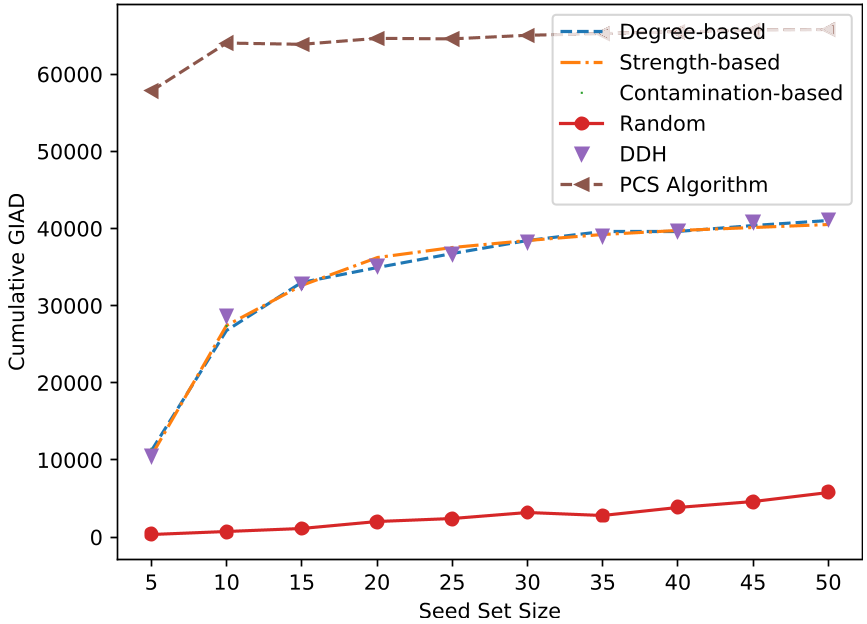 Figure 2: Cumulative Global Influence Attention Degree (GIAD) across different seeding strategies.
Key Experimental Findings:
- Distraction > Blocking: At higher budget levels, injecting new influences using MCS/PCS actually performs better than the "Block Users" strategy (which is the upper bound of traditional methods).
- Topical Relevance Matters: Injecting a message relevant to multiple popular existing topics (Figure 5 in the paper) is the most efficient way to collapse the "Global Influence Attention Degree" of the rumor.
- Temporal Sensitivity: The paper proves that the cost of suppression grows exponentially the longer you wait. Taking action at is significantly cheaper than at .
Critical Analysis & Takeaways
The brilliance of this work lies in its realism. It acknowledges that:
- We don't own the platforms (we can't delete links).
- Users are fickle and have limited time.
Limitations: The model assumes we can accurately estimate user preferences () and topic membership degrees (), which in a real-world setting requires sophisticated NLP and user profiling. Furthermore, the "Gaussian distribution" for attention capacity might need empirical validation for different age groups or platforms (e.g., TikTok vs. LinkedIn).
Final Conclusion
The CMID model provides a robust theoretical and practical framework for "social engineering" an information environment back to health. By understanding that influence is a competition for space, researchers and organizations can use the "supportive" relationship of multiple topics to push out negative influences through sheer relevance and interest.