
Maximizing Social Influence via the Collective Intelligence of Discrete Bat Algorithms
KNOWLEDGE‐BASED SYSTEMS
This paper proposes a Discrete Bat Algorithm (DBA) to solve the Influence Maximization (IM) problem in social networks. By adapting the bio-inspired echolocation behavior of bats to a discrete space and incorporating a local search strategy, the method identifies "superspreader" seed sets that outperform traditional metaheuristics and approach the accuracy of greedy algorithms.
Executive Summary
Influence Maximization (IM) is the cornerstone of viral marketing, identifying a small set of "seed" nodes to trigger a massive information cascade. This paper introduces the Discrete Bat Algorithm (DBA), a metaheuristic approach that mimics the hunting behavior of bats to find optimal seed sets.
Problem Position: While greedy algorithms are the "gold standard" for accuracy, they are too slow. Centrality methods are fast but "dumb." DBA sits in the sweet spot: providing near-greedy accuracy with the efficiency typical of swarm intelligence.
The Core Challenge: Accuracy vs. Efficiency
In large-scale social networks, deciding which nodes to target is a combinatorial nightmare. Current state-of-the-art methods like CELF use submodularity to prune searches, but they still rely on thousands of Monte-Carlo simulations to estimate influence spread—a process that becomes "unbearable" as networks grow.
The authors identify two gaps in current metaheuristic solutions:
- They often get trapped in local optima (suboptimal solutions).
- They search the entire network blindly without utilizing structural topology.
Methodology: The Discrete Bat Framework
The original Bat Algorithm (BA) operates in continuous space. To apply it to graphs, the authors reinvented the "flight" of a bat through discrete logic.
1. Discrete Evolutionary Rules
Instead of adjusting coordinates, "velocity" in DBA becomes a decision vector. If a velocity element is 1, the corresponding seed node is replaced; if 0, it is retained. This allows the population to "learn" from the current global best bat ().
2. Probabilistic Greedy Local Search
To prevent premature convergence, the authors added a local search that looks at the one-hop neighbors of every node in a bat's seed set. If a neighbor provides a higher Local Influence Estimator (LIE) value, the bat moves there.

3. The CandidatesPool
Unlike standard random walks that pick any node from the network, DBA uses a CandidatesPool. This pool is populated with nodes that score high on a weighted combination of Degree Centrality and Closeness Centrality, ensuring that even "random" jumps are directed toward high-value areas of the graph.
Experimental Results
The authors tested DBA against CELF, DPSO (Particle Swarm), and SSA (Stop-and-Stare) across various networks, including a synthetic Gaussian network and large-scale social graphs like Slashdot ( nodes).
Key Findings:
- Influence Spread: DBA consistently matched CELF's results and outperformed other metaheuristics like DPSO and DDSE.
- Convergence: As shown in the LIE optimization curves, DBA demonstrates much smoother and more consistent convergence than DPSO, which tends to be "choppy."
- Speed: DBA maintains a runtime significantly lower than CELF, making it feasible for real-time marketing strategy generation.
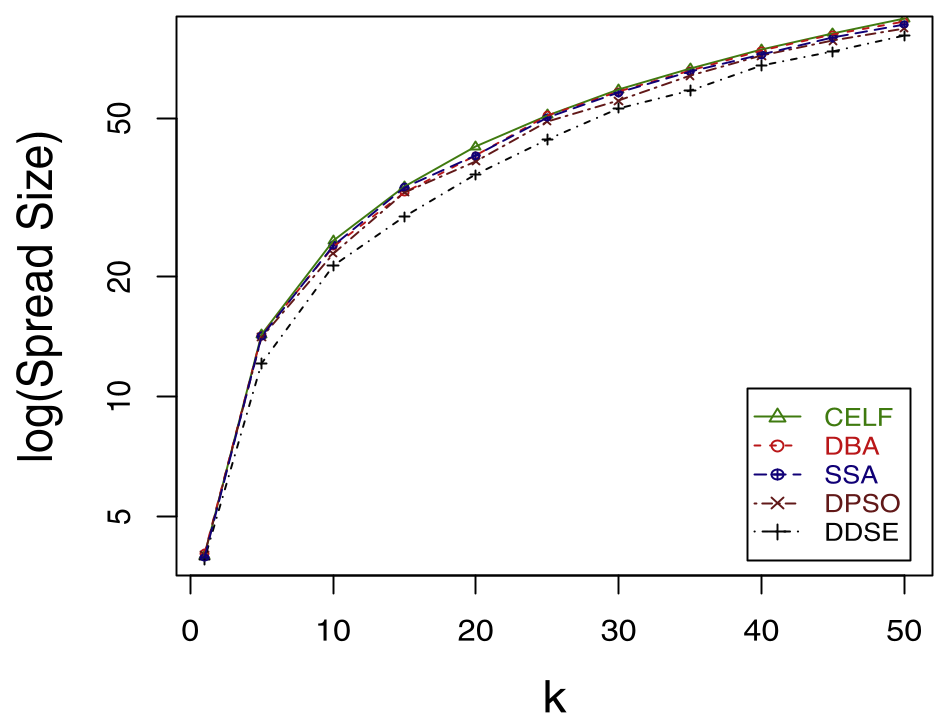 Fig: Comparisons of Influence Spread under the Independent Cascade (IC) model. DBA (Red) consistently stays at the top of the curve.
Critical Insight & Analysis
The success of DBA lies in its Local Influence Estimator (LIE). By calculating influence only within a two-hop radius, the algorithm avoids the global simulation bottleneck. While this is technically an approximation, social influence is inherently local—your "friend's friend's friend" rarely changes your shopping habits. DBA smartly exploits this physical intuition to gain a massive speedup without sacrificing significant accuracy.
Conclusion
The Discrete Bat Algorithm represents a significant step forward in making Influence Maximization practical for massive datasets. By blending the global exploration of swarm intelligence with the local structural insights of social graphs, it offers a robust alternative to expensive greedy methods.
Future Outlook: The next frontier for this research involves adapting DBA to dynamic networks where the edges (friendships) change in real-time.