
Beyond Static Sentiment: Predicting Emotional Evolution via Game Theory
KNOWLEDGE‐BASED SYSTEMS
This paper introduces an integrated framework for sentiment analysis and emotional evolution prediction in Chinese online reviews, specifically targeting the Tianya forum. It combines an unsupervised affective computing model with a game-theoretic algorithm (EEPA) to predict future user attitudes by calculating Mixed Nash Equilibrium strategies based on historical interaction utilities.
TL;DR
Researchers have moved beyond simple "positive vs. negative" classification to predict how users will feel in the future. By treating online arguments and discussions as a strategic game, this study introduces a framework that calculates the "Nash Equilibrium" of human emotions, achieving an 80.5% accuracy in predicting user attitudes in one of China's largest legacy forums, Tianya.
The Interactive Wall: Why Traditional NLP Fails
Most sentiment analysis tools treat reviews as isolated data points. However, online interactions are a "ping-pong" match of emotions. If User A insults User B, User B’s next response isn't just a reflection of their personal style—it's a strategic reaction to User A. Previous models ignored this mutual infection of attitudes.
The authors identified three critical gaps:
- Dynamic Shift: Attitudes towards topics (and people) evolve through discussion.
- Language Barrier: Chinese short-text lacks the robust sentiment lexicons found in English.
- Strategy: Rational users maximize their "happiness" or "popularity" during interactions.
Methodology: Gaming the Emotion
The paper proposes a two-stage solution: Affective Computing followed by Emotional Evolution Prediction.
1. Affective Computing (The Sensor)
Instead of manual labeling, the authors used SO-PMI (Semantic Orientation from Pointwise Mutual Information). They selected 533 high-frequency features and used a small seed set of 90 (45 positive, 45 negative) words to "propagate" emotional values across the entire dataset. This allows the model to calculate a "Trust Score" (0 to 1) for every comment.
2. EEPA: The Game Theory Engine
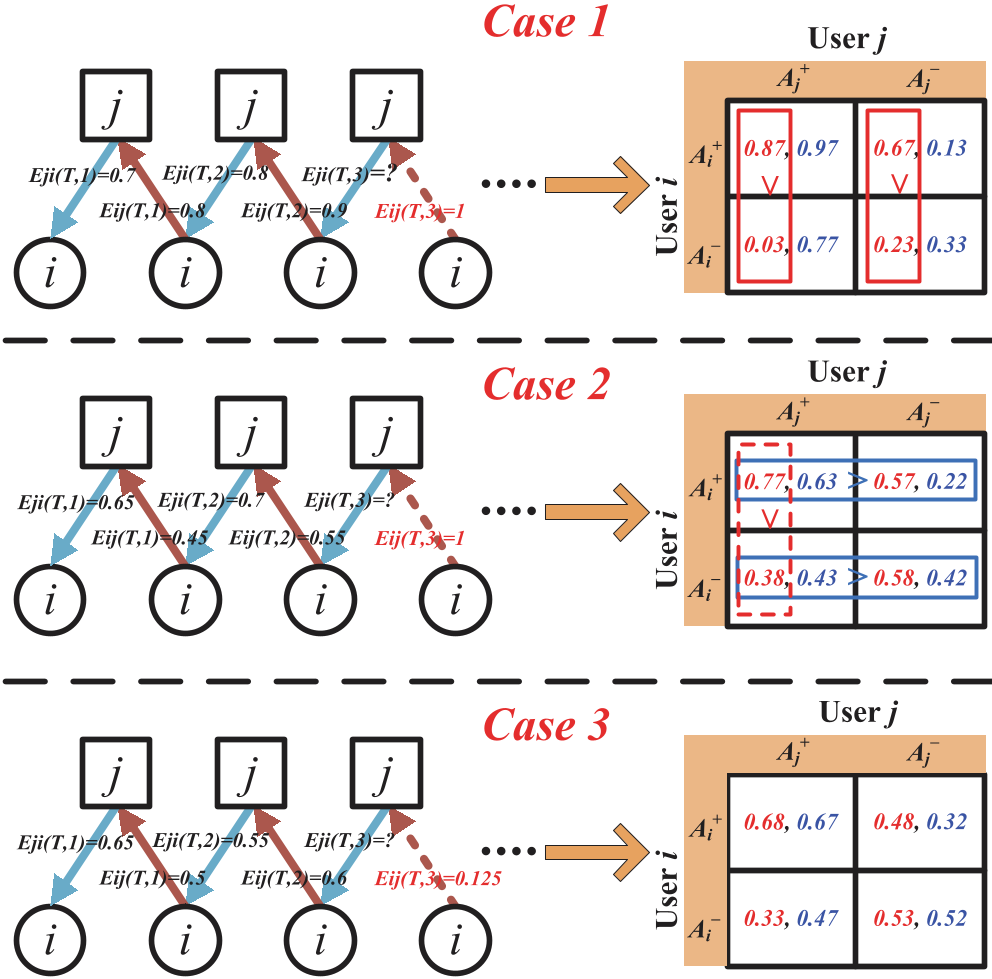
The core innovation is the Emotional Evolution Prediction Algorithm (EEPA). They define a game between two users where the "Payoff" (Utility) is defined by:
- Satisfaction: Receiving a positive reply after sending one.
- Disappointment: Receiving a negative reply after being positive.
The model uses three hierarchical criteria to predict the next move:
- Criterion 1 (Dominant Strategy): If one choice is always better regardless of the opponent.
- Criterion 2 (Best Response): If User I predicts User J will be rational and reacts accordingly.
- Criterion 3 (Mixed Nash Equilibrium): When no dominant strategy exists, the model calculates the probability distribution of future attitudes that keeps the system in equilibrium.
Experiments: Real-World Validity on Tianya Forum
The study utilized 7 years of data from the "World View" board of the Tianya forum, involving over 32 million users.
Key Findings:
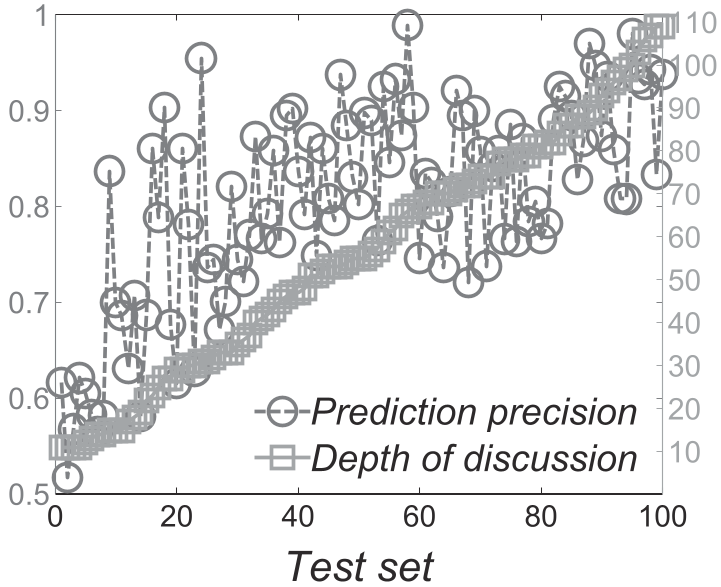
- The "Cold-Start" Effect: Prediction accuracy improves as the depth of discussion increases, reaching its peak once the utility functions have enough historical data to stabilize.
- Social Network Topology: The "Reciprocal Network" (users who reply to each other) shows a "Small-World" property. Interestingly, the forum exhibits Disassortative Mixing, meaning high-degree (popular) users often interact with low-degree users.
- Happiness-Popularity Coordination: There is a strong positive correlation (0.5657) between being "optimistic" and being "popular." Rational, objective users are more welcome than "blind followers" or those who "let off steam" wantonly.
Critical Insight: The Macro View
The researchers also mapped "Macro Happiness" against major world events in 2010. Significant dips in happiness were observed during the American pressure on RMB currency and the Chilean mine disaster, proving that the model captures real-world pulses beyond the micro-interaction of two users.
Conclusion & Future Outlook
This work demonstrates that social media is not just a collection of text, but a living ecosystem of strategic actors. While the study is limited by its reliance on explicit sentiment features (ignoring irony or implicit sarcasm), it provides a robust foundation for Predictive Social Analytics.
Future Work involves integrating "User Portraits" to tailor the utility functions to individual personality traits, potentially allowing for even more granular predictions of online behavior and group polarization.