
HeteroGraphRec: Elevating Items to First-Class Citizens in Social Recommendation
KNOWLEDGE‐BASED SYSTEMS
HeteroGraphRec is a novel social recommendation framework that models social networks as heterogeneous graphs. It utilizes Graph Neural Networks (GNNs) with multi-head attention mechanisms to aggregate information from four distinct dimensions: user-user (trust), user-item (interaction), item-user (collaborative), and item-item (similarity), achieving SOTA performance across Ciao, Douban, and Epinions datasets.
TL;DR
HeteroGraphRec is a state-of-the-art recommendation framework that redefines social networks as multi-dimensional heterogeneous graphs. Unlike previous models that treat items as simple attributes of users, this approach treats items as independent entities with their own structural connections. By leveraging Graph Attention Networks (GATs), it intelligently harvests insights from trust networks and item similarities, resulting in superior accuracy and robustness against data sparsity.
Problem & Motivation: The "Item-Blind" Limitation
The core challenge in social recommendation is effectively fusing two different signals: the social signal (who you trust) and the interest signal (what you like).
Previous SOTA methods like GraphRec made strikes by using GNNs, but they suffered from a structural "blind spot." They modeled users as the primary nodes and shifted items into the background as features. This hierarchy neglects a fundamental truth of commerce: items have relationships too. A user's preference for a specific movie isn't just informed by their friends; it's constrained by the inherent similarity of that movie to others in the catalog. By ignoring item-item structures, prior models missed a vital dimension of inductive bias.
Methodology: The Power of Heterogeneous Aggregation
HeteroGraphRec introduces a Heterogeneous Social Graph consisting of:
- User-User Edges: Trust and social friendship.
- Item-Item Edges: Similarity based on category, tags, or helpfulness ratings.
- User-Item Edges: Practical interaction history (ratings).
Architecture Decomposition
The model employs a dual-aggregator strategy powered by Multi-head Self-Attention.
- User Aggregator: Combines social influence (from friends) and interaction history (from items the user liked).
- Item Aggregator: This is the "secret sauce." It collects features from users who interacted with the item (collaborative filtering essence) AND from similar items (structural essence).
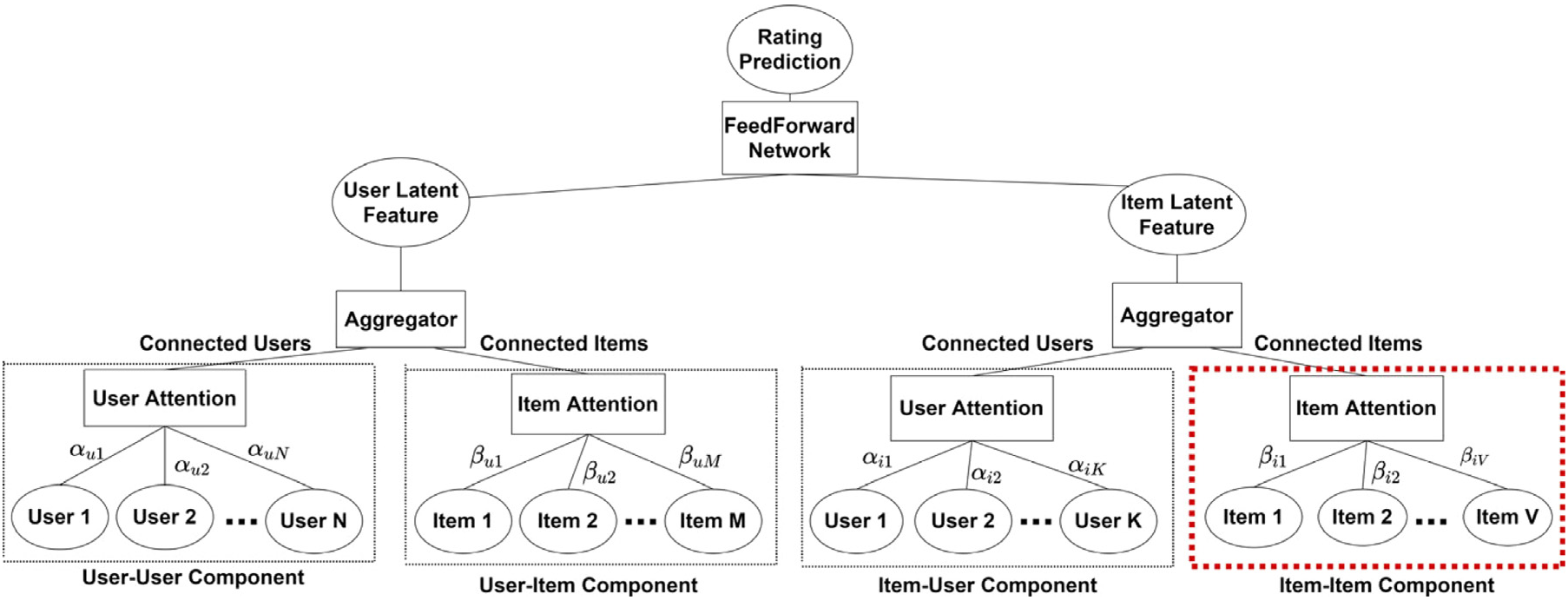 Fig 1: The HeteroGraphRec architecture showing the independent yet symmetric aggregation of user and item latent features.
The use of Attention Coefficients () is crucial. Not all friends are equally influential, and not all "similar" items are equally relevant. The attention mechanism allows the model to dynamically weigh these neighbors during feature propagation.
Experiments: Proving the Advantage
The authors validated the model on three benchmark datasets: Ciao, Douban, and Epinions.
SOTA Comparison
HeteroGraphRec consistently outperformed classical Matrix Factorization (PMF), Deep Neural Collaborative Filtering (NeuMF), and even contemporary Graph-based models (GraphRec).
 Fig 2: Comparison of RMSE/MAE across multiple datasets. HeteroGraphRec shows a clear lead in all scenarios.
Ablation Insights: What Matters Most?
The ablation study (disabling components like item-item or user-user) revealed that while the social network (user-user) remains the strongest signal, the addition of item-item connections provides the marginal gain necessary to surpass previous SOTA benchmarks. This confirms that guiding the neural network with item similarity acts as a powerful regularizer for sparse interaction data.
Critical Analysis & Conclusion
HeteroGraphRec demonstrates that structural parity between users and items is a winning strategy for GNNs. By treating the recommendation problem as a link prediction task on a fully realized heterogeneous graph, the authors have provided a more versatile framework that can easily be adapted for tasks like item bundling or trust prediction.
Limitations & Future Work: Currently, the item-item similarity graph is constructed as a preprocessing step (static). Future iterations could benefit from dynamic graph construction, where item similarities are updated in real-time as the model learns better embeddings. Additionally, incorporating temporal data (the "when" of a rating) would further refine the model's ability to capture shifting user tastes.
Takeaway: In the world of GNNs, the graph's topology is your most potent hyperparameter. Enriching that topology with item-side relationships is no longer optional—it is essential for top-tier performance.