
KGE-MMSLDA: Bridging Knowledge Priors and Max-Margin Learning for Multi-Modal Social Event Analysis
Knowledge-Based Topic Model for Multi-Modal Social Event Analysis
2019-11-04
Summary
Problem
Method
Results
Takeaways
Abstract
This paper introduces KGE-MMSLDA, a novel multi-modal topic model that integrates knowledge graph embeddings and a max-margin classifier. It aims to improve event analysis by jointly learning feature representations from text and images while leveraging external knowledge priors to enhance topic coherence and classification accuracy.
## Executive Summary
**TL;DR**: KGE-MMSLDA is a unified probabilistic framework that enhances social event classification by fusing text, images, and external knowledge bases. By embedding entities into the topic space and employing a max-margin classifier during training, the model achieves a state-of-the-art 85.1% accuracy on social media event detection.
In the landscape of social media analytics, standard Latent Dirichlet Allocation (LDA) often falls short due to the "noise" of user-generated content. KGE-MMSLDA positions itself as a robust evolution, moving from purely unsupervised discovery to a **knowledge-aware, supervised representation learning** paradigm.
## The Core Challenge: Noise and Interpretation
Social media events (e.g., the Syrian Civil War or the World Cup) are complex. A tweet might mention "peace" and "veterans" alongside an image of a soldier. Standard models struggle because:
1. **Modality Gap**: They fail to align the "visual vocabulary" of images with the textual semantics.
2. **Semantic Sparsity**: Short, noisy texts lack the context found in formal documents.
3. **Weak Discrimination**: Unsupervised topics are descriptive but not necessarily useful for distinguishing between similar event classes.
## Methodology: The Unified Framework
The authors' "Secret Sauce" lies in two components: **Knowledge Embedding** and **Max-Margin Regularization**.
### 1. Knowledge-Based Topic Modeling
Instead of just looking at word frequencies, the model pulls in entities from Freebase or Wikipedia. These entities are represented as continuous vectors in a latent space. The model uses the **von Mises-Fisher (vMF) distribution** to sample these embeddings, ensuring that words related to the same "Knowledge Entity" are clustered into the same topic.
### 2. Max-Margin Integration
Unlike standard supervised LDA (sLDA) which uses simple regression, KGE-MMSLDA incorporates a **max-margin classifier** (inspired by SVMs). This acts as a regularization term during the Gibbs sampling process, effectively "pushing" the latent topic distributions to be as discriminative as possible for the final classification task.
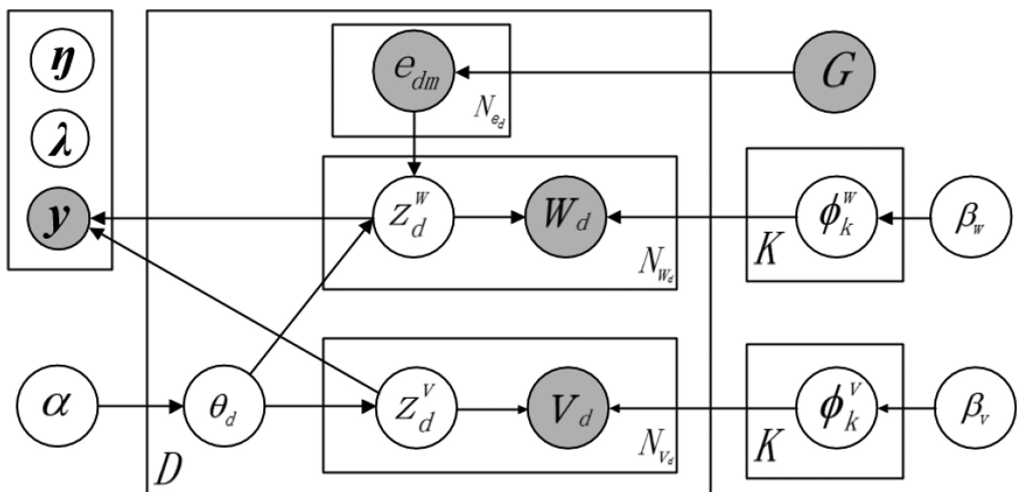
*Fig 1: The graphical representation showing the interplay between visual words (v), textual words (w), and knowledge entities (e).*
## Experimental Insights
The authors introduced the **HFUT-mmdata** dataset, containing 74,000+ documents across 10 major events.
### Performance Gains
* **Accuracy**: The model reached **85.1%**, significantly higher than the 68.2% of standard LDA.
* **Coherence**: The PMI (Pointwise Mutual Information) scores, which measure how human-readable the topics are, reached **89.7**, compared to just 78.1 for LDA.
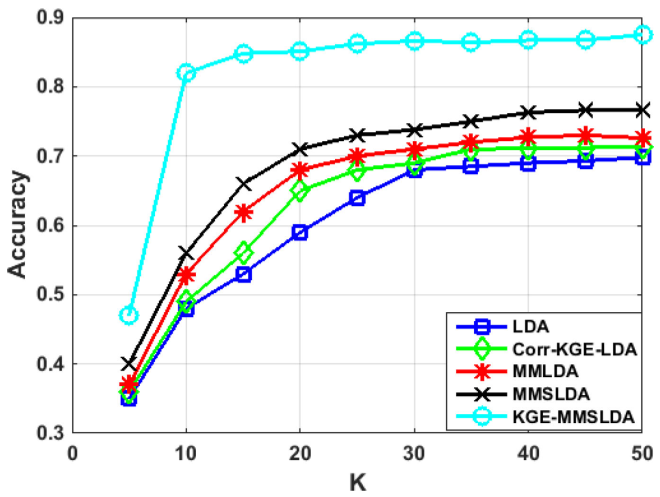
*Fig 2: Classification accuracy across different numbers of topics (K). KGE-MMSLDA consistently outperforms baselines.*
### Qualitative Success
When mining topics like the "Adele Concert Tour," the model successfully aligned textual keywords like "live, concert, love" with visual patches of stage lighting and microphones, proving its ability to bridge the semantic gap.
## Critical Analysis & Future Directions
While KGE-MMSLDA represents a significant leap, it is not without its overhead. The **computational complexity** is high because it requires simultaneous sampling for three distinct pipelines (text, image, knowledge).
**Future Perspective**: The transition from traditional Gibbs sampling to Variational Inference or even integrating this "Knowledge-Prior" logic into Transformer-based architectures (like multimodal LLMs) could be the next frontier for this research line.
## Conclusion
KGE-MMSLDA proves that "Big Knowledge" (from external bases) and "Large-Margin Logic" (from SVMs) are the right tools to tame the "Big Data" of social media. It moves us closer to a world where machines don't just count words, but actually understand the context of global events.