
K-broker: Solving the Tacit Knowledge Dilemma via Social Network Analysis
Building a Knowledge Brokering System using social network analysis: A case study of the Korean financial industry
This paper introduces the K-broker system, a prototype Knowledge Brokering System designed to facilitate the transfer of context-specific tacit knowledge within organizations. By integrating Social Network Analysis (SNA) with traditional Knowledge Management Systems, it identifies experts and provides a visualized "single view" of human communication paths, focusing on the South Korean financial industry.
TL;DR
Knowledge is power, but only if it flows. While explicit knowledge (manuals, code) is easy to store, tacit knowledge (intuition, experience) remains trapped in human minds. This paper proposes the K-broker system, which uses Social Network Analysis (SNA) to map the informal "human web" of an organization. By calculating expertise through social centrality and providing visualized connection paths, it ensures that experts are just one or two introductions away.
Problem & Motivation: The Bottleneck of Human Memory
In complex industries—like the Korean financial sector—projects often stall because a junior developer doesn't know who has the "know-how" for a specific legacy system.
The authors identify two fatal flaws in current Knowledge Management (KM):
- Document Obsession: Most systems search for documents, not people.
- Human Broker Fatigue: Relying on managers to "know everyone" creates bottlenecks and distorted information.
The motivation here is to build a Knowledge Broker that is digital, permanent, and objective, using the mathematical rigor of SNA to find the "hidden influencers" in a company.
Methodology: The Math of Expertise
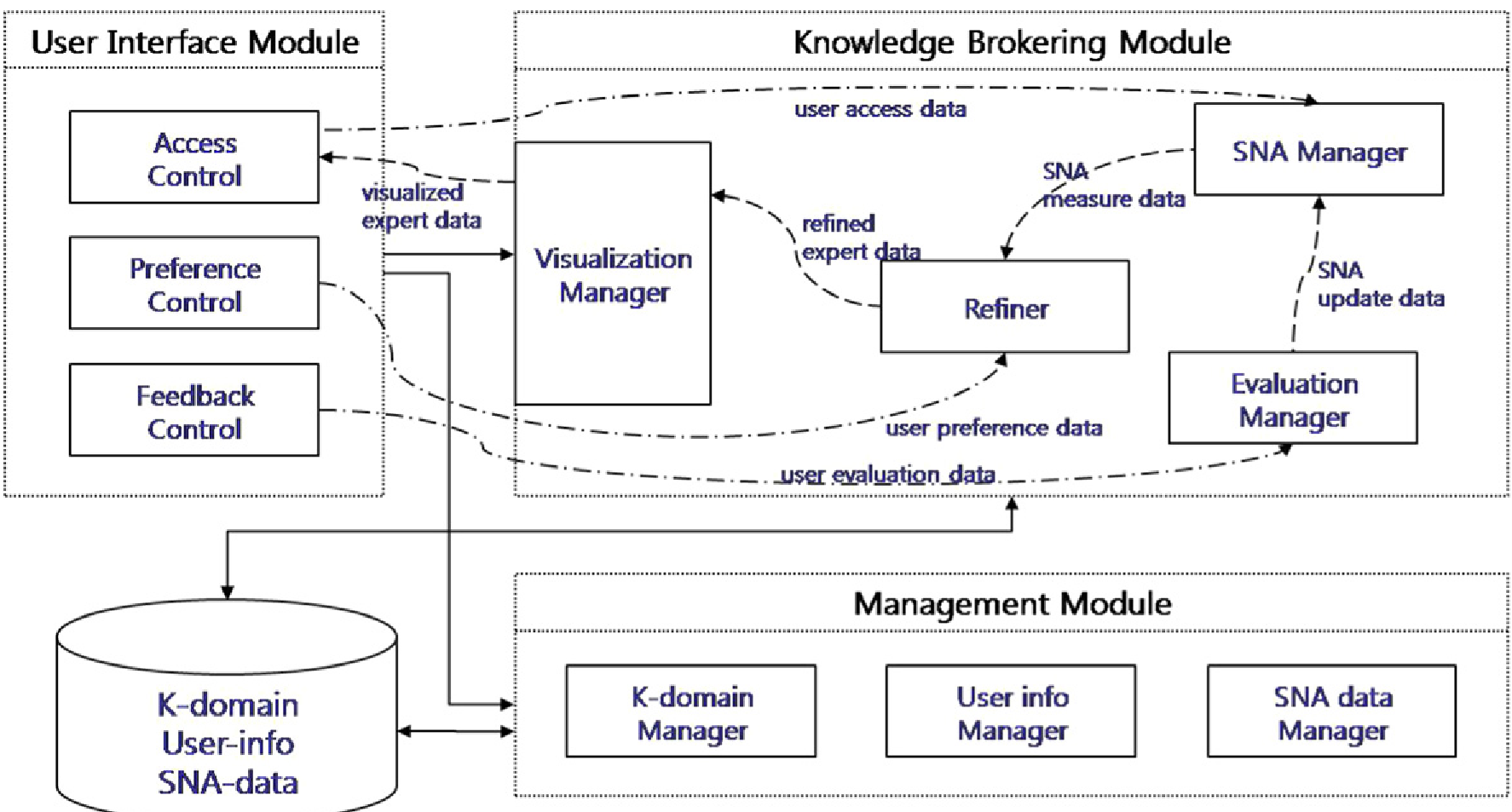
The K-broker isn't just a search engine; it's a social navigator. It uses three subsystems: the User Interface, the Knowledge Brokering Module, and the Management Module.
The Expertise Index
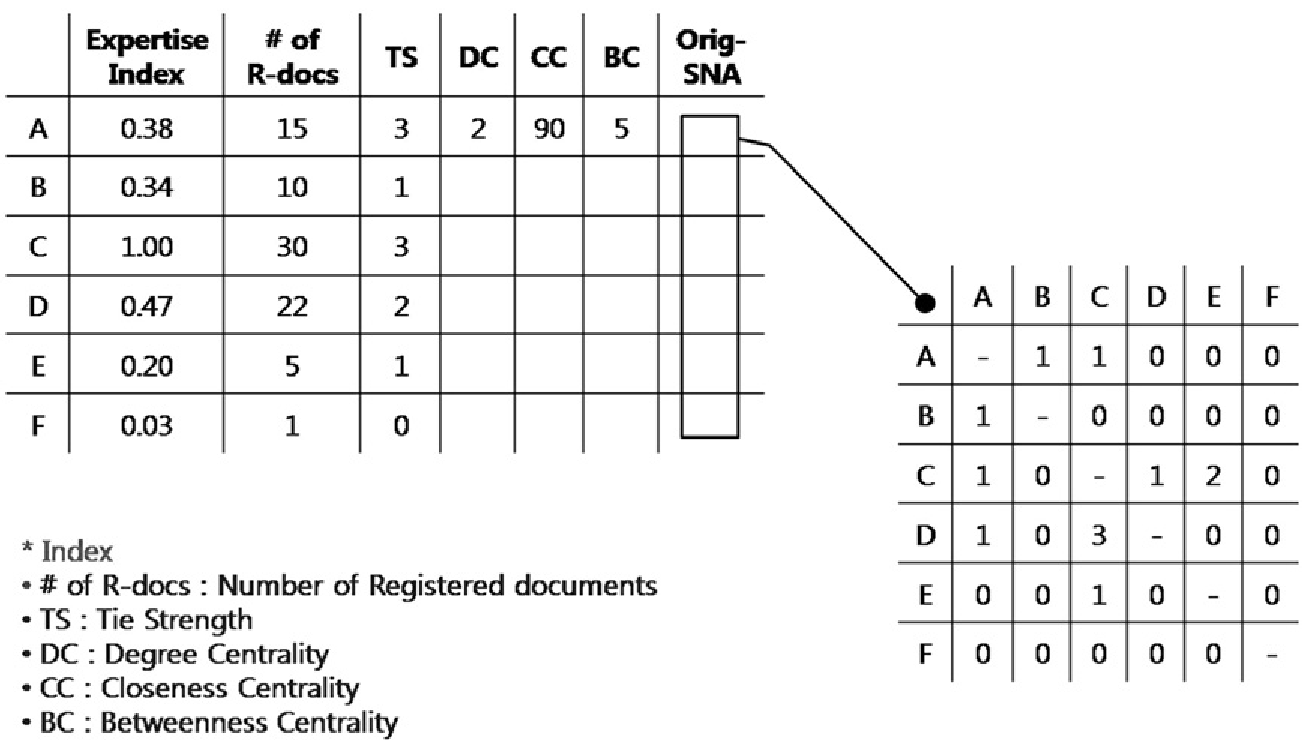
To determine who an "expert" is, the system doesn't just look at how many documents someone wrote. It uses a weighted formula: This considers:
- Degree Centrality: How many people contact this person?
- Betweenness Centrality: Does this person act as a bridge between different departments?
- Closeness Centrality: How fast can information spread from this person to the rest of the network?
Experiments: Validating at KFTC
The system was tested at the Korea Financial Telecommunications & Clearings Institute (KFTC). In one scenario, a user named 'Lee' needed 'Java' expertise. Instead of a list of names, the system provided a Path Visualization.
- The "Shortest Path" Logic: The system identifies the intermediary persons (bridges) who can introduce the seeker to the expert.
- Iterative Learning: Every time a transfer happens, users provide feedback (Likert-5 scale), which automatically updates the expert's rank and the organizational tie strength.
Results and Comparative Advantage
Unlike previous Expert Finding Systems (EFS), K-broker excels in Intermediary Information and Automatic Updates.
| Feature | EFS / ERS | K-broker (This Study) |
|---|---|---|
| Intermediary Info | Usually None | Full Visibility |
| Expertise Evaluation | Static | Dynamic / Feedback-driven |
| Single View | Document-centric | Social-network centric |
Critical Analysis & Conclusion
The Takeaway: The K-broker system proves that for tacit knowledge, the relationship path is more important than the ranking. If a seeker sees they are connected to an expert via a trusted colleague, the "social friction" of reaching out is significantly reduced.
Limitations:
- Data Cold Start: The system relies on KMS logs; if employees don't use the system, the social graph remains empty.
- Privacy: Mapping social ties can lead to concerns about "who is watching who."
Future Outlook: The authors suggest expanding this to Inter-organizational Brokerage, allowing multinational corporations to bridge knowledge across international borders. In the age of AI, integrating these SNA metrics into LLM agents could potentially allow an AI to say: "I don't know the answer, but your colleague Min-jun does, and you both worked with Sora last month."