
KEA: Bridging the Gap Between Context and Emotion with Knowledge-Embedded Attention
Using Knowledge-Embedded Attention to Augment Pre-trained Language Models for Fine-Grained Emotion Recognition
This paper introduces Knowledge-Embedded Attention (KEA), a novel framework for fine-grained emotion recognition that augments pre-trained language models like ELECTRA and BERT with external emotion lexicons. By integrating valence, arousal, and dominance (VAD) scores into a modified attention mechanism, the model achieves state-of-the-art results on datasets like EmpatheticDialogues and GoEmotions, effectively distinguishing nuanced emotional states.
TL;DR
While modern AI can "read" text, it often fails the "empathy test"—struggling to distinguish between being just "sad" and feeling deep "grief." This paper introduces Knowledge-Embedded Attention (KEA), a method that plugs external emotion lexicons directly into the attention mechanism of models like ELECTRA and BERT. The result? A significant boost in fine-grained emotion recognition (28-32 classes) and a better understanding of emotional intensity.
Problem & Motivation: The "Basic Emotion" Trap
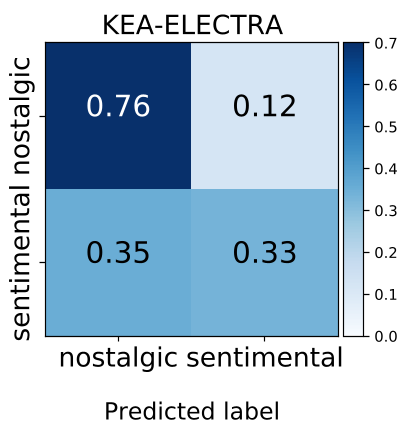
Most AI systems are stuck in the 1970s, relying on Paul Ekman’s six basic emotions (Happy, Sad, Angry, etc.). However, human experience is a high-dimensional spectrum. Current State-of-the-Art (SOTA) models often confuse "sentimental" with "nostalgic" because they rely solely on Co-occurrence patterns in pre-training.
The authors argue that to achieve true empathy, AI needs Inductive Bias from psychological resources—specifically emotion lexicons that define the Valence (positivity), Arousal (energy), and Dominance (control) of words.
Methodology: How KEA Works
The core innovation is moving away from simple concatenation and toward a modified attention key.
1. Two Flavors of KEA
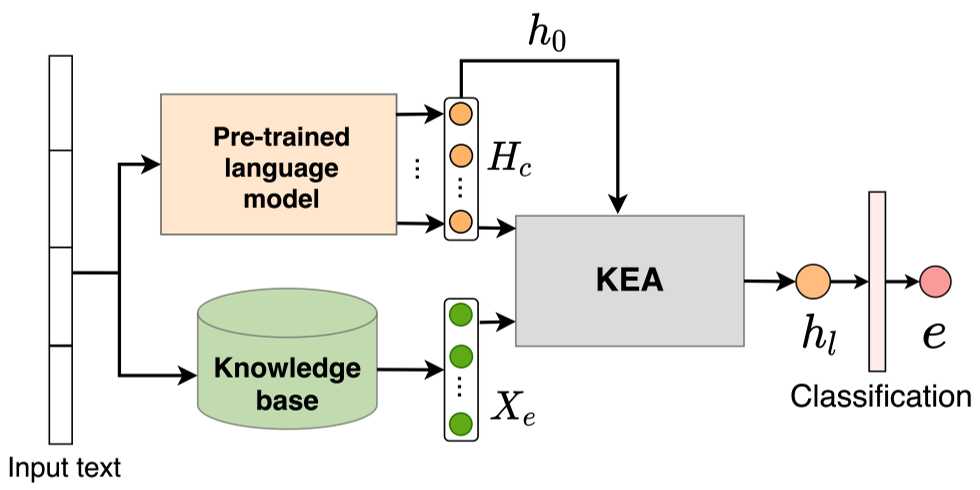
- Sentence-level KEA: It generates an emotional encoding () for the whole input and appends it to the Key matrix. The [CLS] token (Query) then attends to both the contextual words and the emotional summary.
- Word-level KEA: It uses a BiLSTM to fuse every single word's lexicon score with its contextual embedding.
2. The Mechanics of the Attention
In standard self-attention, the Query () looks for relevant information in the Key (). KEA injects "Emotional Knowledge" into , forcing the model to re-weight its attention based on the emotional intensity scores found in lexicons like NRC-VAD.
Experiments & Results
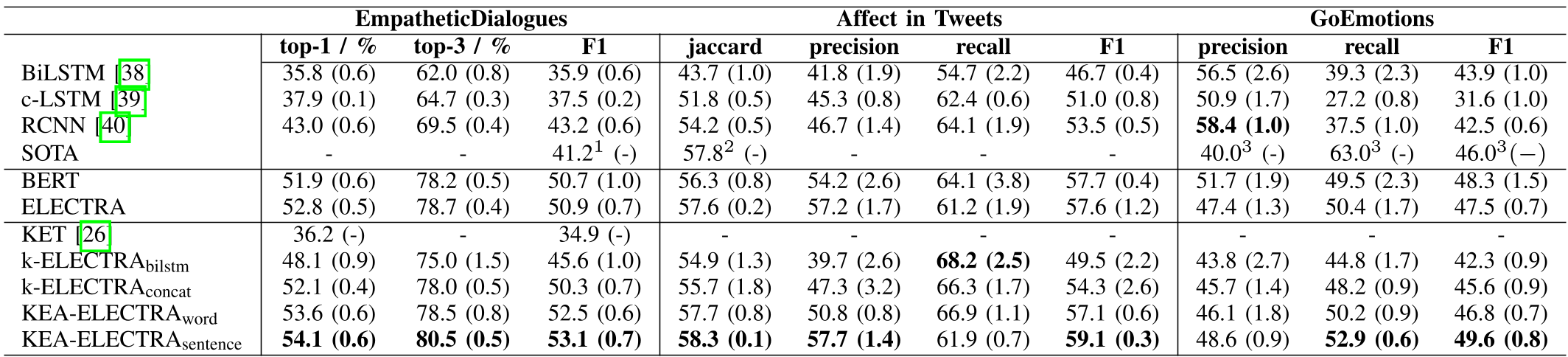
The authors tested KEA across three major benchmarks: EmpatheticDialogues (32 classes), GoEmotions (28 classes), and Affect in Tweets (11 classes).
Key Findings:
- Superiority of Sentence-Level: Interestingly, Sentence-level KEA generally outperformed Word-level KEA. Global emotional summaries seem to provide a more stable signal for classification than noisy word-level injections.
- Accuracy Boost: KEA-ELECTRA attained a Top-1 accuracy of 54.1% on the ED dataset, consistently beating vanilla BERT and ELECTRA.
The Intensity Breakthrough
A critical win for KEA was in Intensity Differentiation. Standard models often collapsed categories like "afraid" and "terrified" into a single "fear" bucket. KEA, by leveraging lexicon scores that explicitly highlight that "terrified" has higher arousal/intensity, significantly reduced the confusion between these two.
Critical Analysis & Conclusion
Takeaway
The paper proves that we don't necessarily need bigger models (scaling) to solve nuanced tasks; we need smarter integration of existing human knowledge. KEA provides a plug-and-play architectural module that can be added to any Transformer.
Limitations
- Inter-individual variability: As shown in the paper's case study, two people might describe the same terrifying event but label it differently (one as "afraid," one as "terrified"). KEA cannot yet account for personal "emotional styles."
- Lexicon Coverage: The model is limited by the vocabulary of the lexicon used (e.g., 20k words in NRC-VAD).
Future Outlook
The move toward "Empathetic AI" will likely involve combining KEA-style attention with Large Language Models (LLMs) to handle even more complex relational and cultural nuances in emotion.