
The Genealogy of Intelligence: Tracing the 50-Year Evolution of Knowledge Graphs
4451_Knowledge Graphs A Tutorial on the History of Knowledge Graph's Main Ideas.
This paper introduces a comprehensive tutorial on the history and evolution of Knowledge Graphs, tracing their origins across five decades (1950s–2000s). It synthesizes advancements from the Semantic Web, Database systems, and Knowledge Representation to provide a unified historical framework for current AI systems.
TL;DR
Knowledge Graphs (KGs) didn't appear out of thin air with the Google announcement in 2012. This tutorial by Gutierrez and Sequeda serves as a "DNA test" for KGs, tracing their lineage back to 1950s logic and 1970s database theory. It reconstructs the history of how we moved from simple data storage to intelligent, reasoning-capable knowledge systems.
Background: Why History Matters
As the quote by George Santayana goes: "Those who cannot remember the past are condemned to repeat it." The AI community often experiences "amnesia," where "new" breakthroughs are actually rebranded concepts from the 1980s. The authors argue that to advance KGs, we must understand the "Winter" of AI, the evolution of the Semantic Web, and the foundational interplay between Logic and Data.
The Core Conflict: Logic vs. Data
The history of KGs is essentially a 50-year marriage—often a rocky one—between two distinct disciplines:
- Logic (The "Knowledge" side): Focused on reasoning, automation, and formal semantics (e.g., Description Logics, Frames).
- Databases (The "Data" side): Focused on scale, efficiency, and structured storage (e.g., Relational Algebra, SQL).
The "Knowledge Graph" is the ultimate synthesis of these two, allowing us to perform complex reasoning over massive, heterogeneous datasets.
Methodology: A Decadal Journey
The authors structure the history into five distinct eras, providing a roadmap for how disparate technologies converged.
The Historical Roadmap
The tutorial's most valuable asset is its chronological mapping of concepts, as seen in the table below:
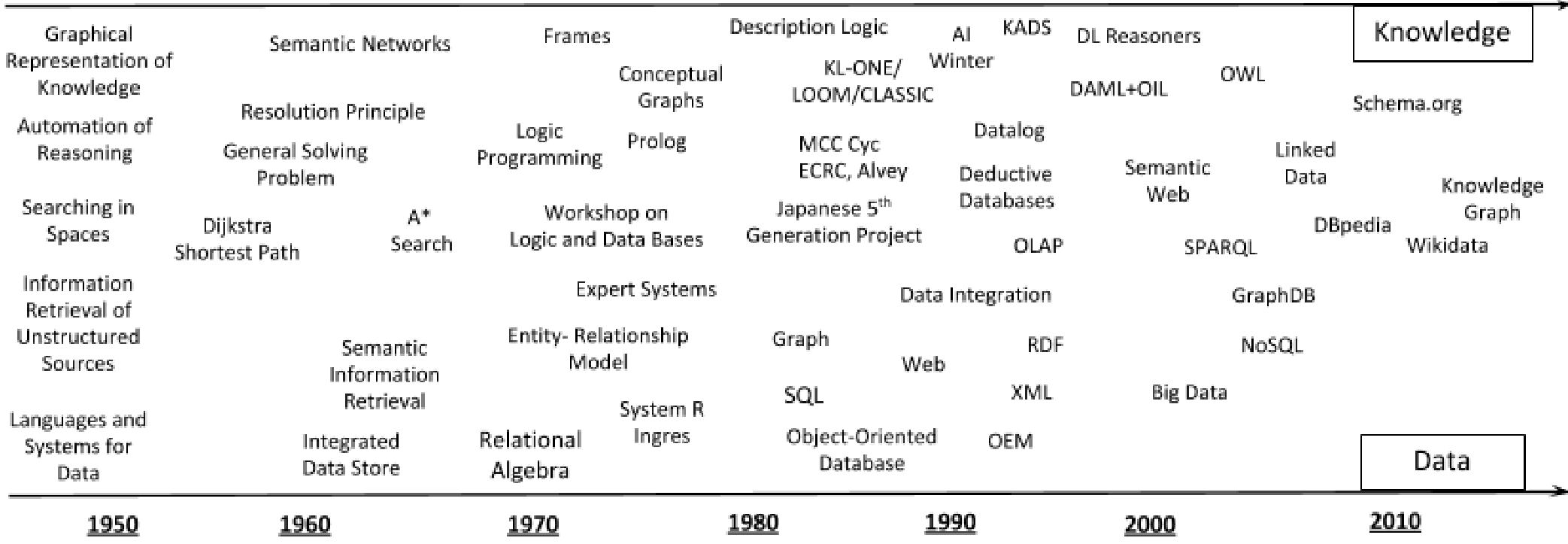
- 1950s-60s (Advent of Digital Age): The birth of Semantic Networks and the Resolution Principle. This era established the dream of "Search in Spaces" (Dijkstra, A* Search).
- 1970s (Foundations): The introduction of the Relational Model and Prolog. Logic and Databases began their first serious dialogue.
- 1980s (Managing Knowledge): The rise of Expert Systems and "Datalog." This was the era of the Japanese 5th Generation Project, an ambitious attempt to build hardware dedicated to logic programming.
- 1990s (The Web): Data integration became the priority. XML and early GraphDBs emerged as the Web provided a medium for unstructured information.
- 2000s (Scale): The Semantic Web era. Concepts like RDF, SPARQL, and Linked Data moved KGs from academic theory to large-scale implementations like DBpedia and eventually Wikidata.
Key Takeaways from the Evolution
The tutorial highlights that KGs are enriched by several "ancestors":
- From AI: The use of ontologies and reasoning (OWL/DL).
- From Databases: The ability to handle semi-structured data and complex queries.
- From Semantic Web: The global identification of entities and the "Linked Data" paradigm.
Critical Insight & Conclusion
By looking at the provided timeline, it's clear that the modern "Knowledge Graph" is less of a new technology and more of a maturation of the "Deductive Database" and "Expert System" concepts, finally enabled by modern "Big Data" compute power.
The primary takeaway for researchers is to stop treating KGs as just "data in a graph format." To unlock their true potential, we must look back at the formal logic and reasoning frameworks (like Description Logic and Datalog) developed in the 80s and 90s. The future of KGs lies in combining this classical symbolic reasoning with modern neural approaches.
Limitations
As the authors note, this is a history and a map, not a technical exhaustive survey. It provides the "where" and "when," but practitioners must still dive into the seminal papers cited to understand the "how" of implementation.
Blog based on: "Knowledge Graphs: A Tutorial on the History of Knowledge Graph's Main Ideas" by Gutierrez & Sequeda (CIKM 2020).