
Knowledge-Based Marketing: Bridging Data Mining and Customer Relationship Management
16949_Knowledge management and data mining for marketing.
This paper proposes a systematic methodology integrating data mining and knowledge management to support marketing decision-making. It details a comprehensive framework for Customer Relationship Management (CRM) using techniques such as dependency analysis, class identification, and trend analysis to transform raw data into actionable marketing intelligence.
TL;DR
This seminal work by Shaw et al. addresses the gap between technical data extraction and strategic marketing. By proposing an integrated framework that treats data mining as an iterative knowledge management process, the paper provides a roadmap for shifting from "mass marketing" to "one-to-one relationship marketing" through tools like dependency analysis and customer profiling.
Context: The Wealth of Data and the Poverty of Insight
In the early 2000s, retailers like Wal-Mart began accumulating terabytes of data—volumes exceeding those of the IRS. However, a "surprising lack of a simple and overall framework" prevented businesses from converting this data into customer-centric strategies. The authors argue that competitive advantage no longer comes from having data, but from the ability to manage the knowledge hidden within it.
Methodology: The Integrated DM-KM Framework
The core innovation is the integration of Data Mining (DM) tasks with Knowledge Management (KM) processes. Instead of viewing data mining as a one-off computational task, the authors define it as an iterative cycle of learning.
1. The Taxonomy of Data Mining Tasks
The paper categorizes the essential tools for a marketer:
- Dependency Analysis: Finding associations (e.g., "Market Basket Analysis" identifying that mustard is often bought with sausage).
- Class Identification: Using clustering to group customers by behavior rather than just demographics.
- Concept Description: Summarizing customer profiles to build "prototypical" segments.
- Deviation Detection: Identifying anomalies, such as potential fraud or sudden shifts in buyer status.
- Data Visualization: Using 3D graphs and pixel-oriented techniques to navigate complex datasets.
 Figure 1: The proposed taxonomy of data mining tasks for marketing.
2. The Knowledge Management Cycle
The authors emphasize that knowledge must be organized, distributed, and refined. This involves indexing data elements and ensuring knowledge is shared across the supply chain—exemplified by the partnership between Procter & Gamble and Wal-Mart, where a "common data highway" allows both companies to synchronize their marketing and inventory efforts.
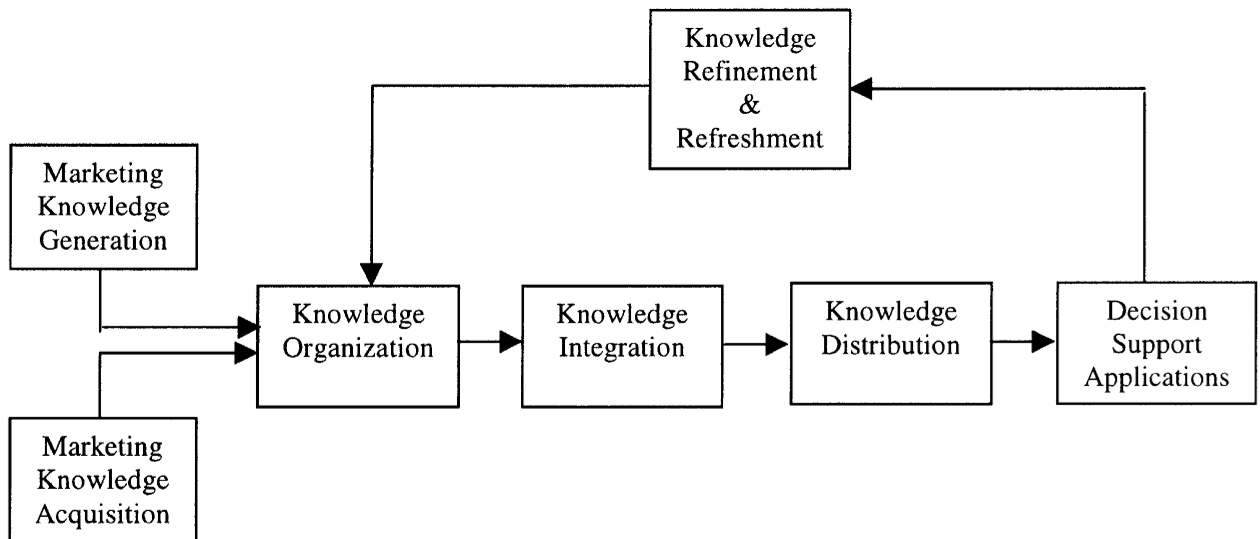 Figure 2: The iterative cycle of refining and distributing marketing knowledge.
Experiments & Strategic Applications
The paper delineates how "Knowledge-Based Marketing" outperforms traditional methods in three specific areas:
- Customer Profiling: Calculating "Customer Lifetime Value" (CLV) to prioritize high-value segments.
- Prospecting: Predicting future needs (e.g., targeting high-income toy buyers for bicycle catalogs six months later).
- Trend Analysis: Detecting subtle, long-term shifts in product performance that traditional scatter plots might miss.
Critical Insight: Why This Matters
The shift described in this paper is the transition from Product-Centric to Customer-Centric business models. The authors correctly predicted that the "Internet and the World Wide Web" would become the primary channel for this interaction, necessitating "Web Mining" to handle distributed and multi-format data.
Conclusion & Future Outlook
While the paper focuses on the then-emerging 43TB databases, its logic remains the foundation for modern AI-driven CRM. The main limitation discussed—the difficulty of "multiple classification" (where a customer belongs to several categories simultaneously)—is still a vibrant area of research in fuzzy logic and machine learning today.
The ultimate takeaway for modern practitioners is clear: Knowledge management is the bridge that turns the "computational process" of data mining into a "strategic asset" for business growth.