
TE-Cap 2: Bridging the Silos of Professional Communities through ICP
A Knowledge Management System and Social Networking Service to Connect Communities of Practice
This paper introduces the Interconnection of Communities of Practice (ICP) model and the TE-Cap 2 platform, designed to link disparate professional communities sharing common activities. By leveraging a hybrid Knowledge Management (KM) and Social Networking Service (SNS) architecture, it facilitates cross-organizational knowledge dissemination among educational tutors.
TL;DR
Professional Communities of Practice (CoPs) often suffer from "institutional isolation," where experts in different organizations solve the same problems without ever communicating. This paper presents TE-Cap 2, a platform based on the Interconnection of Communities of Practice (ICP) model. By treating individual members as "brokers" who bridge multiple domains, the system enables structured knowledge sharing across borders using a unique, bubble-based visual indexing tool.
Problem & Motivation: The "Reinvention" Trap
In professions like educational tutoring, practitioners usually belong to a local CoP within their specific university. However, a tutor in France and a tutor in Canada might be facing identical challenges—such as managing collective student projects—yet they have no shared infrastructure to exchange solutions.
The author identifies a gap between two existing solutions:
- Traditional KM Systems: Designed for rigid corporate hierarchies, not informal, fluid communities.
- Social Networks (LinkedIn/Facebook): Great for meeting people, but their "tagging" (folksonomy) systems are too messy and unstructured for retrieving specific professional methodologies.
The core insight is that we need a structured yet flexible way to connect these communities, moving from simple information flow to interaction among practices.
Methodology: The ICP Model
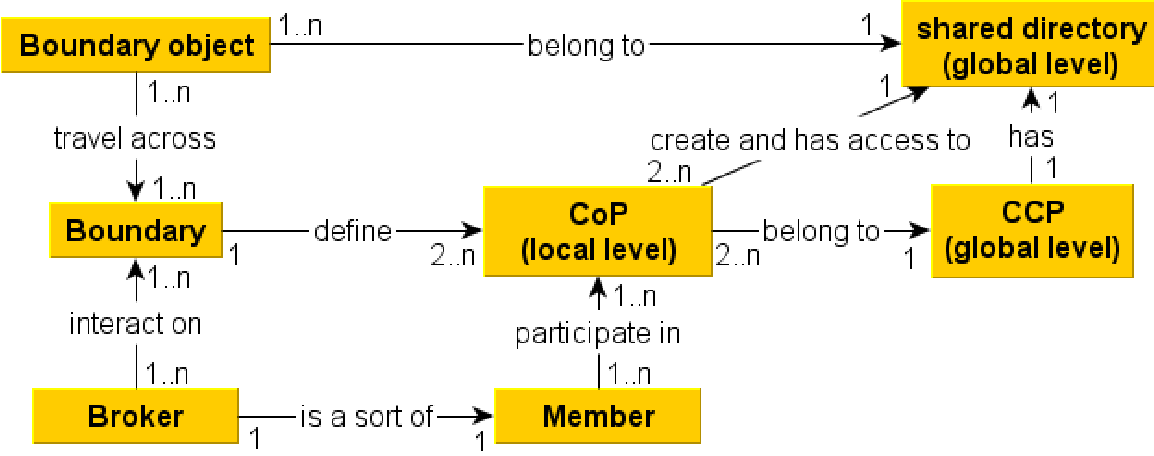
The proposed Interconnection of Communities of Practice (ICP) model is a refinement of Etienne Wenger’s "Constellations." While a Constellation assumes members share historical roots or global proximity, the ICP model acknowledges that in the digital age, members may only meet on the platform.
The Practitioner as a Node
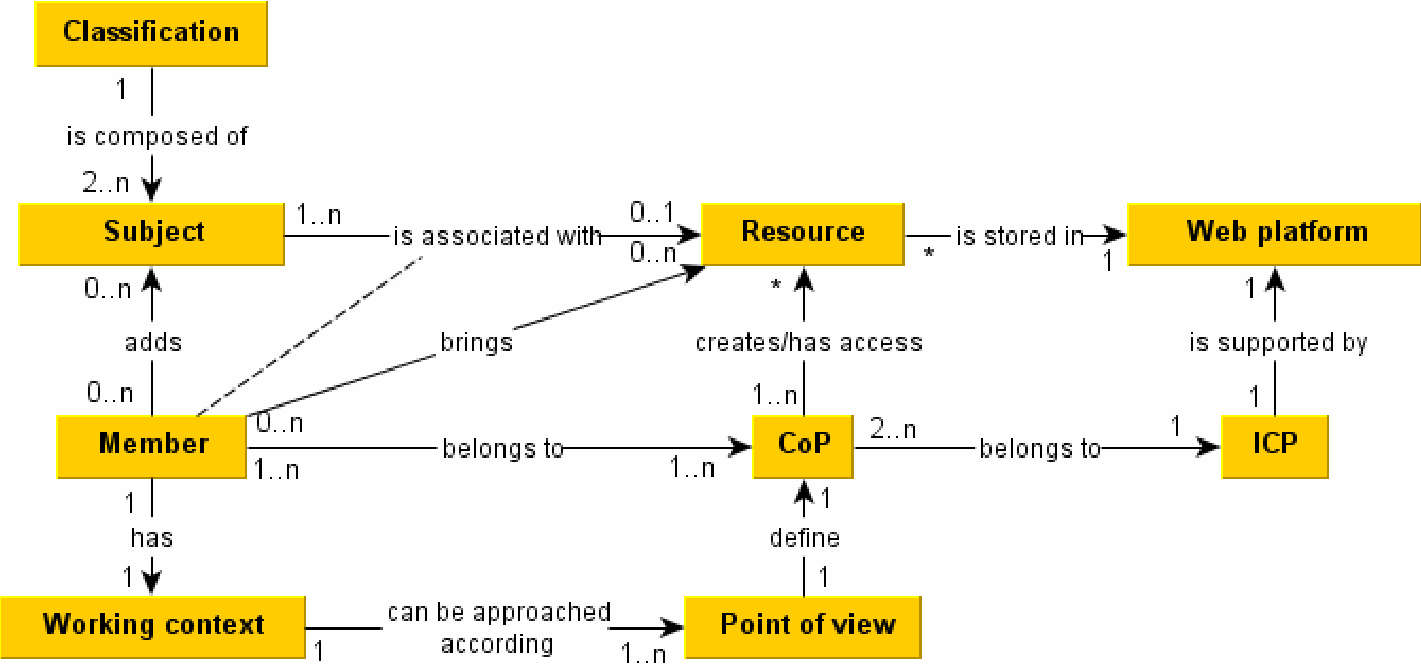
The model posits that a single person belongs to multiple CoPs simultaneously (e.g., based on their discipline, their institution, or their teaching method). By tagging a resource in one context, the user acts as a "broker," allowing that knowledge to flow into other overlapping communities.
Innovative Interaction Design
The TE-Cap 2 platform introduces a "Bubble Interface" for knowledge indexing. Instead of a flat list, the taxonomy is hierarchical.
- Contextual Filtering: The system uses the user's profile to "prune" the knowledge tree, showing only what is relevant to their specific working context.
- Dynamic Evolution: Users can add new subjects to the classification, ensuring the vocabulary stays current with actual practice.

Experiments & Results
The author conducted a 4-month field study with 42 tutors from 9 francophone countries.
Key Findings:
- Need for Cross-Border Connection: Questionnaire results showed a high demand for sharing "learning scenarios" and "tutor roles" beyond local institutional levels.
- Knowledge Evolution: 45 new subjects were added to the taxonomy by users, demonstrating that the community was actively shaping its own knowledge structure.
- The "Lurker" Effect: While only 15 discussion threads were started, 27 users were active readers. The author argues this "non-participation" is still a valid form of peripheral learning in a CoP.
Critical Analysis & Conclusion
The ICP model successfully transposes the theoretical "Constellation" concept into a practical Web 2.0 architecture. Its strength lies in Knowledge Indexation—moving beyond the chaos of hashtags to a structured, evolvable taxonomy.
Limitations: The study noted that without a "Community Leader," engagement can remain passive. Furthermore, many users struggled to understand the link between their profile settings and the content filters, indicating that innovative HCI features require better onboarding (perhaps via "software companions").
Future Outlook: TE-Cap 2 proves that professional social networks must be "context-aware." The future of expertise sharing lies not in bigger networks, but in smarter interconnections where the system understands the practice of the user, not just their connections.