
Bridging the Gap: Transforming Raw Data Mining into Business Intelligence
Knowledge Mining for the Business Analyst
The paper presents a comprehensive Knowledge Mining Framework designed for business analysts in the e-commerce and manufacturing sectors. It introduces a systematic pipeline that converts raw data mining results, specifically frequent sequence patterns, into "actionable knowledge" through semantic enrichment and multi-dimensional analysis modules.
TL;DR
While data mining algorithms have become increasingly powerful, they remains "black boxes" to the business analysts who actually make the decisions. This paper proposes a Knowledge Mining Framework that enriches raw frequent-sequence patterns with business metadata. In a real-world automotive application, it slashed analysis time by over 90% and identified savings worth hundreds of millions of dollars.
The "Interpretation Gap": Why Data Mining Fails the C-Suite
Most academic research focuses on making algorithms 5% faster or slightly more accurate. However, the authors identify a more critical bottleneck: The Human Gap. A business analyst doesn't care about a "support-confidence" score; they care about why a specific engine part is failing in 2024 models at 10,000 miles.
Existing tools are either too generic or require a PhD to interpret. The authors argue that for data mining to be truly "actionable," it must move beyond discovery into contextual enrichment.
Methodology: The Four Pillars of Actionable Knowledge
The framework moves beyond the traditional mining process by adding a heavy emphasis on what happens after the patterns are found.
1. Pattern Discovery & Constraints
The system allows users to define constraints (e.g., maximum elapsed time between failures), enabling "exploratory mining."
2. Data Enrichment (The Secret Sauce)
Instead of outputting simple sequences like [A -> B], the framework correlates these with:
- Demographics: Manufacturing plant, build year, engine type.
- Financials: Labor vs. part costs.
- Statistical Distribution: Mean and standard deviation of mileage at failure.
3. Multi-Dimensional Analysis
The framework provides three specialized lenses:
- Ranking: Prioritizing issues by financial impact.
- Clustering: Grouping similar failure patterns to find root causes.
- Prediction: Using historical patterns to flag future risks.
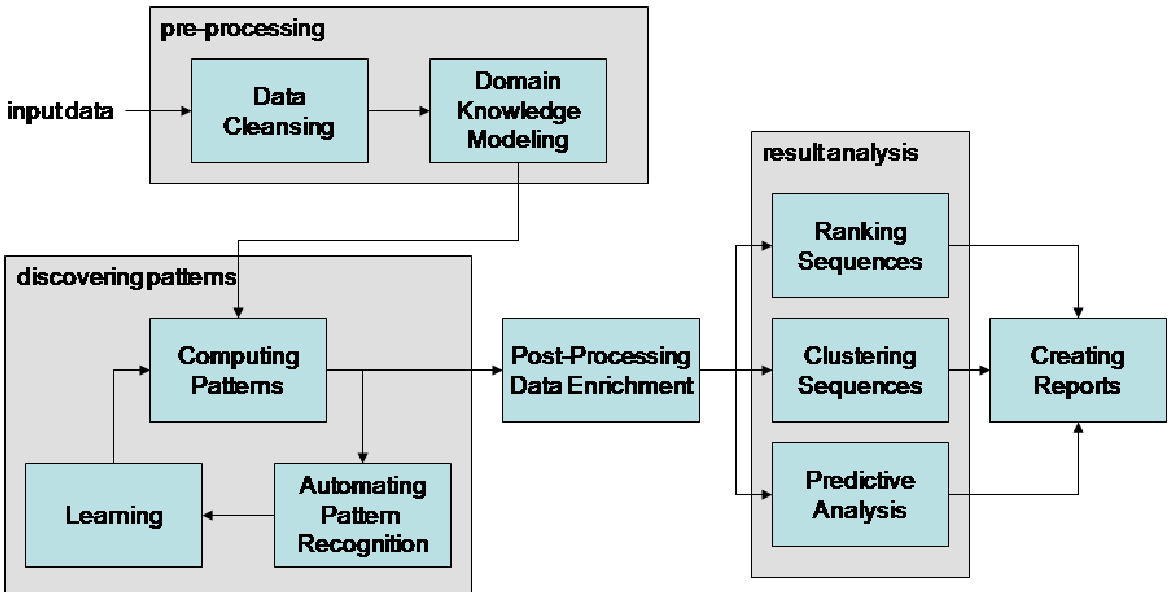 Figure 1: The proposed Knowledge Mining Framework, showing the flow from raw data to enriched business reports.
Real-World Impact: The $300 Million Use Case
The authors validated their framework using a massive dataset of 2,000,000 warranty claims from a vehicle manufacturer.
Key Discovery: Brakes and Axles
The framework identified a pattern of leaking parts in specific sub-systems. By looking at the enriched data, the analyst could see that 90% of these vehicles came from the same factory (P1) during the 2004 production year.
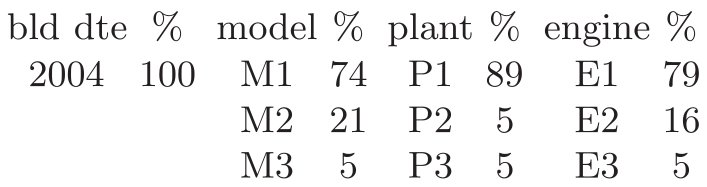 Table 3: Enriched demographic data showing the concentration of failures in Plant P1 and Engine E1.
The Financial Upside
By identifying these "root-cause" patterns quickly, the company could:
- Reduce labor costs: Designing engines for easier access to high-failure parts.
- Slash resolution cycles: Shortening the warranty response by 10 days leads to a $300M saving for a major OEM.
Critical Analysis & Expert Insight
The brilliance of this work is not in a new math formula, but in the Inductive Bias of its architecture: it assumes that patterns without context are noise.
Strengths:
- Speed to Insight: Reducing analysis from 45 days to "a few days" is a game-changer for industrial cycles.
- Actionability: It answers "Why" and "Where" (e.g., Plant P1), not just "What."
Limitations:
- The framework relies heavily on the quality of the "Pre-processing" and semantic normalization phase.
- While it handles frequent sequences well, it is unclear how it would handle highly non-linear or multi-modal data (e.g., sensor telemetry mixed with text comments).
Future Outlook
This paper serves as a precursor to modern "Automated Insights" platforms. Today, we might replace the "Report Creation" module with Generative AI to provide natural language narratives, but the underlying need for semantic enrichment remains the bedrock of industrial data science.