
Extenics-Driven IK: Redefining Knowledge Representation Beyond Static Data
12907_Knowledge Mining for Intelligent Decision Making in Small and Middle Business.
This paper introduces an Intelligent Knowledge (IK) representation framework based on Extenics theory, utilizing Matter-Element, Affair-Element, and Relation-Element models. It aims to transform static data into dynamic, multi-dimensional knowledge structures to enhance AI decision-making.
TL;DR
This research bridges the gap between formal logic and dialectical reasoning by introducing an Intelligent Knowledge (IK) framework powered by Extenics. By utilizing Matter-Element matrices, the framework captures not just what an object is, but its latent, dynamic, and relational transformations, providing a superior scaffold for AI to handle complex, contradictory scenarios.
Background: The Limits of Traditional Knowledge
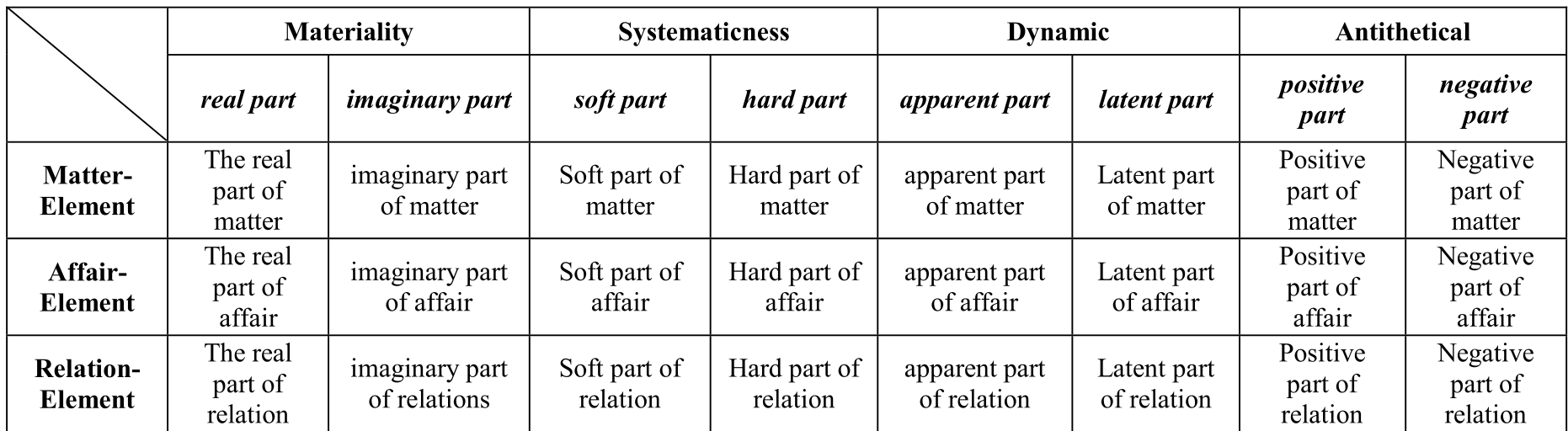
Most modern AI systems view knowledge as a collection of static triplets (Subject-Predicate-Object). While efficient for retrieval, this "flat" view fails when dealing with the real world's complexity—where an affair has "soft" parts (abstract qualities) and "hard" parts (physical constraints), or where a "latent" part of a relation might become "apparent" over time.
Methodology: The Matrix of Matter-Elements
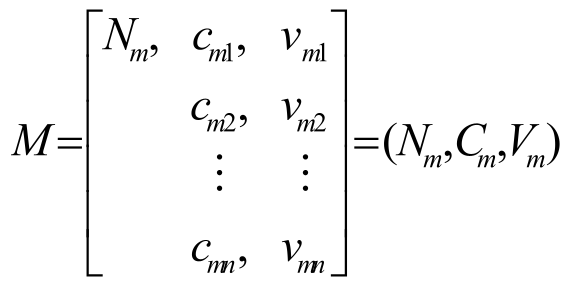
The authors leverage the fundamental logic of Extenics, which defines an element as: Where is the name, is the characteristic, and is the value. To handle complex entities, they expand this into a multi-dimensional matrix:
The Eight-Part View of Elements
A standout feature of this methodology is the categorization of knowledge into eight distinct dimensions, as seen in the table below. This allows the system to distinguish between the "Real part" (tangible) and the "Imaginary part" (conceptual) of an affair.
Implementation of Intelligent Knowledge (IK)
The paper defines a specific schema for IK nodes that includes auditing scores, last-used timestamps, and categorical metadata. This ensures that every piece of knowledge in the database is not just a value, but a traceable, evaluatable entity.
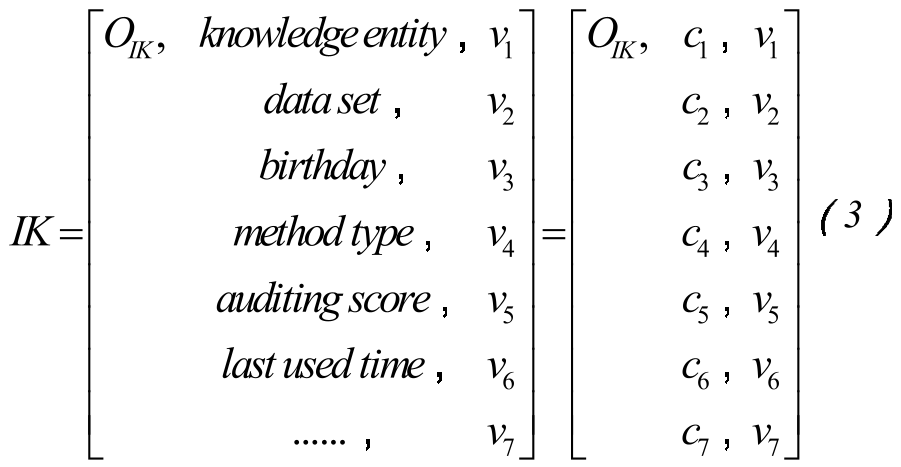
By structuring knowledge this way, the system can perform Extensible Analysis, looking for "Next IK" or "Last IK" links to understand the flow and transformation of information.
Deep Insight: Why This Matters for SOTA AI
While Large Language Models (LLMs) are great at probabilistic prediction, they lack a formal "world model" that understands the Antithetical (positive/negative) and Dynamic (latent/apparent) nature of properties.
This Extenics-based approach provides a "Logic Layer" that could theoretically sit on top of neural networks to:
- Solve Contradictions: Use extension rules to find a "v" that satisfies conflicting requirements.
- Dynamic Knowledge Update: Track the "latent" features that may become relevant under different contexts ().
Conclusion
The proposed IK framework moves us closer to "Cognitive AI" by treating knowledge as a multi-faceted, evolving matrix rather than a static record. Despite the mathematical complexity, the structure it provides—especially the distinction between soft/hard and latent/apparent parts—is essential for the next generation of expert systems and decision-support engines.
Future Outlook: The integration of this formal Extenics logic with modern Graph Neural Networks (GNNs) could yield highly resilient AI systems capable of human-like "out-of-the-box" thinking.