
Mining the Path to Success: How Storyboarding Formalizes Didactic Knowledge
Knowledge mining for supporting learning processes
This paper introduces a knowledge mining framework based on "Storyboarding," a semi-formal modeling approach used to design and optimize collegiate learning processes. By constructing decision trees from historical student paths, the system predicts success chances and recommends optimal curriculum sequences to "humans in the loop."
TL;DR
Educational design is often more of an art than a science, leading to inconsistent student outcomes. This paper presents Storyboarding, a semi-formal graph-based representation of learning processes. By treating a curriculum as a navigable map and applying data mining to historical student "travels," the authors can predict a student's success probability and suggest "GPS-like" rerouting to optimize their academic journey.
Problem & Motivation: The "Jungle" of Academic Choices
In the traditional university setting, two major issues persist:
- Didactic Deficiency: Professors are subject-matter experts but often lack formal training in teaching methodology (didactics).
- Hidden Constraints: Students face a "jungle of opportunities" when picking courses, often unaware of how their sequence of subjects (their "path") influences their final success.
Prior work like SiteLang focused on modeling web systems, but applying such logic to human learning requires accounting for "humans in the loop"—their unpredictable wishes, talents, and prerequisites. The authors argue that while individual behavior varies, didactic variants (the ways a subject can be taught and learned) are finite and modelable.
Methodology: From Storyboards to Decision Trees
The core of the approach lies in treating education as a nested hierarchy of directed graphs.
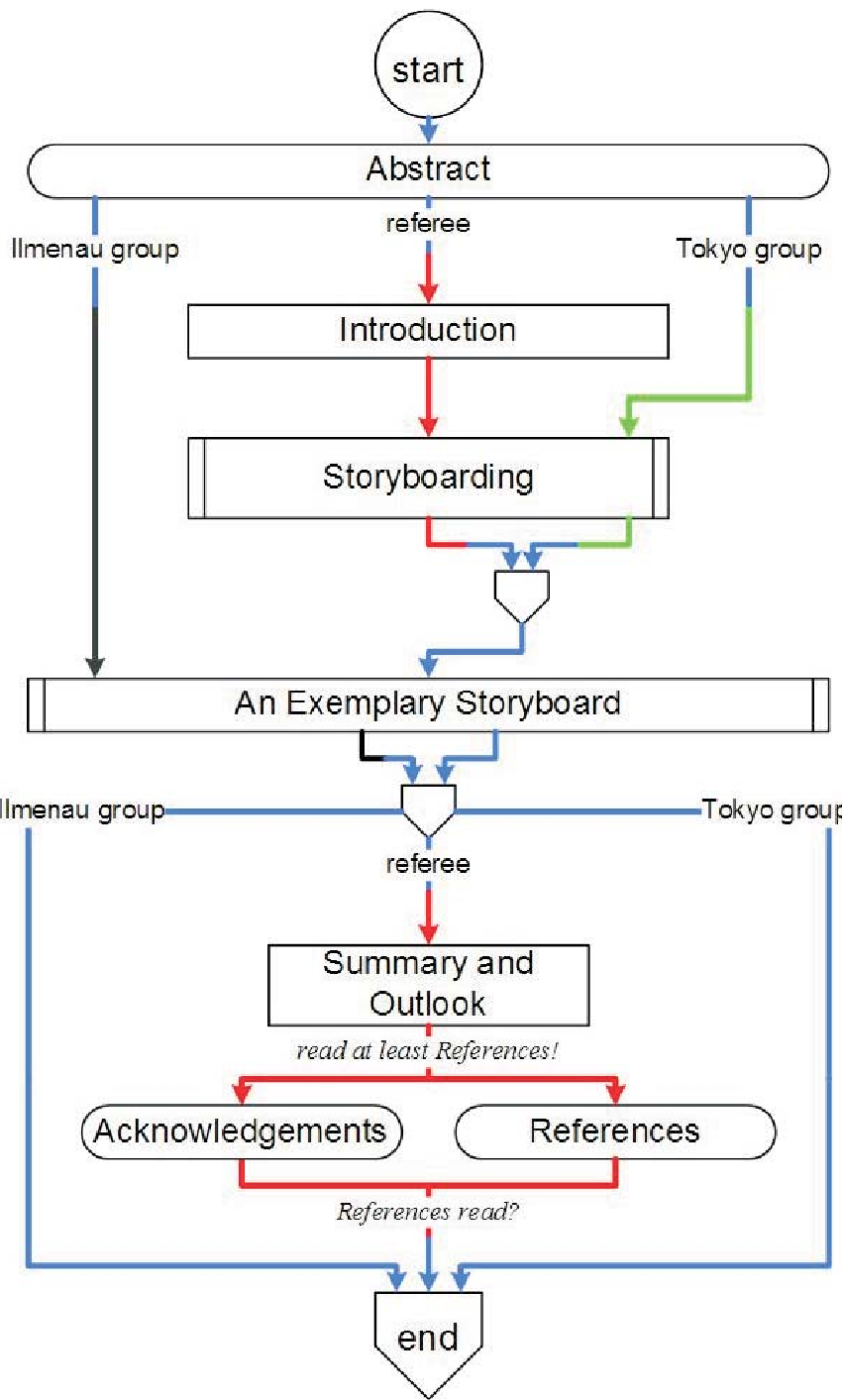
1. The Storyboard Architecture
- Scenes: Atomic learning activities (e.g., a lecture, a PDF, or a lab).
- Episodes: Sub-graphs that encapsulate complex modules.
- Edges: Transitions that can be "color-coded" or conditioned on prerequisites.
2. Knowledge Mining via Flattening
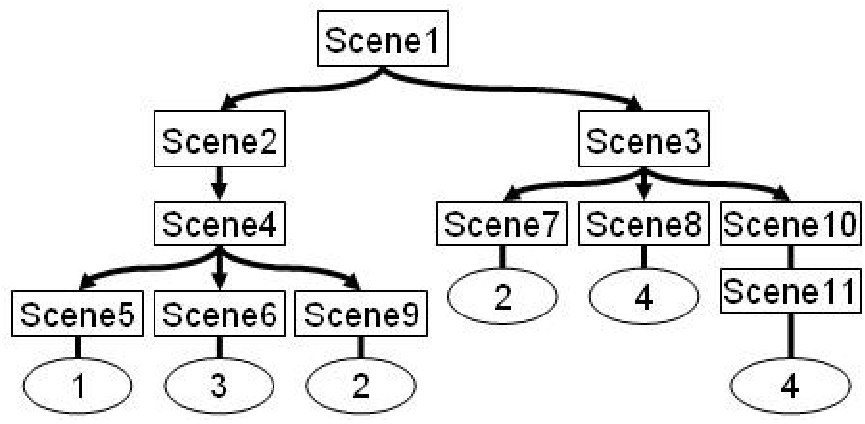
To analyze success, the system "flattens" these nested hierarchies into linear paths of atomic scenes. By aggregating the paths taken by previous students and their resulting grades, the authors construct a Decision Tree.
- Nodes: Common starting sequences of subjects.
- Leaves (Labels): Contain the distribution of marks and the Weighted Arithmetic Average (WAA).
Experiments & Results: Real-World Deployment
The system was prototyped in Prolog and tested at Tokyo Denki University. Students in their first semester submitted a plan (a proposed path). The system then performed two tasks:
- Estimation: If a student's path matches a branch in the tree, it returns the expected WAA.
- Optimization: If the path is non-optimal or unique, the system identifies the "longest common sub-path" and suggests a "Recommended Rest Path" that leads to the highest statistical success.
The researchers introduced Significance of Estimation, a metric determining how much of the student's plan is actually backed by historical data, ensuring students don't over-rely on predictions based on small sample sizes.
Critical Analysis & Conclusion
Takeaway
The true value of this work is the formalization of didactics. By moving pedagogical design from the professor's head into a semi-formal graph, it becomes subject to AI verification, validation, and evolutionary refinement.
Limitations
- Data Dependency: The system's accuracy is entirely dependent on the volume of historical "traversals." Rare or innovative student paths may suffer from low significance scores.
- Quantitative Bias: Success is measured via grades (WAA). This doesn't account for qualitative growth or "soft" skills that aren't captured in a final mark.
Future Work
The authors envision a "Pattern Library"—a collection of proven didactic templates that can be dragged and dropped to build new courses. Integrating this with Dynamic Learning Need Reflection Systems (DLNRS) could eventually allow universities to manage physical resources (rooms, teachers) in real-time based on the predicted paths of their student body.