
Bridging the Crowd Gap: An Ontology-Driven Framework for Innovation Intermediaries
Knowledge Repository Framework for Crowdsourcing Innovation Intermediary: A Proposal
The paper proposes a conceptual Knowledge Repository (KR) framework for crowdsourcing innovation intermediaries, designed to integrate community building, brokering, and technology transfer. The framework is formalized using ontology engineering to ensure semantic interoperability and structured knowledge reuse across the innovation lifecycle.
TL;DR
This paper introduces a formal Knowledge Repository (KR) framework for Crowdsourcing Innovation Intermediaries. By leveraging Ontology Engineering, the authors propose a system that integrates community building, brokering, and technology transfer into a unified "Collective Memory," solving the fragmentation and interoperability issues prevalent in current Open Innovation platforms.
Background: The Rise of the Intermediary
In the era of Open Innovation, companies no longer rely solely on internal R&D. Instead, they look to the "crowd"—a global network of specialists, researchers, and hobbyists. However, the bridge between a company's problem and the crowd's wisdom is often fragile. Crowdsourcing intermediaries exist to facilitate this, but most lack a structured way to capture, store, and reuse the massive amounts of knowledge generated during the process.
The Problem: Why Knowledge Repositories Fail
The authors identify a critical gap: while the Web 2.0 has made collaboration easy, the management of resultant knowledge remains chaotic. Current intermediaries often focus on only one slice of the pie—either community voting or brokering—but rarely the entire value chain. Furthermore, standard Knowledge Repositories (KRs) often fail because:
- They return too much "noise" (unfiltered information).
- They lack semantic structure, making it impossible for different systems to "talk" to each other.
- They don't provide a clear path from a raw idea to a commercialized technology.
Methodology: The Power of Ontologies
To solve this, the authors turn to Ontologies—a formal, explicit specification of a shared conceptualization. Instead of treating data as entries in a flat table, an ontology defines the relationships and logic between entities (e.g., how a "Seeker's Challenge" relates to a "Solver's Intellectual Property").
The Integrated Framework
The proposed framework is divided into three core modules, as visualized in the architecture below:
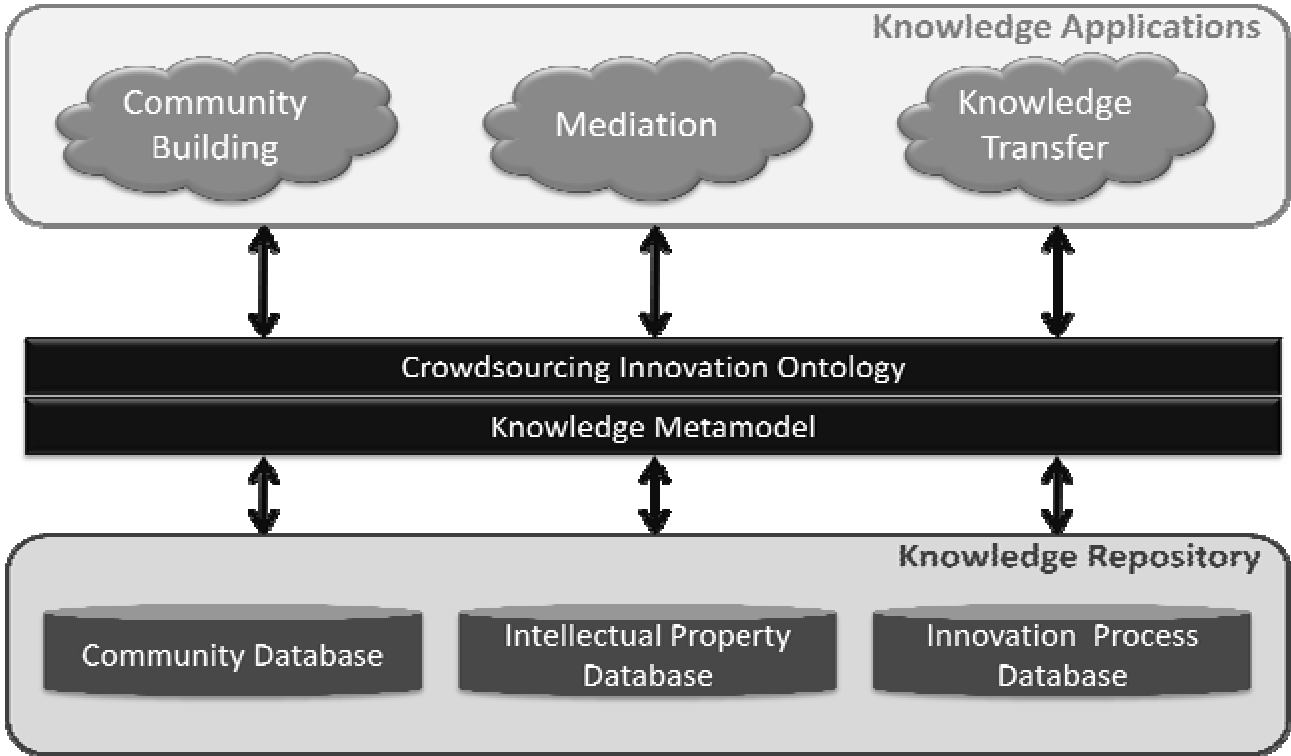
- Knowledge Network (Community Building): Focuses on capturing the "Collective Memory." It tracks user profiles, moderates virtual communities, and stores the explicit knowledge exchanged during social learning.
- Innovation Brokering: Manages the "business" side of innovation—contract negotiations, project management, and Intellectual Property (IP) management.
- Innovation Incubator (Technology Transfer): The final frontier where ideas become products. This module supports technology tracking, funding opportunities, and market trend analysis.
Key Insights & Results
The core contribution is the shift from Information Retrieval to Knowledge Reuse. By defining a "Domain Ontology," the researchers provide:
- Standardized Vocabulary: Ensuring all stakeholders (seekers, solvers, and brokers) use the same terms.
- Logical Inference: Allowing the system to suggest connections between a company's need and a solver's previous work automatically.
- Interoperability: Enabling the repository to function as a "Content Theory" that can be integrated into broader Enterprise Resource Planning (ERP) systems.
The paper argues that for MSMEs (Micro, Small, and Medium Enterprises), such an integrated service is not just a luxury but a necessity to compete with larger firms that have massive internal R&D budgets.
Critical Analysis & Conclusion
Takeaway
The value of crowdsourcing isn't just in the "winning idea," but in the structured knowledge generated along the way. This paper provides the architectural skeleton (the ontology) needed to prevent this knowledge from leaking out of the innovation pipeline.
Limitations & Future Work
While the framework is conceptually robust, the paper remains at the "proposal" stage. The next challenge—acknowledged by the authors—is the actual implementation of this ontology using languages like WebODE or OWL and testing it in a real-world brokering environment. Future research will need to address the "Incentives Gap"—how to motivate participants to contribute high-quality metadata that makes the ontology work.
Final Thought: As AI begins to play a larger role in parsing human ideas, having a formal "Domain Ontology" like the one proposed here will be the prerequisite for any AI-driven innovation intermediary.