
The Cloud Model: Bridging the Gap Between Quantitative Data and Qualitative Wisdom
Knowledge representation and discovery based on linguistic atoms
The paper introduces the Cloud Model, utilizing "Linguistic Atoms" to bridge quantitative data and qualitative knowledge in databases (KDD). It represents linguistic terms via three digital characteristics—Expected Value (Ex), Entropy (En), and Deviation (D)—effectively integrating fuzziness and randomness into a unified framework.
TL;DR
In the realm of Knowledge Discovery in Databases (KDD), we often face a paradox: the more precise our data mining rules, the less robust they are to real-world changes. This paper introduces the Cloud Model, a revolutionary framework that transforms "hard" numbers into "soft" Linguistic Atoms. By modeling uncertainty through the dual lenses of fuzziness and randomness, it allows AI to reason and generalize like a human expert.
Context: The Robustness Crisis in Data Mining
Traditional data mining outputs look like this: "With 54.14% support, customers aged 20.124 years have balances lower than $516.20."
From an academic standpoint, this is fragile. If the database updates slightly, the rule breaks. The authors point out the Principle of Incompatibility: as the complexity of a system increases, our ability to make precise yet significant statements about its behavior diminishes. We need a way to say: "Generally speaking, young people have low balances."
Methodology: The Architecture of a Cloud
The core innovation is the Compatibility Cloud. Unlike a traditional fuzzy membership curve (which is a one-to-one mapping), a cloud is a one-to-multi mapping.
1. The Three Digital Characteristics
Any linguistic atom (like "Young" or "About 20") is defined by a triplet:
- Expected Value (Ex): The mathematical "center" of the concept.
- Entropy (En): Represents the fuzziness (how many elements fit the concept).
- Deviation (D): Represents the randomness (the "thickness" of the cloud).
2. Forward and Backward Generators
- Forward Cloud Generator: Converts the triplet into "Cloud Drops" (quantitative points).
- Backward Cloud Generator: Reverse-engineers raw data points back into a qualitative linguistic triplet.
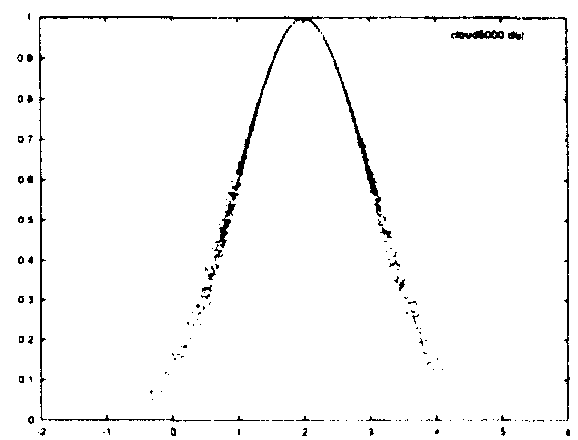 Visualizing the transition from 100 to 5,000 drops: As density increases, the stable 'shape' of the linguistic concept emerges, showing the integration of fuzziness and randomness.
Automatic Hierarchy Generation
One of the paper's most powerful contributions is the Cloud Transform. By treating attributes as linguistic variables, the system can automatically group data into higher-level abstractions.
By synthesizing two atoms into a Virtual Linguistic Atom, the system ensures that the "torque" (mathematical weight) is balanced. For example, "about 14" and "about 18" are mathematically merged into the broader concept of "teenager."
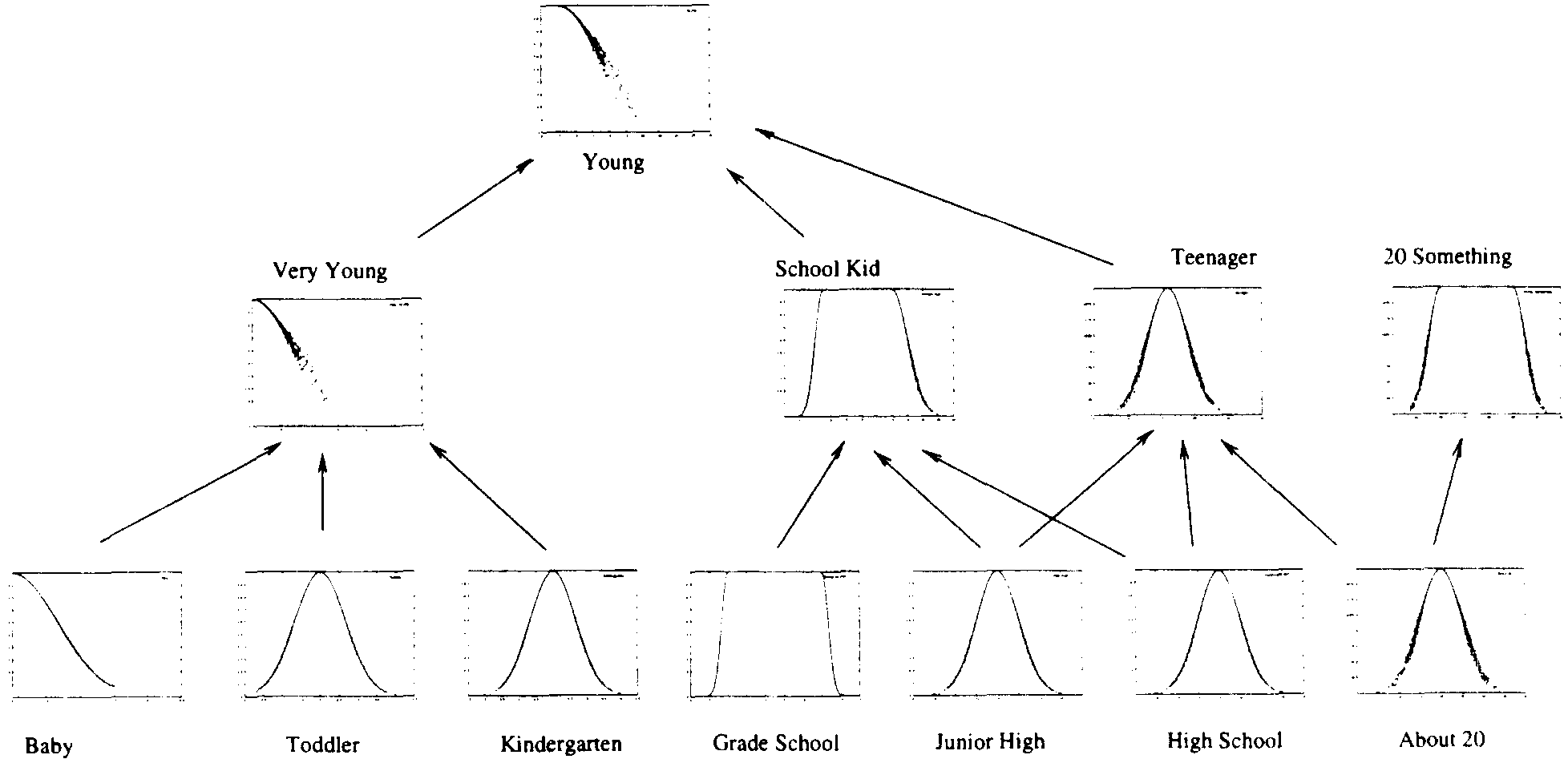 Figure 8: A generated hierarchy where raw age data flows into specific labels like "About 20" and finally into abstract strategic concepts like "Young".
Predictive Data Mining: Chaining Uncertainty
In standard prediction, we lose the "nuance" of uncertainty at every step of a rule chain. Using the Cloud Model, when a rule like "If A then B" fires, the output is not a fixed number but a set of cloud drops. This preserves the "softness" of the prediction, mimicking how a human expert gives a range or a "fuzzy" estimate rather than a rigid value.
Critical Insight & Conclusion
This paper is a seminal work in Soft Computing. It acknowledges that uncertainty is not just a lack of data, but an inherent property of human language.
Key Takeaways:
- Independence from Rigidity: Qualitative labels are more stable than quantitative thresholds.
- Unified Mathematical Framework: It provides a bridge (the triplet ) between the statistical world (probability) and the logical world (fuzzy sets).
- Future Impact: While written in the context of 1990s KDD, its principles are increasingly relevant to modern "Explainable AI" (XAI) and LLMs, where the goal is to map high-dimensional latent vectors back to human-understandable linguistic concepts.
The Cloud Model proves that in the search for knowledge, sometimes it is more robust to be "vaguely right" than "precisely wrong."