
Krowdix: Beyond Connectivity — Simulating the Human Logic Behind Social Networks
Simulation of Online Social Networks with Krowdix
This paper introduces Krowdix, an Agent-Based Modeling (ABM) simulation framework designed specifically for Online Social Networks (OSNs). Unlike traditional statistical models, Krowdix simulates network evolution through individual agent behaviors, profiles, and context-dependent actions, providing a discrete-time environment for studying complex social dynamics.
TL;DR
Static graphs and statistical probabilities have long dominated social network simulations, but they miss a critical factor: the user. Krowdix is a new simulation platform that uses Agent-Based Modeling (ABM) to put individual behavior back at the center of the network. By modeling users as "agents" with distinct profiles and goals, it allows researchers to see how personal choices—rather than just math—drive the evolution of platforms like Facebook.
The "Structural" Blind Spot
Most researchers look at Online Social Networks (OSNs) as a series of dots and lines (nodes and edges). While this is great for measuring "centrality" or "density," it doesn't explain why a link is formed.
Traditional tools (like Pajek or UCINET) often treat network growth as a statistical inevitability. They miss the micro-level rationality: Why does a user choose to follow a stranger? How does a "Trending Topic" change individual posting habits? Without modeling the user's intent, our simulations are just shadows of reality.
Methodology: The Anatomy of Krowdix
Krowdix departs from the norm by defining three core components:
- Social Network Users (SNUs): These are the agents. They don't just exist; they act. Each SNU has a Profile (e.g., "The Power User" or "The Town Crier") that dictates how frequently they perform certain actions.
- Profiles and Quotas: To simulate the passage of time, Krowdix uses a discrete-time system where actions "cost" points. If an agent wants to "Create a Blog," it might take two simulation steps to complete, realistically capping how much any one user can do.
- System Actions: Unlike other simulators that are "set and forget," Krowdix allows researchers to inject "System Actions"—unexpected events like a server crash or a change in privacy policy—to see how the agents react in real-time.
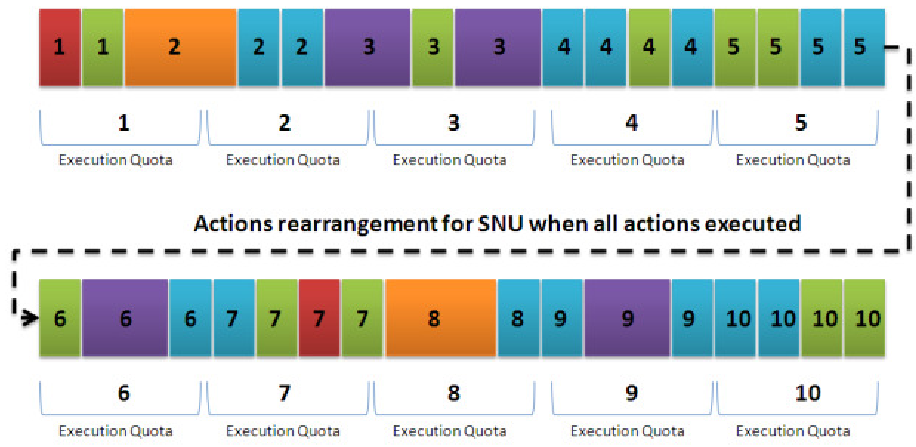 Figure 1: The execution order and quota-based management of agent actions.
Exploring the "Time Tree"
One of the most innovative features of Krowdix is its Simulation Tree. Since agents and researchers can make different choices at any step, the simulation isn't a single line; it's a branching path.
- Forward/Backward Navigation: Researchers can "rewind" a simulation and change a variable (like decreasing user activity) to see how it leads to a different social outcome.
Case Study: Reconstructing Facebook
The authors validated Krowdix by mapping Facebook's complex ecosystem (Events, News Feeds, Groups) onto Krowdix primitives.
| Profile | Core Actions | Weight (Frequency) |
|---|---|---|
| The Deep End Diver | Creating Relationships | 60% Focus on Linkage |
| The Town Crier | Status Updates | High Content Volume |
| The Moderate User | Mixed / Passive | Low Frequency |
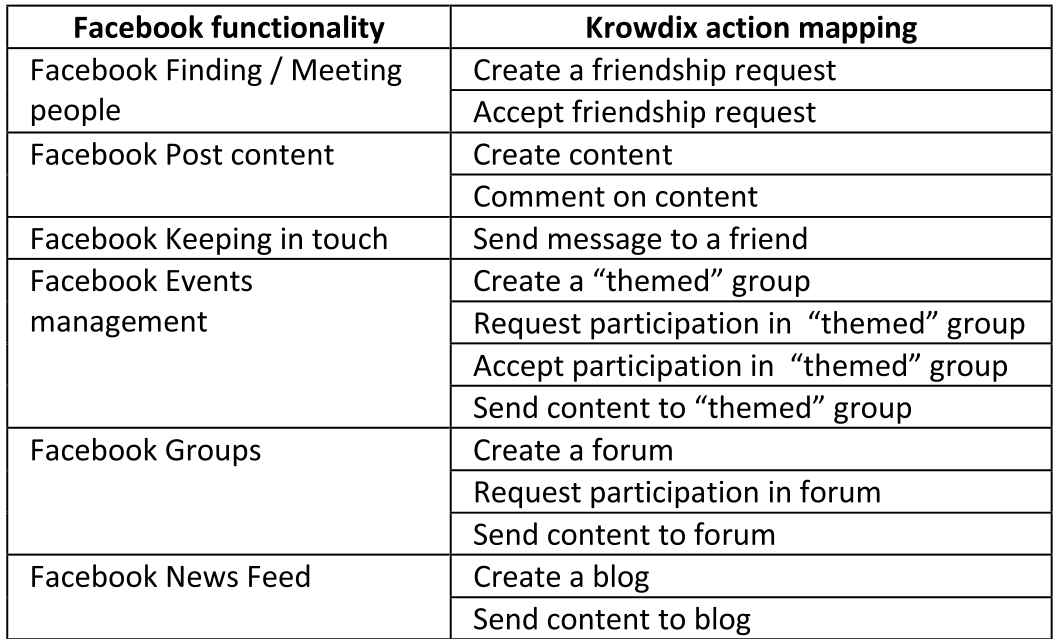 Figure 2: Mapping Facebook functionalities to Krowdix action logic.
The simulation successfully mirrored the "real" Facebook experience: as the population grew, it became more heterogeneous, eventually forming highly coupled clusters (echo chambers) based on the agents' profile weights.
Critical Insight: Why This Matters
The value of Krowdix lies in its Extensibility. Because it is built on an agent-oriented framework, it can adapt as social networks change. If a new platform like TikTok introduces a new interaction (e.g., "Dueting"), Krowdix simply requires a new Action definition rather than a total rewrite of its mathematical core.
Limitations: Currently, the "rationality" of agents is still based on weighted probabilities (profiles). A future, more "intelligent" version of Krowdix might incorporate Large Language Models (LLMs) to give agents truly autonomous decision-making capabilities.
Conclusions
Krowdix effectively shifts the focus of OSN simulation from "What does the graph look like?" to "How did the users build this?" By providing a platform where micro-behaviors drive macro-results, it opens the door for more psychological and sociological depth in digital research.
Takeaway: To understand the network, you must understand the agent. Krowdix provides the playground for that discovery.