
Decoding Creativity: How Your Body Language Reveals Your Emotions During Design
Application of Classification Method of Emotional Expression Type Based on Laban Movement Analysis to Design Creation
This paper presents a framework for estimating emotions during digital design tasks by applying Laban Movement Analysis (LMA) to body motions. By classifying users into four distinct "emotional expression types" using LMA-based feature values and Support Vector Machines (SVM), the authors achieved a high emotion estimation accuracy of approximately 80%.
TL;DR
Researchers have developed a method to "read" the emotions of designers by analyzing their body movements using Laban Movement Analysis (LMA). By classifying people into different "expression types," their system can estimate whether a user is feeling excited, frustrated, or bored with 80% accuracy, even when the movements are as subtle as those made while sitting at a computer.
The Problem: Why Facial Recognition Isn't Enough
While AI has become adept at reading faces (thanks to pioneering work by Paul Ekman), facial expressions are often masked or neutral when we are deeply focused on a creative task like 3D modeling or graphic design. Body movement provides a "leaky" channel where true emotions often surface, but the challenge lies in the sheer variety of how people move. One person might express frustration through sharp, sudden movements, while another might simply sit more rigidly. Without account for these individual "expression styles," general AI models often fail.
Methodology: The Laban Insight
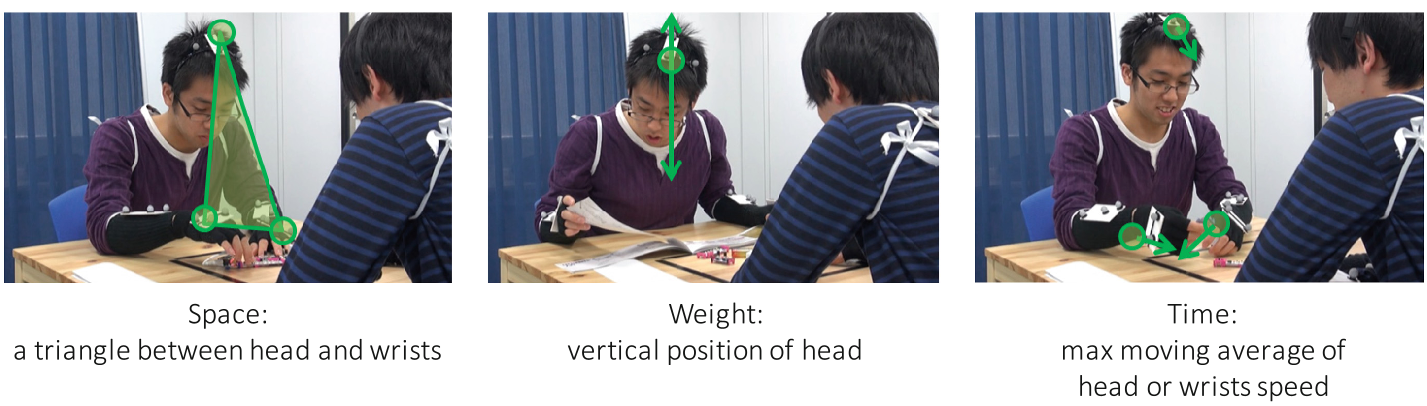
To solve this, the authors turned to Laban Movement Analysis (LMA), a theoretical framework traditionally used by dancers and actors to describe human movement. They focused on three "Effort" factors:
- Space (Direct/Indirect): Measured by the area of the triangle formed by the head and wrists.
- Weight (Strong/Light): Measured by the vertical positioning/pressure of the head.
- Time (Sudden/Sustained): Measured by the speed and acceleration of the head and wrists.
The Workflow
The researchers combined these LMA features with a Core Affect Model (mapping emotions onto axes of Pleasantness and Arousal) and a unique Expression Sensitivity (ES) parameter.
Rather than treating everyone the same, they used Ward’s hierarchical clustering to group participants into four "Types":
- Type 1: Balanced expression (not dominated by Time).
- Type 2: Space-dominant (emotions show through directional bias).
- Type 3: Time-dominant (emotions show through speed changes).
- Type 4: Weight-dominant (emotions show through posture/strength).
Experiments: Designing with the SONY FES Watch U
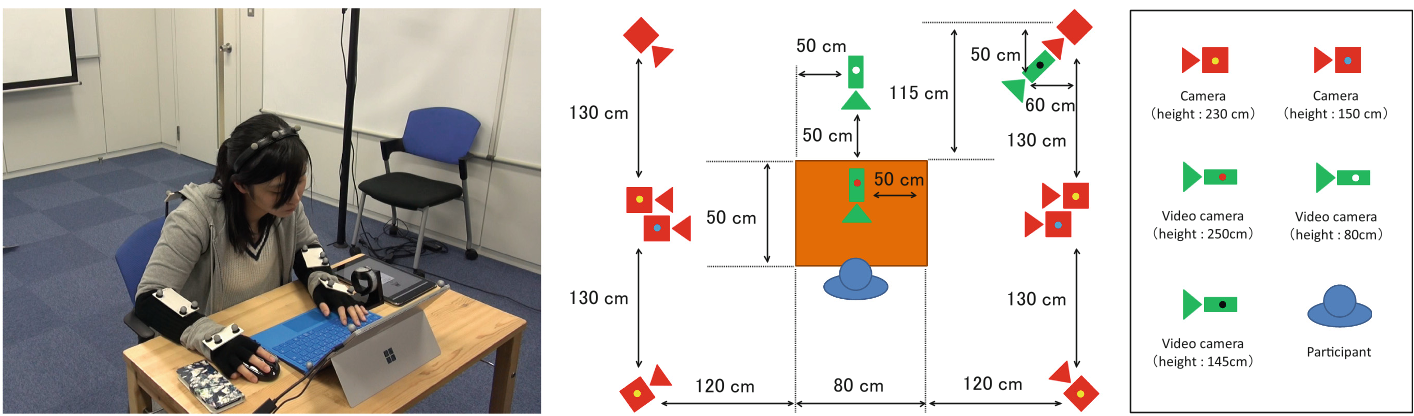
The authors tested their theory using a design task where participants created custom faces for the SONY FES Watch U (an e-paper smartwatch). While participants designed on a Surface Pro, their movements were tracked via a high-precision Vicon motion capture system.
Comparing Accuracy
By training a Support Vector Machine (SVM) on these specific types, the results showed a massive boost in performance.
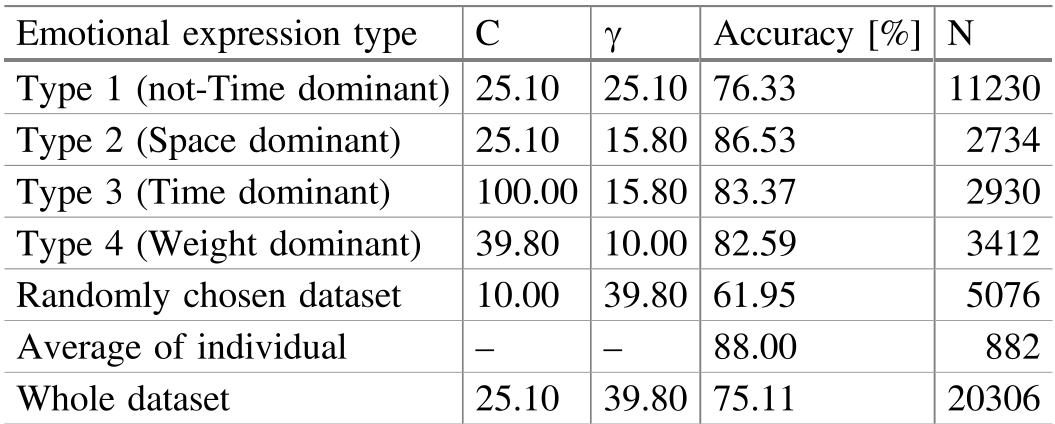
As seen in the data, identifying the Expression Type first allows the model to reach 80-86% accuracy, compared to only ~62% when using a generic, randomly chosen dataset. This proves that "knowing the mover" is key to "knowing the emotion."
Deep Insight & Conclusion
This research moves us closer to Affective Computing that doesn't require a camera pointed at your face. By understanding that different people have different "emotional signatures" in their movements, we can build smarter workstations that can sense when a designer is "in the zone" (Flow) or when they are becoming "fatigued" and need a break.
Limitations & Future Work: The current study relies on expensive motion capture markers. The authors acknowledge that the next step is to translate these LMA features into data that can be gathered from standard devices—like the movement of a mouse or the subtle tilt of a head through a standard webcam. Once that leap is made, this technology could become a standard part of our digital creative tools.