
Beyond Profiles: Exploiting Label-Dependent Topology for Superior Social Network Classification
Label-Dependent Feature Extraction in Social Networks for Node Classification
The paper introduces a novel feature extraction method for within-network node classification in social networks. The core approach, called Label-Dependent (LD) feature extraction, combines network topology with class label information to create discriminative attributes, achieving near-perfect accuracy (up to 99%) on the Attendee Meta-Data (AMD) dataset.
TL;DR
This research challenges the reliance on static user profiles for social network classification. By introducing Label-Dependent (LD) feature extraction, the authors demonstrate that the "social context"—defined by how a node interacts with specific class clusters—is a far more potent predictor than age, gender, or location. Their method boosted classification accuracy from roughly 76% to a staggering 99% on real-world conference data.
The "Blind Spot" in Network Analysis
In standard machine learning, we often assume objects are independent. However, in social networks, homophily (the tendency of individuals to associate with similar others) creates relational autocorrelation.
The problem with existing approaches is twofold:
- Label-Independent (LI) Features (like Betweenness Centrality) describe the shape of the network but ignore the color (labels) of the connections.
- Raw Attributes (Profiles) are often "noisy" or voluntarily self-reported, making them less reliable than actual behavioral links.
Methodology: The Power of Sub-Network Selection
The authors' core contribution is a systematic way to turn the "neighborhood" into a feature vector. They define a selection operator , which isolates a sub-graph containing only nodes of label .
Key Engineered Features:
- NCN (Normalized Number of Connections): Instead of just looking at total degree, it measures the ratio of a node's connections that lead to a specific class.
- NCS (Normalized Strength): For weighted networks, this measures the aggregate intensity of interactions with a specific class relative to all interactions.
- Custom Label-Dependent Metrics: The authors generalize this to transform any metric (like Clustering Coefficient) into a label-aware version.
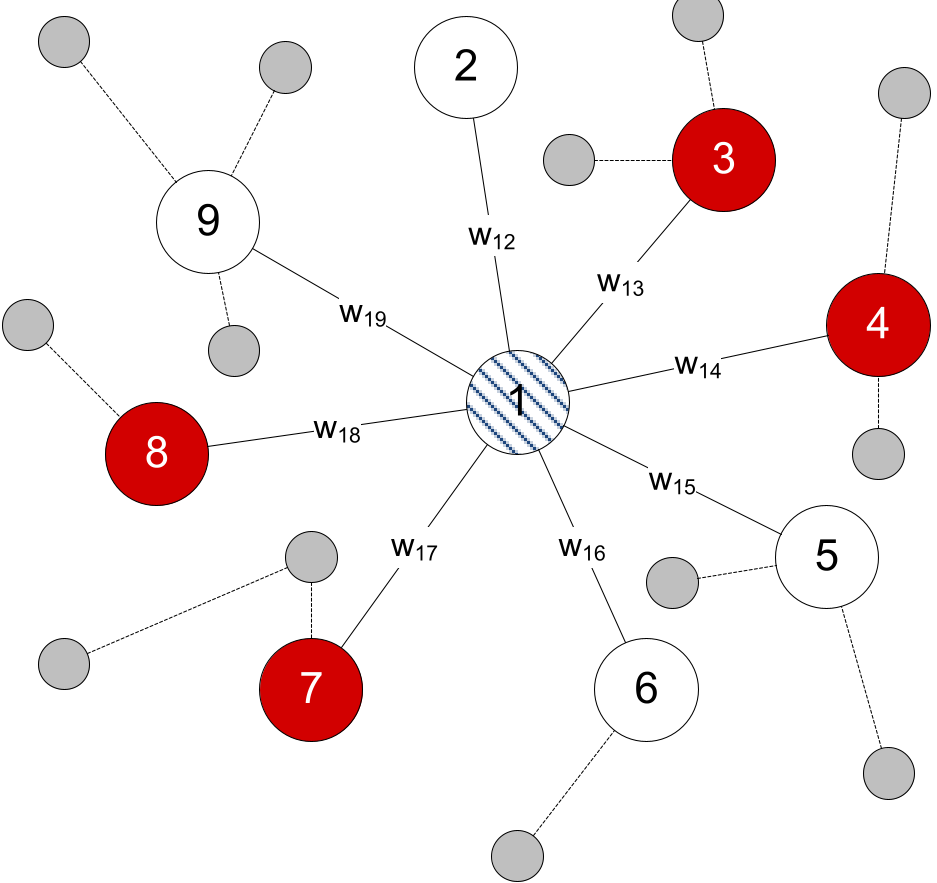 Fig 1: Illustration of how features are weighted based on label-dependent neighborhoods.
Experimental Setup: The AMD Dataset
The researchers tested their theory on the Attendee Meta-Data (AMD) dataset from "The Last HOPE" conference. They mapped 334 participants and 68,770 directed connections based on shared talk attendance—a proxy for real-world interest.
They compared four feature sets:
- Set 1: Raw Profile Data (Age, Sex, etc.)
- Set 2: Label-Independent Features (Topological only)
- Set 3: Label-Dependent Features (The proposed method)
- Set 4: All features combined.
Results: A Dramatic Leap in Performance
The results were nearly binary in their clarity. While raw profiles and topological features struggled to break the 80% accuracy barrier, the inclusion of Label-Dependent features pushed accuracy to 98-99% across different classifiers (AdaBoost, MLP, and SVM).
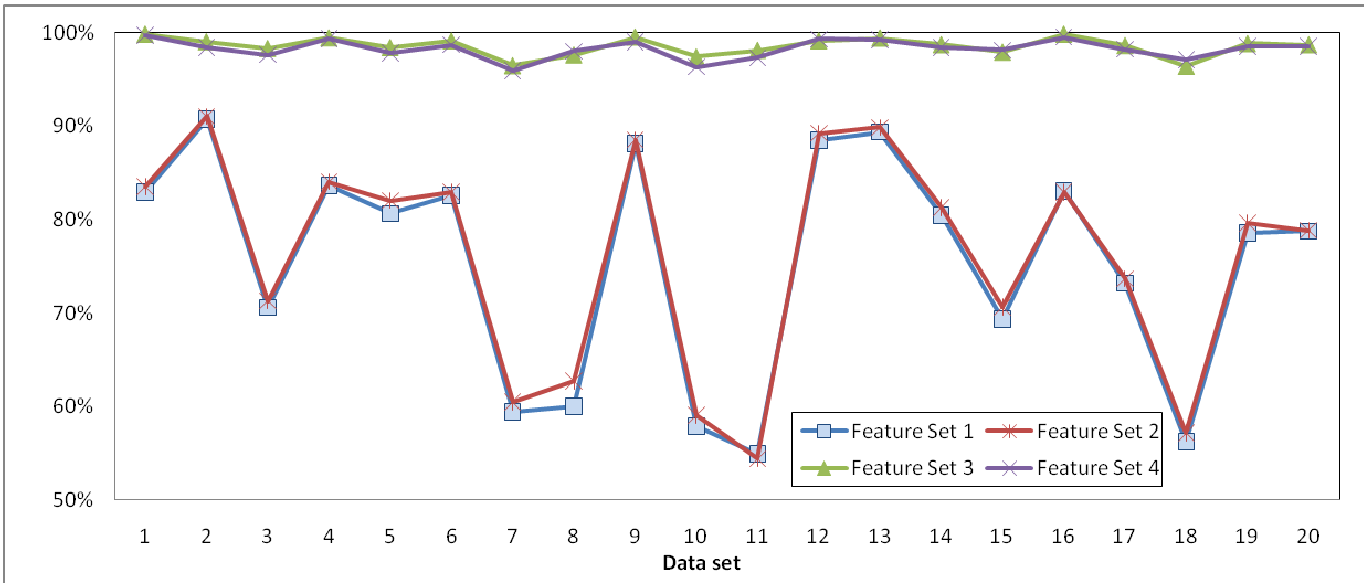 Fig 2: Average accuracy for 20 data sets showing the dominance of Feature Sets 3 and 4.
Interestingly, Set 4 (All features) performed slightly worse than Set 3 (LD features only). This suggests that "regular" profile features actually act as noise, degrading the high-quality signal provided by the network structure.
Critical Insight & Conclusion
The "Surprising Outcome" noted by the authors—that profile data might be better left out of the model—highlights a profound truth in social data science: Actions speak louder than profiles.
Takeaways:
- Context is King: The specific sub-set of the network a person "lives" in is the best indicator of their properties.
- Reliability: Behavioral data (captured via RFID in this study) provides a more objective ground truth than self-declared tags.
- Future Path: While this work uses classical classifiers, the "selection operator" logic is a precursor to modern Graph Neural Networks that use message passing to aggregate neighborhood labels.
Limitations: The study assumes we have some labeled nodes to start with (within-network classification). In a purely "cold start" scenario with 0% labels, this method would require initial iterative estimation.