
The Social Network of Labor: Decoding the Mechanics of Persistent Inequality
Networks in labor markets: Wage and employment dynamics and inequality ଁ
This paper presents a stochastic model of labor markets where job information is transmitted through social networks. Using Markov processes and the theory of supermodular games, the authors prove that wages and employment are "strongly associated," leading to persistent inequality and correlated labor outcomes among connected agents.
TL;DR
Why does wage inequality persist even when groups have similar skills? This seminal paper by Antoni Calvó-Armengol and Matthew O. Jackson provides a mathematical framework showing that labor markets are inextricably linked to social networks. By proving that employment status is "strongly associated" through networks, the authors demonstrate how a "bad" starting state in a social group leads to higher dropout rates and a self-perpetuating cycle of poverty.
Background: The Hidden Infrastructure of Jobs
It is a well-documented stylized fact: between 25% and 80% of all jobs are found through personal contacts. However, most economic models treat job seeking as an individual endeavor. Calvó-Armengol and Jackson shift the focus to the social graph, arguing that the network is the primary conduit for information, and therefore, the primary driver of inequality.
1. The Core Intuition: Strong Association
The paper’s first major breakthrough is proving that wages are not just correlated, but strongly associated across a network.
The Conflict: Competition vs. Cooperation
You might think your friend getting a job is bad for you because they might have taken a job you wanted (short-run competition). However, the authors prove that in the long run, the "Friends-of-Friends" effect wins. An employed friend is a better "relay" for future job information than an unemployed one.
Mathematically:
If agent and agent are connected in the network, their wages and will show a positive covariance under the steady-state distribution. This means "good news" for one person in a network is statistically "good news" for everyone they are connected to.
 Note: The network structure determines the flow of pij(w), the probability that information heard by i ends up as an offer for j.
2. Methodology: The Wage Dynamics Model
The model operates in two repeating phases:
- Hiring Phase: Agents hear about jobs. If an agent is already happy with their wage, they pass the info to a contact.
- Breakup Phase: Employed agents lose jobs with a specific probability .
The genius of this model is the reduced form function . It captures the probability that an offer reaches agent given the previous period's wage state. This allows the model to scale from simple "employed/unemployed" states to complex heterogeneous wage tiers.
3. The Dropout Game: Why Inequality Persists
The paper doesn't just look at who has a job, but who chooses to look for one.
Strategic Complements
Entering the labor market involves costs (education, opportunity costs). Because wages are associated, your incentive to stay in the labor force increases if your friends are employed. This makes the "Entry/Drop-out" game supermodular.
The "Starting State" Trap
If a social group (e.g., a specific race or neighborhood) starts with a low employment profile, the expected benefit of staying in the market is lower for every individual in that group.
- Result: Higher dropout rates in "poor" networks.
- Outcome: Even if members of two different races are equally talented, the one in the "worse" network is more likely to drop out, creating persistent inequality.
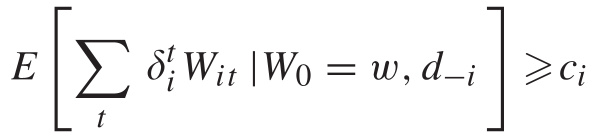 The decision to stay (di=1) depends on the discounted flow of future wages, which is conditioned on the network's state and the decisions of others (d-i).
4. Critical Insights & Results
The authors utilize T-period subdivisions to handle the complexities of continuous job flow. Their primary findings include:
- Wage vs. Employment: Wage data is a much more sensitive indicator of network health than binary employment status. Two agents can have independent employment statuses but still have highly correlated wages due to the quality of information shared.
- Stochastic Dominance: A better initial wage state leads to a distribution of future wages that first-order stochastically dominates a lower initial state .
5. Conclusion: Beyond Individualism
This work serves as a powerful critique of the "pull yourself up by your bootstraps" philosophy in labor economics. It proves that:
- Inequality is Structural: It is embedded in the network, not just individual merit.
- Collective History Matters: Current disparities are often just the long-term echoes of initial historical disadvantages in network connectivity.
Limitations
The model assumes "minimal reciprocity" in connections and requires large T-period subdivisions for the strict correlation proofs to hold. In the real world, "weak ties" (acquaintances) might play a different role than the "strong ties" modeled here, a distinction popularized by Granovetter but simplified in this specific Markovian approach.
Future Outlook
As we move into an era of algorithmic hiring and digital networking, the functions are changing. Understanding how digital platforms reshape these social graphs is the next frontier for labor market research.