
Laboratories of Community: Mining the Social Fabric of European Integration
Laboratories of Community: How Digital Humanities Can Further New European Integration History
The paper introduces a people-centric text mining methodology to construct dynamic social networks from unstructured historical Dutch newspapers (1945–1955). It aims to map European integration history by analyzing co-occurrences and contextual topics between key actors, moving beyond traditional state-centric narratives.
TL;DR
Historians often treat the birth of the European Union as a series of high-level treaties between states. This paper argues that the real story lives in the public discourse. By applying NLP techniques to a decade of Dutch newspaper archives (1945–1955), the authors automatically reconstruct the social networks of influential figures, revealing how "epistemic communities" shaped the European project through media long before the treaties were signed.
The Motivation: Moving Beyond the "Nation-State Rescue"
For decades, the dominant historical narrative (led by Alan Milward and Andrew Moravcsik) viewed European integration as a pragmatic tool for nation-states to survive. However, this "top-down" view misses the "bottom-up" influence of public opinion and non-political actors.
The challenge is scale. How can a historian read tens of thousands of digitized Dutch newspaper pages to find these hidden networks? The authors propose that we should treat these archives not just as text, but as Laboratories of Community—data sources that can be mined to see who was talking to whom, and about what.
Methodology: From Unstructured Ink to Structured Graphs
The paper's technical pipeline transitions from raw OCR text to a weighted, dynamic social network in three main steps:
1. Enhanced Entity Extraction
Recognizing names in 1950s Dutch news is harder than in modern text due to OCR errors and specific linguistic styles. The authors didn't just use a standard NER; they added heuristic rules based on linguistic cues:
- Age and Titles: Identifying patterns like "de 64-jarige" (the 64-year-old) or titles like "kapitein" to flag surrounding capitalized words as names.
- Verb Constraints: Only specific verbs (think, laugh, cry) were used as human indicators to avoid "personalizing" institutions (like a government "answering" a query).
2. Relational Weighting & TF-IDF Edges
Nodes are connected if they appear in the same article. But the authors go a step further:
- Edge Attributes: Each link between two people contains a list of articles.
- Contextual Insight: They apply TF-IDF (Term Frequency-Inverse Document Frequency) to the text associated with those edges. This allows a historian to see not just that Schuman and Adenauer are linked, but that their specific link in 1952 was defined by keywords like "coal" and "steel."
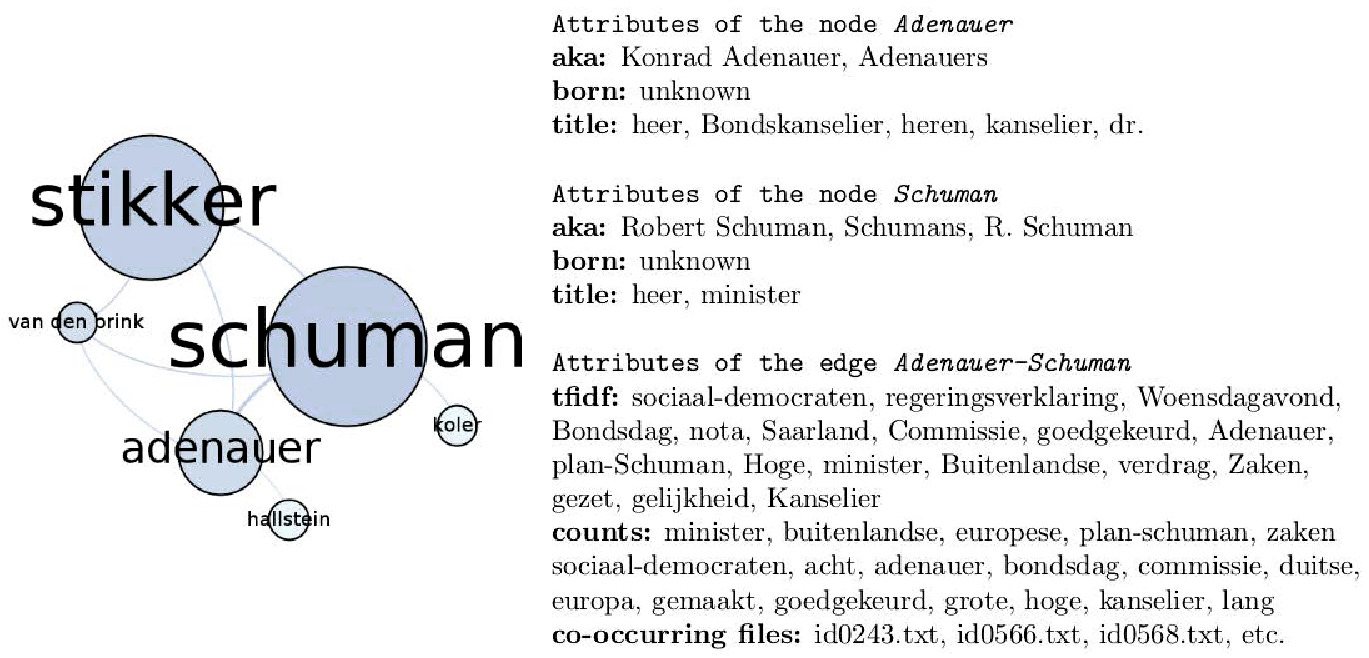 Figure 1: While a specific flowchart was not provided in the paper, the authors utilize a pipeline of Stanford NER -> Custom Rules -> Co-occurrence Graph -> Gephi Visualization.
Experimental Insights: Validating Intuition & Finding Anomalies
The authors analyzed three Dutch newspapers: De Tijd (Catholic), Het Vrije Volk (Socialist), and De Telegraaf (Neutral).
- SOTA Agreement: The networks correctly placed "Big Names" (Winston Churchill, Robert Schuman) at the center, proving the algorithm's validity.
- The "American Surprise": Traditional history suggests that after 1950, Europe became more self-reliant. However, the extracted networks show that American politicians remained central in Dutch public discourse much longer than previously emphasized.
- Ideology Matters: By looking at keywords like "solidariteit" (solidarity) on the edges, the authors provide evidence against the theory that early integration was purely a "cold, technocratic" process.
Note: The paper includes a table (not rendered here) showing that the top 10 actors in the Catholic newspaper held significantly more weight (16%) than in the Socialist outlet (10%), indicating a more decentralized, local focus for the latter.
Critical Analysis & Future Outlook
The "Human-in-the-loop" approach is the paper's strongest asset. Instead of claiming the algorithm "solves" history, they position it as a Hypothesis Generator. It points the historian to the right 1% of the archive to perform "close reading."
Limitations:
- OCR Reliability: The study restricted itself to "high confidence" OCR, which likely introduced a survival bias towards cleaner, perhaps more mainstream, documents.
- Disambiguation: The lack of advanced entity disambiguation (e.g., distinguishing between two different "Robert Schumans") remains a hurdle for fully automated analysis.
The Takeaway: This work demonstrates that the transition from International Relations (IR) to Digital Humanities (DH) allows us to map the "epistemic communities" that act as the connective tissue of modern Europe. For practitioners, it highlights that contextualizing edges with TF-IDF is just as important as the graph structure itself.
Conclusion
"Laboratories of Community" signifies a shift in how we process our collective past. By turning newspapers into networks, we move from reading individual stories to witnessing the evolution of a continent's identity.