
Forecasting the Digital Tongue: How Language Evolves in On-line Social Networks
Language Innovation and Change in On-line Social Networks
This research develops a predictive framework for forecasting language innovation and change within Online Social Networks (OSNs) like Twitter and Reddit. By integrating Giddens’ Structuration Theory with Big Data analytics (Hadoop/Spark), the study models the interplay between individual agents and social structures to detect and predict the diffusion of neologisms.
TL;DR
Language evolves at a lightning pace in the digital age—terms like "lol" move from niche forums to the Oxford English Dictionary in record time. This research explores a computational framework to detect, track, and forecast these innovations by analyzing the tension between individual users (agents) and their digital communities (social structures). Using Big Data tools like Spark and Hadoop, the study analyzes over 400GB of social media data to predict which new words will "stick" and which will fade into obscurity.
Background: Beyond the Dictionary
Language change has traditionally been the domain of linguistics, often studied through laborious interviews and manual transcription. However, in Online Social Networks (OSNs), change happens in real-time. The core challenge is that language is reflexive: it is created by individuals but governed by the social structures they inhabit. To understand why a word like "iPhone" or a slang term becomes embedded in daily life, we need more than just word counts; we need to understand the social mechanics of the network.
The "Structuration" Approach: The Why and How
The author frames the research using Structuration Theory, which argues that social structure is both the medium and the outcome of the practices they recursively organize. This leads to a three-fold methodology:
- The Agent (The Innovator): How do individuals introduce neologisms? By using the British National Corpus (BNC) as a "Gold Standard," any alphanumeric string appearing outside of it is flagged as a potential innovation.
- The Social Structure (The Filter): Why does one community adopt a word while another rejects it? The research uses temporal topic models to see how innovations survive within specific sub-reddits or Twitter clusters.
- The Interplay (The Forecast): This is the "Holy Grail"—predicting the speed and range of a word's diffusion by identifying influential users and modeling their transmission paths.

Technical Methodology
The research leverages a post-positivist methodology, combining:
- Morphological Analysis: Identifying how words are formed (blends, abbreviations) using text normalization techniques.
- Semantic Shift Detection: Using word correlation and distribution metrics to see if a word's meaning is changing, even if its spelling remains the same.
- Scalable Engineering: Processing 400GB+ of data requires more than a simple script. The study utilizes Hadoop and Spark to create a scalable NLP framework for time-series analysis.
Key Results: Reddit vs. Twitter
The preliminary data reveals a fascinating divergence. Innovations on Twitter tend to follow geographical lines or broad cultural trends, whereas Reddit innovations are highly specialized to topic-based communities.
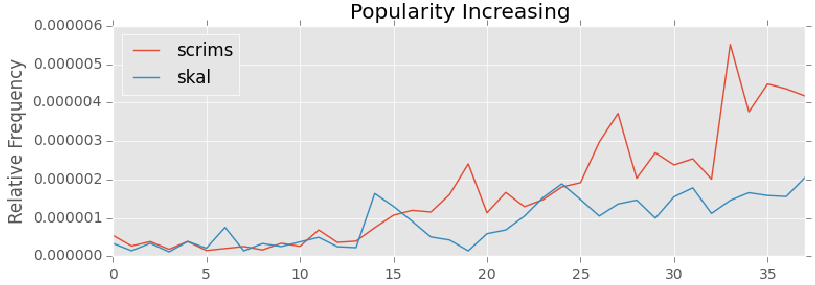 Figure Above: Distribution of Pearson values for Out-of-Vocabulary (OOV) innovations. The peaks indicate clusters of words that are either rapidly gaining or losing popularity.
The study also validated existing linguistic models like VFRGT (Van Fleet-Read-Giddens-Theil) and FUDGE (Frequency, Unobtrusiveness, Diversity, Generation, Endurance), finding that social reinforcement is the primary driver for a word's "survival" in a network.
Critical Insight & Conclusion
This work fills a critical gap by shifting the focus from "what" is being said to "how" the network structure dictates the evolution of the lexicon.
Takeaway: For marketers and sociologists, the value isn't just in spotting a trend, but in identifying the community of practice that validates it. If you can understand the interplay between the agent and the social structure, you can forecast the next "Google" or "Facebook" before it hits the mainstream.
Limitations: The study currently relies on the BNC as a static reference, which may miss innovations that have already become "standard" in the gap between corpus updates. Future work looking at real-time dictionary updates (e.g., Urban Dictionary API) could provide a more dynamic ground truth.