
From Tweets to Transactions: Bootstrapping Business Chatbots with Unsupervised Language Models
Language Model-Driven Chatbot for Business to Address Marketing and Selection of Products
This paper introduces an unsupervised, language model-driven framework for building business chatbots by leveraging User-Generated Content (UGC) from Social Media Platforms (SMP) like Twitter. By utilizing an encoder-decoder architecture with topic vectors, the system enables new businesses to deploy functional chatbots without the prerequisite of years' worth of historical chat manuscripts.
TL;DR
Building a chatbot usually requires years of historical chat logs—a luxury new businesses don't have. This paper presents a framework to skip the wait by training unsupervised language models on Twitter data (UGC). By using a Bi-encoder architecture to extract topic features from social media marketing interactions, businesses can deploy intuitive conversational agents on day one.
The "Data Desert" Problem in E-commerce
In the digital age, immediate response is the cornerstone of Marketing Management. While chatbots are the ideal solution for 24/7 support, they face a catch-22: to be useful, they need data; to get data, they need to be used. Prior work suggests businesses often wait 2 to 5 years to accumulate enough conversational manuscripts to train a traditional supervised model.
The authors identify a critical gap: Can we use generic, abundant social media conversations to fuel specific business interactions?
Methodology: The Topic-Silo Architecture
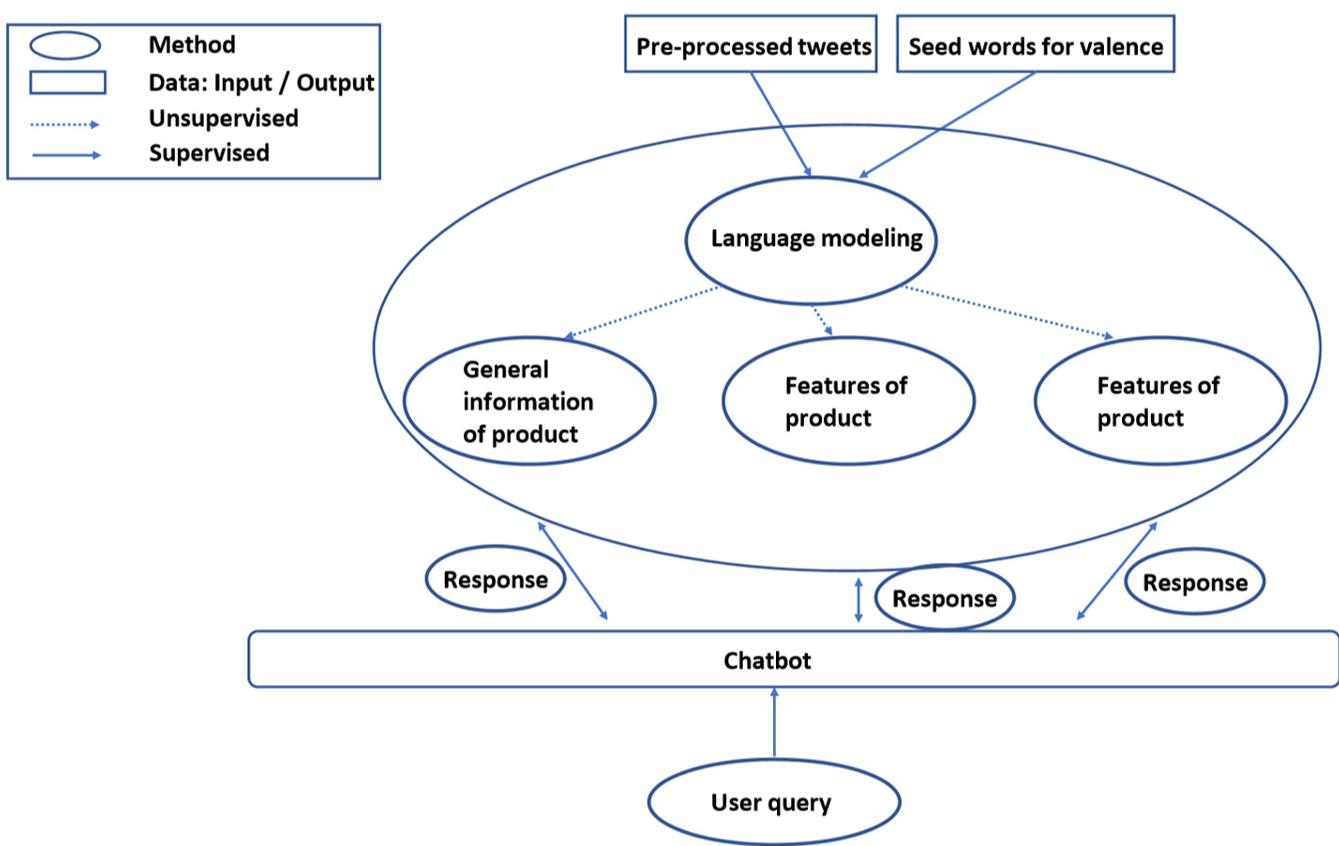
The proposed framework shifts the paradigm from "collecting logs" to "mining ecosystems." It consists of a three-stage pipeline:
- Text Mining Apparatus: Cleaning and chunking millions of tweets (over 1.5 million in this study) related to specific industry hashtags (e.g., #AI, #RoboAdvisor).
- The Bi-Encoder Engine: The core is an RNN-based Encoder-Decoder.
- Encoder: Processes the sequence to find a hidden state that captures the "intent."
- Decoder: Predicts surrounding context to ensure conversational fluidity.
- Topic Expansion: This is the secret sauce. Since the training vocabulary is limited, the authors use L2 regression to map external embeddings (like Word2Vec) into the RNN’s learned space, allowing the bot to understand words it hasn't explicitly seen during training.
The Mathematical Intuition
The model optimizes the log-probabilities of word prediction through a forward and backward learning setup: This ensures that the "Topic Vector" () is not just a static representation but a dynamic bridge between the customer's query and the business's marketing silo.
Experimental Results
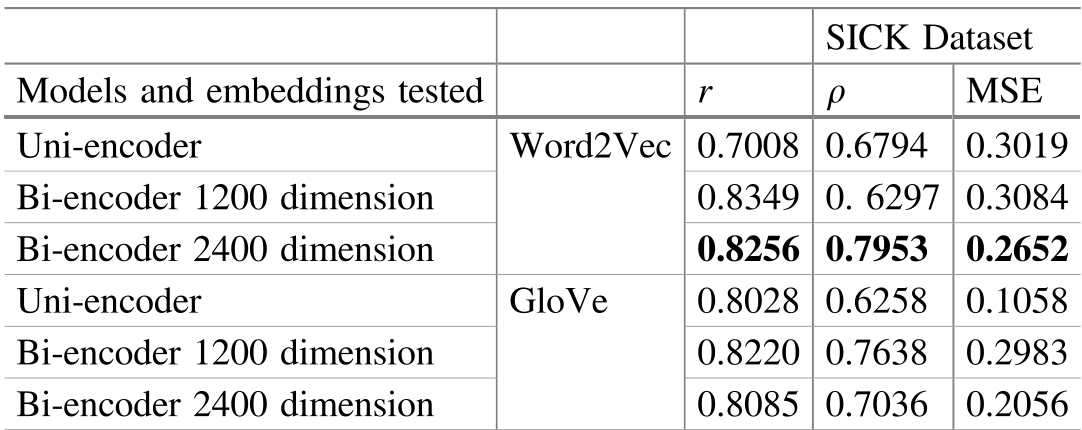
To prove that a bot trained on "Twitter chatter" can actually understand humans, the authors tested it on the SICK (Sentences Involving Compositional Knowledge) dataset.
- Performance: The 2400-dimension Bi-encoder outperformed Uni-encoder variations significantly.
- Metric: It achieved a Pearson’s of 0.8256, proving that the semantic representation is robust enough for real-world business logic.
Critical Insight: Beyond Simple Matching
Unlike most current Virtual Conversational Partners (VCP) which use simple linear matching or local database lookups, this approach creates Multidimensional Language Silos. These silos allow the bot to capture "time-varying discussions"—meaning if a marketing trend shifts on Twitter, the bot’s language model can be updated without manually re-writing local rules.
Conclusion & Future Outlook
This research provides a lifeline for startups. By treating social media as a massive, open-source training ground, businesses can bridge the gap between Online Access (OA) and Customer Experience (CE).
However, there are hurdles:
- Computational Cost: RNN-based training on 1.5M tweets is intensive.
- Platform Specificity: The current model is optimized for Twitter's short-form text; future work needs to integrate LinkedIn or Facebook for B2B contexts.
In the era of Generative AI, this paper serves as an important bridge, showing how unsupervised domain adaptation can solve the specific problem of business-to-customer marketing and product selection.