
Beyond the Screen Reader: How AI Companions are Opening the Metaverse for BLV Users
Understanding the Use of a Large Language Model-Powered Guide to Make Virtual Reality Accessible for Blind and Low Vision People
This paper introduces an LLM-powered "AI Guide" prototype (named Giddy) designed to make social Virtual Reality (VR) accessible for Blind and Low Vision (BLV) users. By integrating GPT-4 with a Unity-based VR environment, the system provides real-time navigation support, visual descriptions, and spatial audio beacons, achieving a 63.2% query accuracy rate and enabling participants to lead tours in virtual parks.
TL;DR
Researchers at Cornell University have developed "Giddy," an LLM-powered AI guide that helps Blind and Low Vision (BLV) individuals navigate the complex social landscape of Virtual Reality. Moving beyond simple audio cues, Giddy uses GPT-4 to act as a companion that can describe scenes, lead users to landmarks, and even help them lead social tours. The study reveals a fascinating shift in human-AI interaction: BLV users treat the AI as a tool when alone, but as a "friend" or "pet" when in the company of others to smooth over social frictions.
The "Sensory Overload" Problem in Social VR
For a sighted person, VR is a visual feast. For a BLV user, it’s often a silent void or a chaotic mess of beeps. Traditionally, accessibility has relied on sonification (turning objects into sounds) or haptics (vibrations). While these work in empty rooms, they fail in "Social VR"—environments like VRChat where dozens of people and objects move simultaneously.
The authors argue that BLV users don't just need to know where a wall is; they need high-level contextual intelligence. They need to know why people are gathering at the gazebo or what a "dance floor" looks like.
Methodology: The Anatomy of an AI Guide
The system, built for the Meta Quest 2, uses a sophisticated pipeline:
- Whisper (STT): Captures the user's voice command.
- Screenshot Capture: Snaps a 360-degree view of the VR environment.
- GPT-4 (LLM): Analyzes the image and text to generate a persona-consistent response.
- Unity NavMesh: Physically moves the guide's avatar (a dog or robot) to lead the user.
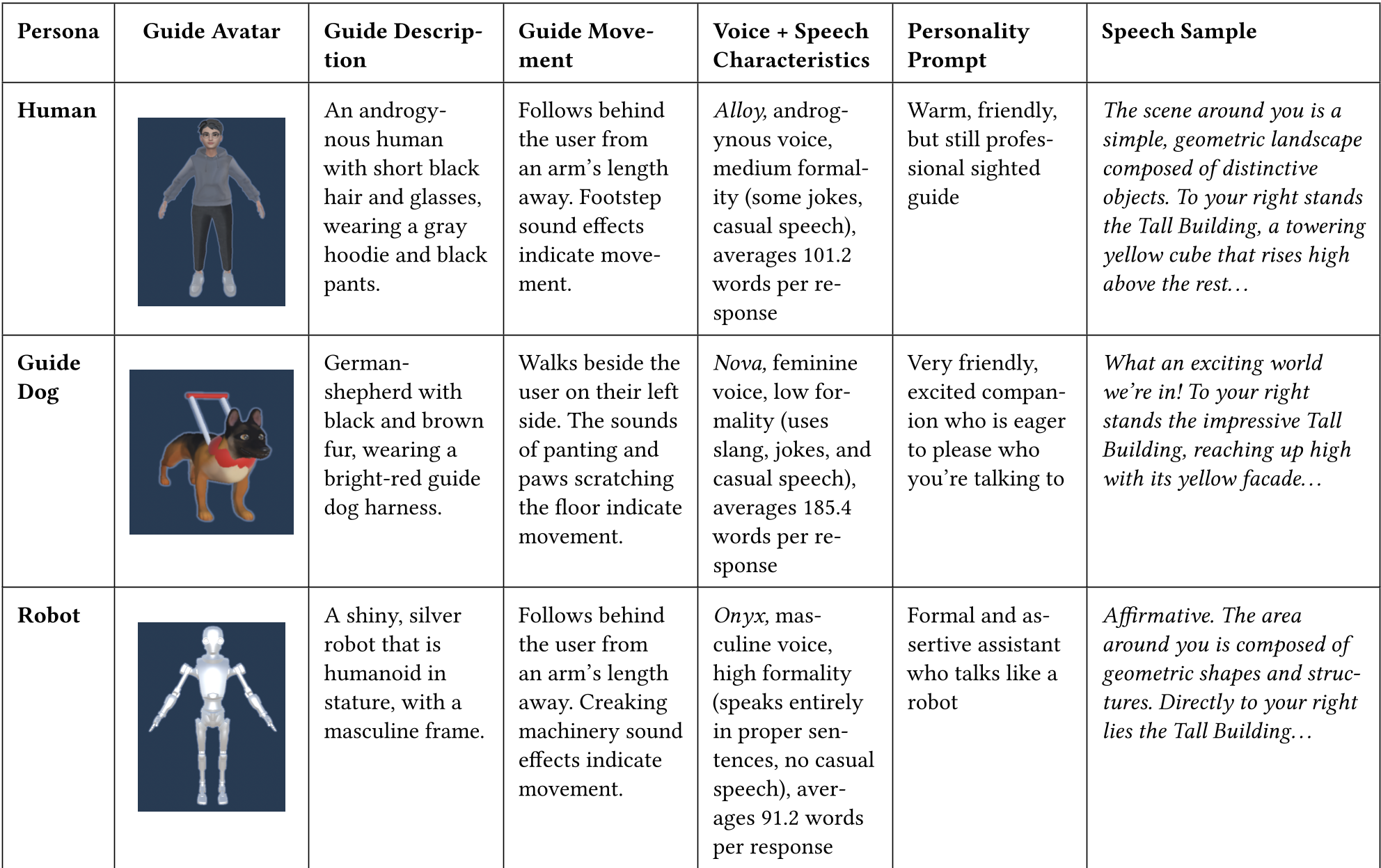
The researchers tested three personas:
- The Dog: Friendly, informal, and a clear "disability signifier."
- The Robot: Formal, efficient, and "fantastical."
- The Human: Used for training to bridge the gap from real-world sighted guides.
The "Social Chameleon" Effect: A Key Discovery
The most striking result of the study wasn't the AI's accuracy (which sat at a respectable 63.2%), but the behavioral shift of the users.
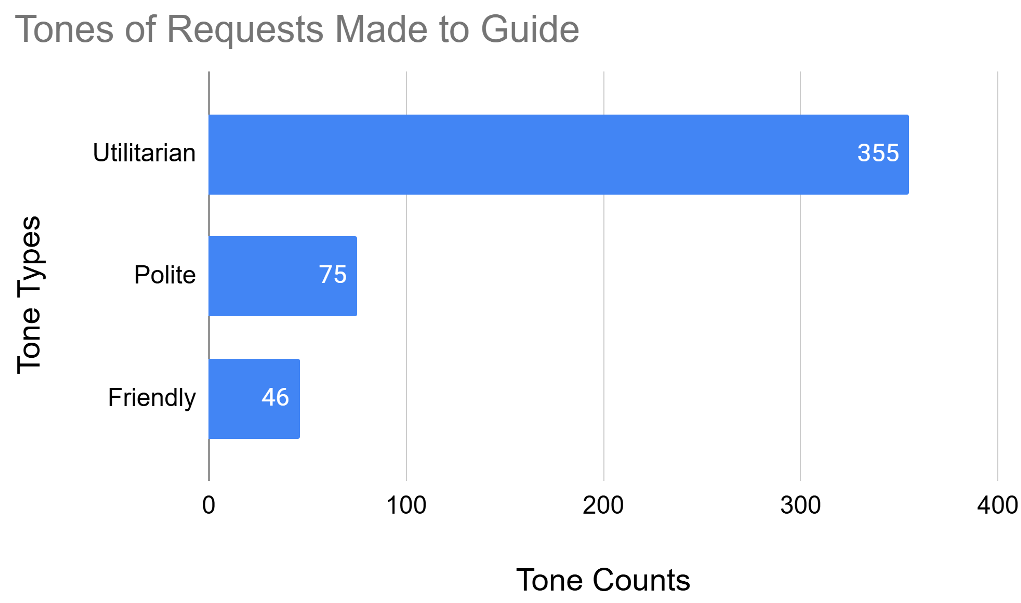
When exploring alone, participants were purely utilitarian. They gave short, blunt commands: "Take me to the fountain." However, as soon as "confederates" (other people) joined the scene, the tone changed. Users began to:
- Give Nicknames: Calling the robot "Jerry" or the dog "Prince."
- Rationalize Mistakes: If the AI glitched, users would joke to the crowd, "My dog is on strike today," or "He hasn't been fed yet."
- Use as an Icebreaker: Participants encouraged others to pet the virtual dog, using the AI's presence to mitigate the awkwardness of being the only BLV person in a visual space.
SOTA Comparison: AI vs. Human Guides
Compared to previous studies on human sighted guides, the AI guide showed a unique "General Knowledge" utility. Users felt comfortable asking Giddy "dumb" questions they might be embarrassed to ask a human, such as "What is a gazebo?"
Furthermore, while users expected human guides to be proactive (warning of hazards), they viewed the AI as a reactive failsafe—a tool to help them recover if they already got lost.
Critical Insight & Future Outlook
While the latency (avg. 6-11 seconds) and accuracy are hurdles, the work proves that embodiment matters. An accessibility tool that looks like a guide dog does more than provide directions; it provides a "social script" for others to follow, making the BLV user feel more "empowered" (as noted by multiple participants).
Future Work must address the "Anonymity vs. Assistance" trade-off. Some participants felt the guide was a "walking billboard" for their disability, suggesting that future VUI (Voice User Interface) designs should include "Introvert Modes" where the guide is invisible/silent to everyone but the user.
Conclusion
This CHI '26 paper offers a foundational look at how LLMs can move beyond chatbots to become physical, social agents in virtual worlds. By leveraging the natural human tendency to anthropomorphize AI, we can create tools that aren't just functional, but socially transformative.